Bahamas Debt Crisis: Historic 29-Member Cabinet Sparks Outrage
The Bahamas is facing severe fiscal strain. Despite a crushing debt mountain of over $11 billion, the re-elected Davis administration has expanded its cabinet to an unprecedented 29 members. This top-heavy government signals political loyalty over discipline, putting the nation's economy at risk.

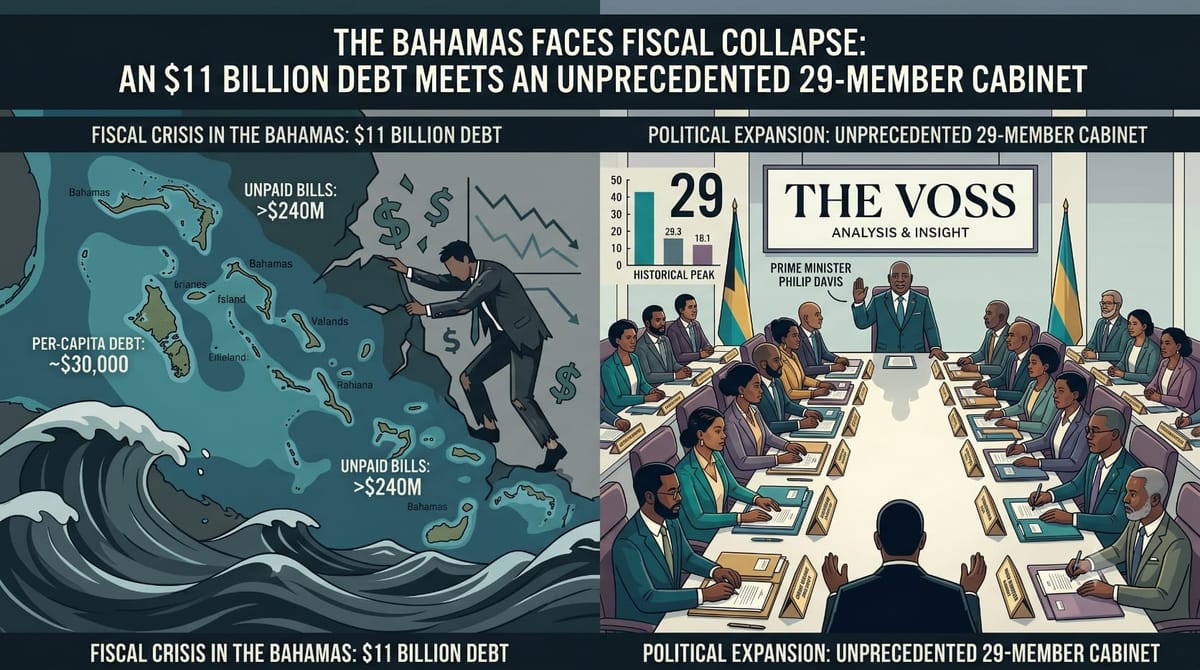
The Bahamas Faces Fiscal Collapse: An $11 Billion Debt Meets an Unprecedented 29-Member Cabinet
While this Caribbean archipelago of just 400,000 citizens suffocates under a crushing mountain of debt, the re-elected Davis administration has sent a fatal signal of political patronage. By swearing in the largest executive branch in national history—exactly 29 ministers and ministers of state—the government has exposed a glaring disconnect between harsh economic reality and reckless state expenditure.
The Mathematical Absurdity: Caribbean Reality by the Numbers
The macroeconomic indicators of The Bahamas reveal a structural deficit that the recent government expansion will only worsen:
| Indicator | Metric / Scope | Economic Implication |
| National Debt | Over $11 Billion USD | Severe strain on the Gross Dollar-pegged GDP. |
| Population | ~ 400,000 | A per-capita debt of nearly $30,000 per citizen. |
| Cabinet Size | 29 Ministers / Ministers of State | Historical peak; massive administrative fixed costs. |
| Direct Salary Costs | ~ $1.9 Million USD annually | Base ministerial pay only; excludes staffs, vehicles, and pensions. |
| Unpaid Bills (Arrears) | Over $240 Million USD | Nearly doubled compared to previous fiscal years. |
Between Fiscal Crisis and Political Spoils: An Analytical Deconstruction
The decision by Prime Minister Philip “Brave” Davis to install a 29-member cabinet following his electoral victory defies all economic logic. For an island nation spread across a fragmented archipelago, effective crisis management demands a lean, agile government structure. Instead, the state apparatus has been artificially inflated.
This hypertrophied government structure raises severe institutional questions:
- Clientelism over Fiscal Discipline: Creating dozens of ministerial slots—including hyper-specific portfolios for innovation, social services, or immigration—serves primarily to pacify internal party factions. It is a textbook attempt to bankroll political loyalty using taxpayer money.
- The Illusion of Governance: While the opposition accuses the government of masking true fiscal risks, the bloated bureaucracy risks grinding itself down through jurisdictional disputes. Historically, just five ministries have accounted for the bulk of skyrocketing unpaid government bills.
- Fiscal Crowding Out: Every dollar funneled into sustaining this top-heavy political elite is a dollar stripped from critical infrastructure, energy grid reforms (BPL), or systematic debt reduction. This directly threatens regional economic stability and heightens risk profiles for foreign investors.
Verdict: An Institutional System at its Limit
The Bahamas is steering open-eyed into a dead end. A chronically indebted micro-state cannot afford the luxury of such an oversized political class. When there is one minister for roughly every 14,000 residents, governance ceases to be a representative democracy and becomes an institutionalized system of self-preservation.
Without radical reforms, a drastic downsizing of the cabinet, and transparent debt restructuring, the country faces the ultimate loss of its fiscal sovereignty. The price for this political gamble will not be paid by the 29 ministers, but by the Bahamian taxpayers and investors left holding the bag.