The Weight of a Witness
Adrian Kerr’s Death at Piraeus turns an Athenian harbor murder into a searching inquiry into trade, testimony and trust. Its detective must learn that a truthful account depends on other people’s freedom to correct him.
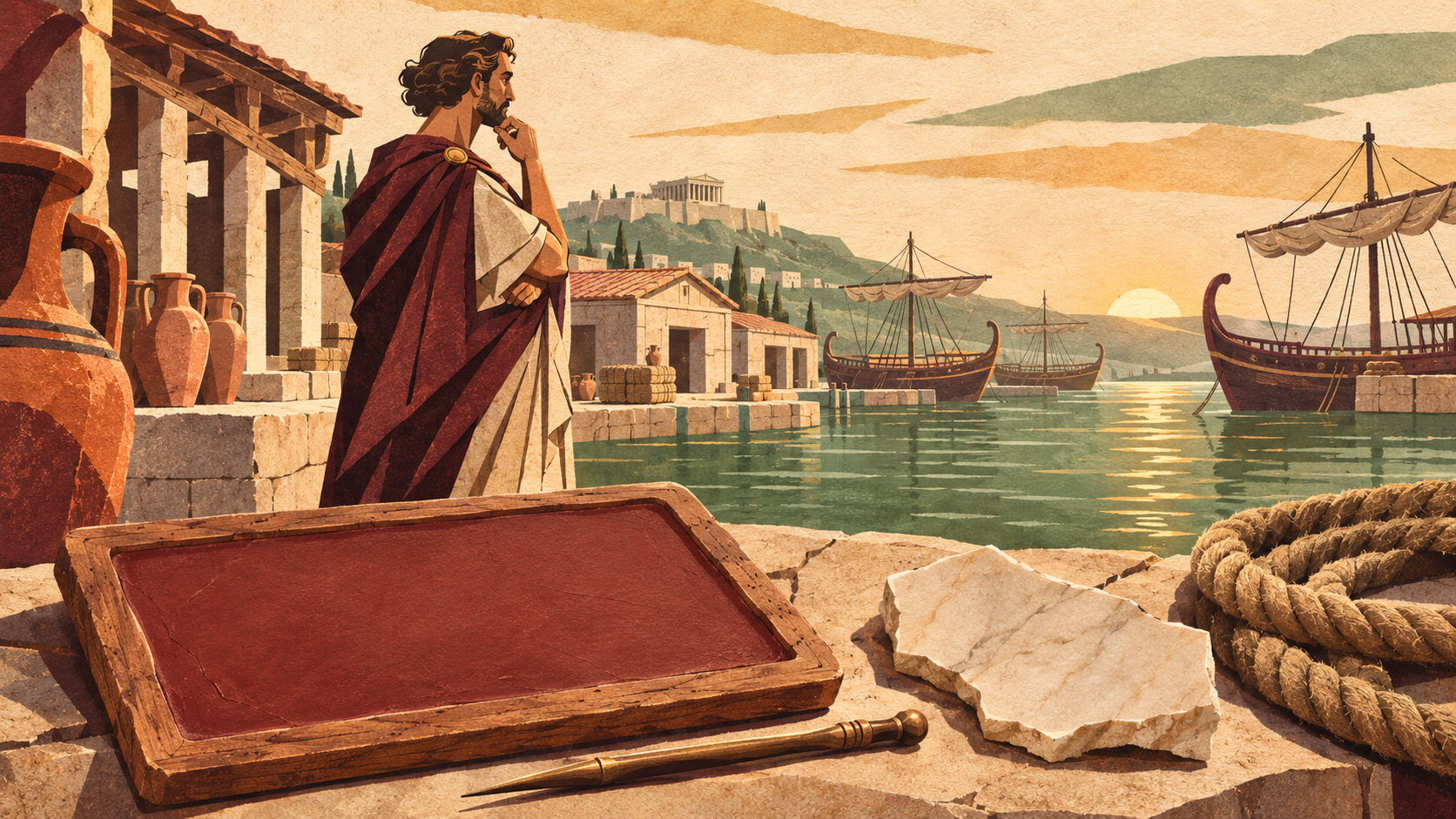
A receipt is a small claim about the world: something arrived, someone counted it, another person accepted responsibility. In Adrian Kerr’s Death at Piraeus, that modest agreement becomes the point at which a city can be robbed. The fifth Athenian Mystery gives Nikandros of Alopeke a murder to investigate and, beneath it, a more difficult problem. How can people establish what happened when the documents on which they depend have been made to tell a convenient story?
The opening establishes the distinction with admirable economy. Menekrates, a merchant who has asked for Nikandros, is found dead before their meeting. His body lies near a broken amphora, apparently surrounded by the ordinary disorder of a working harbor. Yet the blood begins in the wrong place; his new sandals have not collected the alley’s grit; clean wood has caught in their stitching. Kerr lets a discrepancy precede an explanation. The reader shares the investigator’s attention without receiving his conclusion in advance.
Just as telling is the young guard’s uncertainty. He cannot account for every passage through the alley and briefly considers improving his recollection. Nikandros insists that he record the gap. A clerk must note the position of a marble fragment before anyone removes it from the dead man’s hand. The scene makes an unexpectedly absorbing drama of procedure. Having been suspected of compromising evidence before, Nikandros recognizes that good intentions cannot certify an object’s history. His intelligence includes the willingness to leave a question unanswered.
Piraeus gives that discipline a demanding setting. Ships, stores, wages and credit create obligations that extend beyond any one person’s sight. A seal can circulate farther than the cargo it supposedly authenticates. A delayed payment can threaten a household before a magistrate has begun to determine whether fraud occurred. Kerr makes the port legible through its work: carrying, weighing, repairing, cooking and copying. These activities give the financial scheme human scale. Someone must still eat while the figures are being contested.
The broken marble offers another lesson in the difference between a material thing and the story attached to it. Its Phoenician inscription makes it useful to people seeking a foreign explanation for the crime. Restoring its connection to Abdmelqart and Elissa’s family shrine changes the inquiry. What first appears available as an ominous clue has a domestic and devotional history. Kerr gives the family a claim upon the stone that the investigation cannot simply consume. Their damaged possession must eventually be returned, rather than retained as an emblem of the detective’s ingenuity.
The novel’s most searching confrontation takes place away from the public harbor. Nikandros discovers that his father, Demetrios, signed for grain he had not seen. An overdue ship and unpaid carriers made the acknowledgment seem a practical accommodation. Father and son understand the same receipt differently: one sees a record of delivery, the other a means of keeping business alive until delivery becomes possible. Neither can settle the argument by asserting his honesty. They have to open the accounts.
Here Kerr gives his protagonist a welcome vulnerability. Nikandros wants his father to produce an explanation that will allow everything familiar to remain intact. He recognizes in himself the appetite for a comfortable account that he has condemned in magistrates. The childhood lesson of honest weights survives, but its application has become painfully complicated. Demetrios’ replacement purchases do not automatically absolve him; a loss incurred later cannot make an earlier acknowledgment accurate. The scene has moral pressure because affection continues on both sides of the table.
That pressure extends to people whose dependence makes frank testimony costly. Servants, sailors and working women cannot always afford the investigator’s impatience for an answer. A withheld wage or a threatened place of employment can govern what a witness is prepared to remember aloud. Euthydemos, the harbor magistrate, provides a useful counterweight to the fantasy of a solitary truth-teller confronting universally corrupt officeholders. Competence and restraint remain possible within an institution. The inquiry needs arrangements that let people speak, and copies that survive beyond a single keeper’s reach.
The fire aboard the Asterion gives this collective method its most compelling test. When an original tally sinks, Nikandros abandons its recovery to save men. The inquiry survives because another person has preserved a copy, which must still be checked against independent entries. Suspense and argument become inseparable: a life cannot be reduced to the evidence it might carry. Later, the public hearing also exposes the limits of civic inclusion. Elissa can explain her family’s inscription to the inquiry, yet cannot herself address the citizens’ Assembly. Making a voice audible does not confer equal authority upon it.
Kerr’s prose is strongest when an abstract obligation acquires a physical setting. The lentils cooling while Demetrios and Nikandros examine the tablets register the cost of their conversation without interrupting it. A child’s wooden horse, awaiting repair after his father’s death, gives bereavement an unfinished task. Later, the damaged shrine stone is to retain the visible line of its break. These objects resist the tidy movement from injury to solution. Establishing responsibility cannot restore the world to its previous condition.
The relationship between Nikandros and Kallistratos develops the same concern at an intimate scale. Protection becomes suspect when it begins to determine another person’s choices. Their eventual search for a room therefore matters as more than relief after danger. Kallistratos has wages, professional ties and an opinion about the light. Each man pays his share; each needs a key. The practical comedy of negotiating rent gives their attachment a credible future. Kerr lets affection become an arrangement in which disagreement remains possible.
There are limits to this thoroughness. The novel repeatedly returns to the distinction between observation and inference, and several conversations explain a principle that a preceding action has already made clear. Readers seeking a rapidly narrowing field of suspects may find the accumulating accounts and witnesses demanding. The ethical vocabulary of independent choice also sometimes feels especially close to a contemporary conversation. Yet the sustained attention to money, vulnerability and unequal authority gives those concerns a substantial fictional setting, rather than allowing them to float as agreeable declarations.
The closing movement earns its warmth through ordinary transactions. A porter is allowed to give the count himself; grain that needs drying is recorded as such; promised payments acquire a figure and a date. Beyond the lovers’ window, another worker asks to inspect a weight before it enters an account. Kerr has brought the mystery back to the scale on which it began. Death at Piraeus is an engaging historical crime novel whose most persuasive achievement is to make accuracy feel like a shared civic labor. Its investigator deserves our company because he must learn to practice that labor at home as well.
← Discover more in the journal