Who Gets to Speak for Athens?
Adrian Kerr’s The Murder at the Agora begins with a killing in public and follows the dangerous work of making a city listen. Its strongest discovery is that moral courage offers no exemption from accountability.
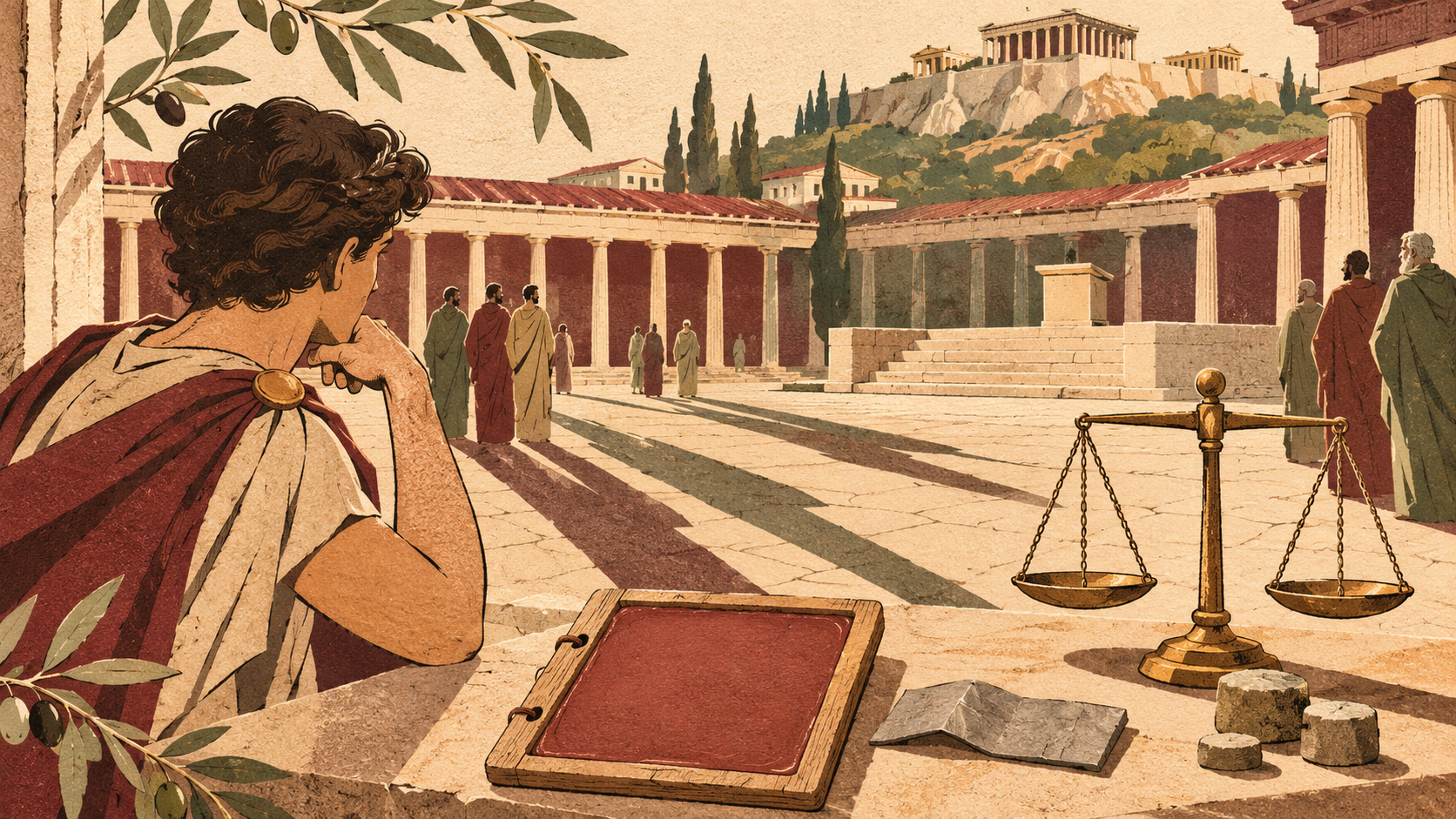
A young man asks to see an account. Before Athens can answer him, he is dying on its speaking platform. Adrian Kerr gives The Murder at the Agora a beginning in which public argument becomes physical danger with shocking speed. Theoros challenges the handling of tribute and the terms of citizenship; moments later, Nikandros is pressing a cloak against his friend’s wound. Somewhere behind him, people are still cheering. The delay between what has happened and what a crowd understands becomes the novel’s first unsettling fact.
Kerr’s second edition builds a historical crime story around that interval. Rumor, official declaration and private knowledge move at different speeds. The murder offers an opportunity to anyone who can make a frightened city accept an explanation before witnesses have finished describing what they saw. Nikandros, the son of a grain merchant, possesses neither an investigator’s office nor an unassailable moral position. His education consists partly in discovering how easily the wish to uncover a crime can become a wish to control its meaning.
The opening household scene prepares this problem with an admirably small object. Demetrios rejects a chipped stone weight before sending his son to the market. Commercial accuracy belongs to ordinary discipline: a measure must be sound before anyone begins to calculate. At the Agora, however, Nikandros takes a lead binding tablet from the place where Theoros fell and conceals it. A name on it seems connected to his father’s business. The boy who has been taught to weigh honestly begins his inquiry by withholding something others ought to examine.
This is a productive fault in a detective protagonist. Nikandros’ later correction cannot make the first false answer disappear. His own conduct becomes part of the record, exposing him to an uncertainty he would prefer to reserve for other people. Kerr gives the investigation a moral pressure that the discovery of a villain alone could not supply. Affection for a father, loyalty to a dead friend and confidence in one’s intelligence can all become reasons for editing an account. The novel asks what remains of truth-seeking when those reasons feel honorable.
The funeral gives Theoros a life beyond his political usefulness. His father’s hands retain the dust of pottery; the bloodied tunic remains beside the washed body. Lament occupies the house while officials and onlookers elsewhere begin to organize the death into a public event. These details preserve the difference between losing a son and possessing a martyr. This encounter with grief gives Nikandros’ determination a weight that public argument alone could not supply. Its urgency is understandable even when the methods it inspires become questionable.
Public purification supplies the private mourning with an uneasy counterpart. A boundary is marked, blood is washed away, and the language of pollution offers a frightened community something it can recognize and perform. Kerr allows ritual its communal force while making its political use visible. The troubling question is who gets to decide what the cleansing has settled. A proclamation can restore the appearance of order while leaving the act of killing unexplained. The people arranging the response have interests of their own.
That distinction keeps the historical setting active. Laïs can enter wealthy men’s private world and obtain material Nikandros could not easily reach, yet she lacks the civic access available to the men examining public accounts. Her help comes with an insistence on identifying how a document reached her. When an apparent payment might be legitimate, she leaves that possibility open. Kerr gives her intelligence a practical expression in the limits she sets upon his excitement. Private access, public standing and the ability to secure another person’s testimony remain different resources.
Desire complicates these judgments further. At the gymnasium, the familiar attentions of Phaidros, Damon and Timokrates carry affection, rivalry and the possibility of control. A reassuring hand can also steer someone away from a question. Nikandros wants the comfort of a trusted body beside him, but wanting it does not establish that the trust is justified. This intimate uncertainty belongs within the crime story. Kerr makes attraction part of the difficulty of interpretation, without allowing it to supply a convenient answer about another person’s intentions.
The plot eventually makes the reader consider several forms of responsibility at once. Physical violence, the ordering of violence, the destruction of evidence and the protagonist’s own unlawful choices cannot simply be folded into a single contest between innocence and corruption. This accumulation gives the closing movement weight. Nikandros cannot assume that helping to expose a murder will make every other action disappear from judgment. The novel’s institutions remain coercive and fallible, yet his frustration does not automatically render their every question illegitimate.
Kerr’s prose works best at the point where bodily experience interrupts a confident interpretation. Nikandros has not actually seen the weapon when Theoros falls. He has seen a movement, a wound and blood; other explanations begin to gather almost immediately. The distinction is simple, but its placement matters. A reader eager for a clue shares the temptation to turn a partial sight into a finished story. Hands, clothing, dust and the position of another body keep bringing the account back to the limits of a particular observer.
The novel is less restrained in its recurrent language of shadows, tongues, names and silencing. These motifs bind the political argument together, but some conversations announce the significance of a discovery after the scene has already conveyed it. The widening network of intermediaries also asks readers to keep careful track of who knows what, and on whose authority. At moments, a sharper reduction of explanation would let uncertainty do more of the dramatic work. The strength of the underlying conflict makes that extra insistence unnecessary.
The ending gives the book a more difficult shape than a celebration of the clever young man who makes Athens listen. Knowledge has consequences beyond the exposure of the crime, and departure cannot settle every claim left behind. The final return to the practical work of recording freight is especially apt. An account must still be kept by someone whose life has become entangled with other people’s accounts. The Murder at the Agora earns its place as the beginning of a series because it leaves its investigator changed rather than perfected. Kerr’s most compelling question is how a person can demand to be heard while remaining answerable for what he says.
← Discover more in the journal