The Exile Who Would Not Be Recruited
Adrian Kerr’s Tales of the Exile follows Nikandros through five encounters with a fellowship that claims authority over speech. Its strongest question is who gets to decide which truths a city can bear.
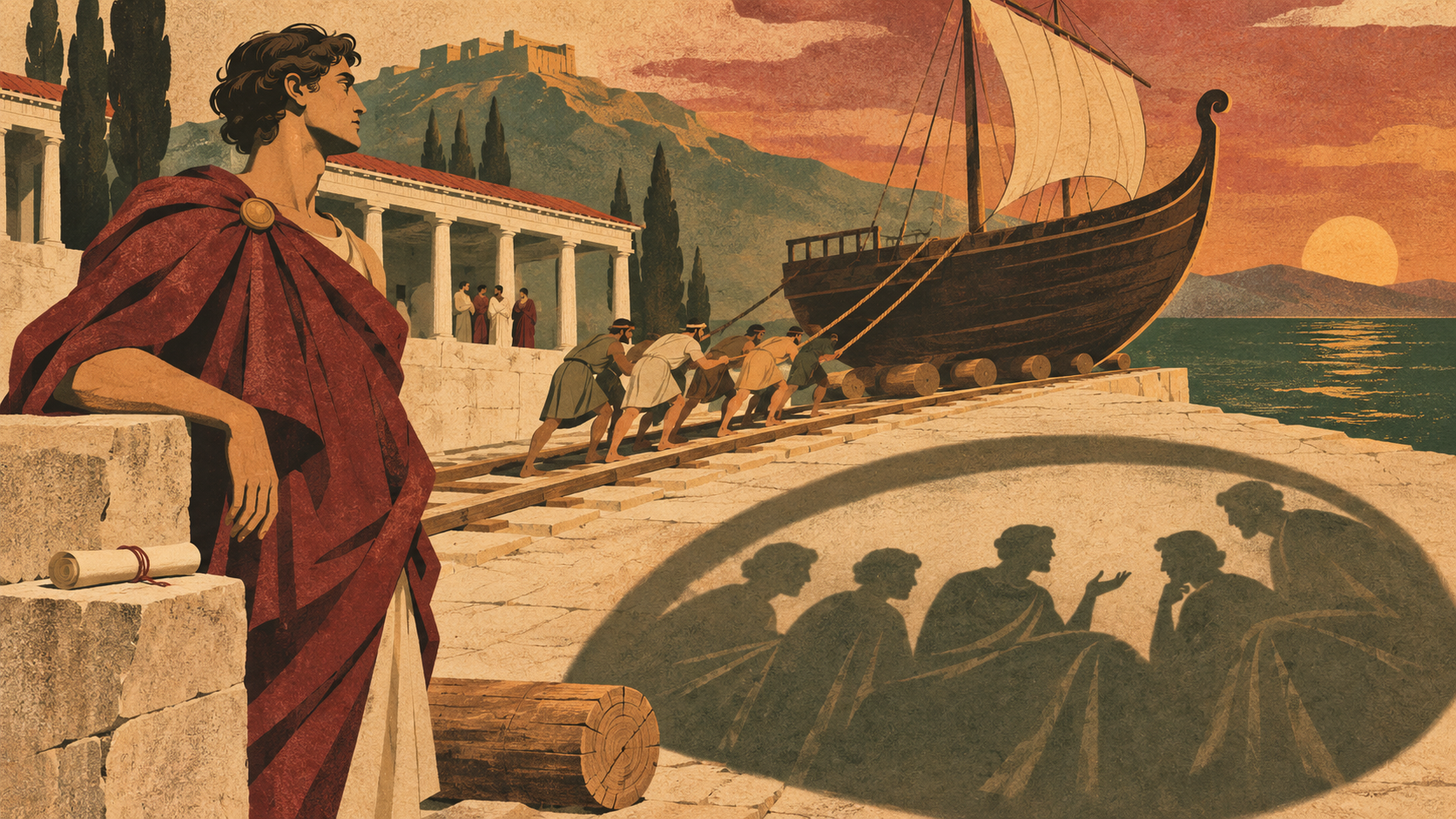
A city can expel a troublesome citizen without answering his questions. Adrian Kerr makes that unfinished argument the engine of Tales of the Exile: Five Shadows Before Athens. Across five linked stories, Nikandros of Alopeke discovers that departure offers little protection from the appetite for obedience. The same claims follow him from harbor to sanctuary: someone must protect the city from dangerous speech, and someone must choose whose throat will bear the cost. Kerr gives this abstraction a brutally physical instrument. His conspirators carry ropes.
The collection accompanies the Athenian Mystery series, supplying episodes from Nikandros’ wandering years. Its movement is cumulative. Corinth, Delphi, Samos, Ephesos and Thessaly become stations in an education, each exposing a different means of governing what people may know. Conversation, prophecy, public argument, poetry and the archive come under pressure in turn. This arrangement gives the short volume a larger design: the threatened life of a community depends on more than the survival of its official institutions.
Corinth establishes the method with particular energy. Kerr begins among hauling crews, wine, resin and the enormous effort of moving ships across the Isthmus. The port has an economy before it acquires a conspiracy. Nikandros arrives with hunger and sore feet, while merchants and laborers pursue purposes that scarcely concern him. The details keep exile material. Losing a city means losing the ordinary arrangements that allow a person to sleep, eat and be recognized without explaining himself.
At the wealthy Timon’s symposium, hospitality becomes a test of political allegiance. Diokles proposes that a disciplined minority should determine which arguments nourish a city and which infect it. The proposition gains force from the setting: comfortable men can entertain the elimination of other people’s voices while a host struggles to preserve the pleasantness of dinner. Phile, the musician, punctures their medical metaphor by asking who gets to become the physician. Her intervention reveals how much power is concealed in an apparently benevolent vocabulary.
The subsequent pursuit along the ship-hauling track gives that debate an effective spatial counterpart. Grooves, wooden levers, ropes and a loose roller determine what Nikandros can do when rhetoric yields to an assassin’s blade. He survives by attending to the ground beneath him. This is an attractive principle for a detective protagonist: intelligence includes reading a room, but also recognizing a surface that will not hold someone’s weight. The philosopher’s body remains vulnerable even when his judgment is sound.
Delphi changes the object of the struggle. A silent oracle has consequences beyond the fate of an individual speaker, because religious authority depends on the expectation that a voice will eventually be heard. Ineis, a priestess who knows too much, corrects the direction of Nikandros’ inquiry: the fellowship wants obedience. The distinction matters. Silence can be an intermediate condition, preparing the way for speech whose apparent independence conceals its management. Kerr’s sanctuary becomes a place where control over the conditions of utterance can pass for reverence.
The Samian episode tests the comforting assumption that recognition brings rescue. Nikandros identifies the danger gathering around Timokles, yet knowledge does not give him command of events. Violence becomes public, with frightened witnesses becoming part of its intended effect. The episode also changes the scale of the fellowship’s ambition. Its agents understand that a visible punishment can govern those who remain alive. For the reader, the protagonist’s failure gives his continuing resistance more weight than another uncomplicated escape would have done.
The most interesting confrontation comes in Ephesos, where Thettalos offers Nikandros membership. Here the enemy briefly acquires an argument capable of touching him. Nikandros has seen public vanity, coercion and the weakness of judgment under political pressure. A fellowship of trained minds promises to correct those failures. His temptation makes sense because the proposed cure exploits a real wound: the city whose freedom he defends has rejected him. The question becomes whether injured intelligence will accept the privilege of supervising everyone else.
Kerr sharpens the scene through the poet Melesigenes, whose wit interrupts Thettalos’ solemn self-justification. Poetry supplies a second form of resistance, able to expose the vanity beneath the program. Nikandros’ decisive questions concern accountability: “Who counts?” and “Who decides which ten?” Thettalos’ calculation of acceptable deaths cannot survive those questions without admitting its own monopoly. Nikandros answers the promise of control with “I prefer risk.” His position allows error, including public foolishness, because freedom requires room for something authority cannot preapprove.
Thessaly extends that problem into memory. The disappearance of a scholar leads to a painted tomb and a contested genealogy. The fellowship is now, in Nikandros’ phrase, “editing the dead.” This is the collection’s most suggestive enlargement of its theme. A pedigree can organize present power; an altered sign on stone can therefore matter as much as a threatened speech. The final story makes scholarship consequential through the small, damaged material object on which a grand account of legitimacy depends.
Kerr favors momentum, emphatic contrasts and short sentences that isolate a gesture or a threat. The rhythm suits pursuit and gives his confrontations immediate clarity. Its limits become apparent when several episodes repeat the same constellation of plain cloaks, disciplined stillness and ominous silence. The conspirators explain their principles so readily that uncertainty sometimes contracts too soon. More hesitation in their speech, and more ordinary life between encounters, would have made this already forceful political drama less predictable in its delivery.
Even so, the volume’s governing idea holds the sequence together. Each journey asks Nikandros to defend a voice whose continued existence offers him little safety. Lyrissa’s practical intelligence, Ineis’ insistence and Melesigenes’ irreverence prevent that defense from belonging to him alone. Tales of the Exile works best as a compact story cycle about the obligations of intelligence. Kerr’s exile earns his place at its center by refusing an invitation that would turn his exclusion into someone else’s sentence.
← Discover more in the journal