The Lives Beneath the Marble
Adrian Kerr’s The Shadows of the Acropolis measures Athenian grandeur against the lives and labor that sustain it. A murder inquiry becomes a searching account of wages, records, intimate loyalties and the price of being heard.
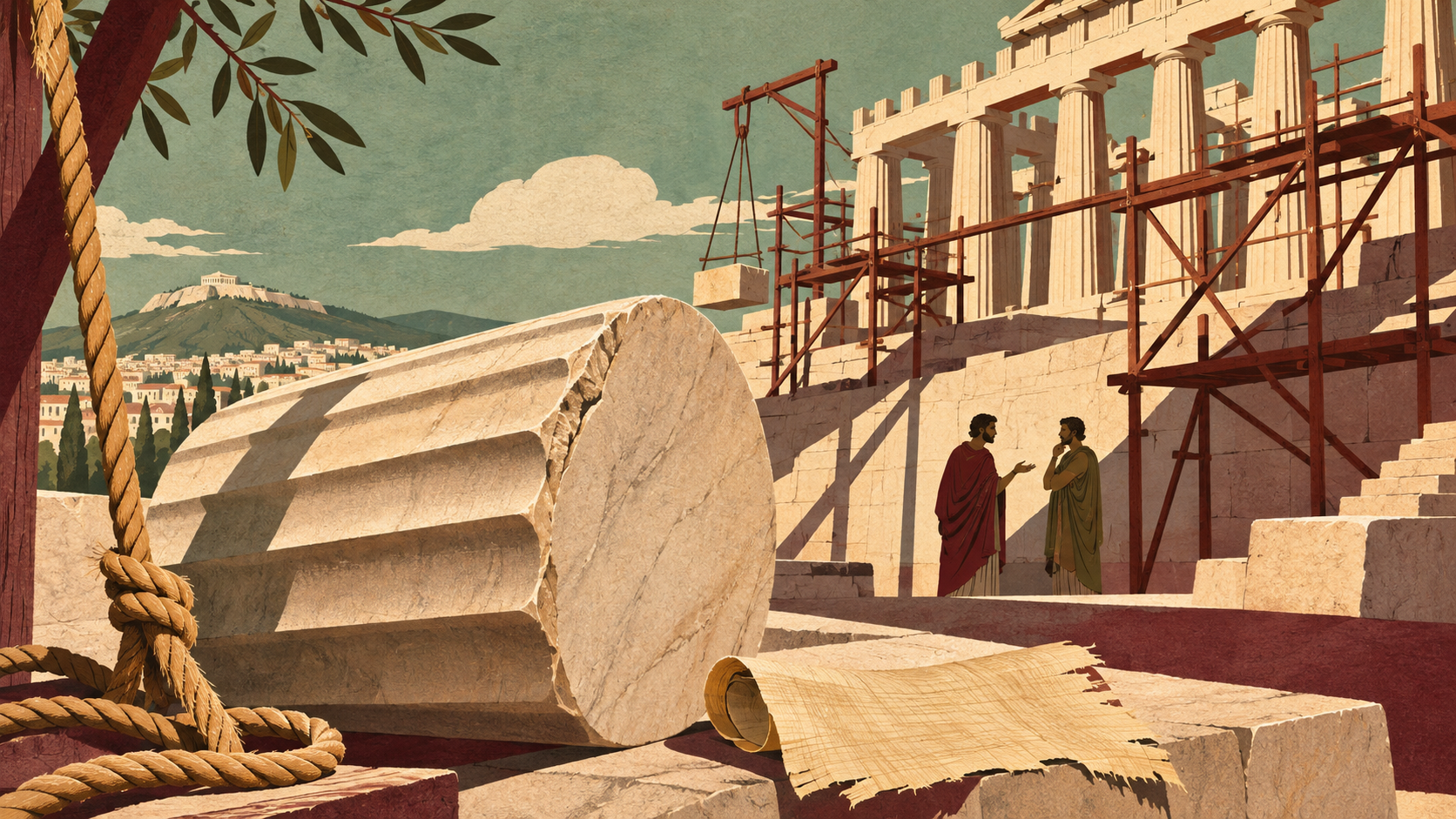
Ariston is waiting with two fish when the man who promised to bring the bread falls from the Acropolis scaffolding. The bread lands beside the body. Adrian Kerr begins The Shadows of the Acropolis by placing an ordinary shared evening beneath the enormous ambitions of Athens. Before the death becomes an inquiry, a rumor or a political opportunity, it has already interrupted a household. The image gives this historical crime novel its most persuasive measure: what a city calls greatness must also be reckoned in the lives spent building it.
The dead man, Meton, has found reasons to question the construction accounts. A damaged column drum he rejected has returned with its faulty face concealed. The city is still being charged for sound stone. Wages, quantities and a twice-billed hoisting rope enlarge the discrepancy. Kerr makes the first fraud tactile: a thumb encounters the seam that an account has made disappear. The murder that follows belongs to the same world of handled objects. A shove, a failing rope and a destroyed sheet become the materials from which an official accident can be assembled.
Nikandros enters the story carrying a delivery account for Meton to sign. He has been back in Athens for twenty-three days after six years of exile. Permission to return has restored neither his confiscated possessions nor the innocence he might once have claimed for himself. This gives the sequel an effective starting point. His renewed involvement grows out of work and acquaintance, with the awkwardness of arriving on business at a place where somebody is mourning. He must put the unsigned account away before he can begin to listen.
Ariston’s presence keeps Meton from dissolving into the role of the man who knew too much. The fish, the flattened bread and the remembered warmth of their sleeping mat establish a relationship with habits and unfinished obligations. Kerr grants the two men an intimacy that does not need to become a public declaration before it deserves attention. The loss matters because their life was particular. Against the monumental building above them, the small domestic promise remains an especially powerful piece of narrative evidence.
The worksite also complicates the political argument. Men test ropes more slowly after the fall; a delay that irritates an overseer has acquired a different meaning for those who must stand beneath a load. Perikles can give a sensible instruction to lower a suspended block while still having interests in the larger project. Thucydides can ask a necessary question about cost without becoming a disinterested guardian of truth. Kerr allows competence, ambition and fear to inhabit the same scene. This makes civic conflict more demanding than a division between clear-sighted outsiders and uniformly corrupt officeholders.
The investigation repeatedly turns on words that appear almost interchangeable until somebody has to bear their consequences. In one of its sharpest passages, Philon’s fair copy changes the description of twelve ropes from new to serviceable. The smoother account has altered what can be claimed about the delivery. Preserving both versions matters because the correction itself needs a history. Kerr understands copying as an action rather than a transparent passage between facts. A clerk can shape responsibility through a small adjustment that makes a sentence sound more reasonable.
This attention to documentary language gives the novel a strong relation between labor and power. Wages, receipts and the custody of records determine who can leave a dispute and who must remain exposed to it. The locked-store rescue of Euxenos brings the issue into particularly clear focus: his refusal to backdate a receipt becomes part of the mechanism holding him. Authority over work begins to look like a claim upon the worker. The mystery makes that pressure visible through an enclosed space and a threatened body, giving the argument urgency beyond the accounts themselves.
Nikandros’ injury during the later inquiry provides a welcome check on the detective’s usual privilege. He cannot always take his own body wherever the next question must go. Others have to investigate, carry messages and undertake the rescue. The resulting distribution of action makes the city feel inhabited by people with skills of their own. It also challenges his tendency to treat personal exposure as the necessary proof of commitment. Questions can continue to matter while their author rests, and an injured man’s determination can become another burden imposed upon his friends.
His relationship with Doros gives that problem an intimate dimension. Affection cannot simply authorize Nikandros to arrange somebody else’s safety or future. Doros has his own work at the kiln, and the relationship must make room for it. Their physical closeness brings warmth into a narrative full of guarded answers, yet it also makes protection harder to distinguish from possession. Kerr is convincing when a kiss and a practical disagreement can belong to the same bond. The love story deepens the crime novel’s concern with consent and dependence rather than suspending it.
There are limits to this patient method. Witnesses and allies frequently remind Nikandros to distinguish what he saw from what he inferred; the qualification sometimes follows an action that has already made the distinction clear. Explanatory conversations can slow the movement between discoveries. The succession of documents, intermediaries and separate claims also rewards careful reading more than a taste for a swiftly narrowing suspect list. A tighter handling of some exchanges would allow the strongest objects and gestures to carry more of the argument without commentary.
The closing proceedings nevertheless repay that attention. A public exposure does not instantly convert every accusation into a judgment, and the later consequences require their own reckoning. Nikandros, too, must answer for taking private records and meet an obligation that useful discoveries do not erase. The book leaves him with work still to do in Athens. This is a satisfying kind of continuation: the investigator has a place in the city without acquiring a right to stand above its other inhabitants.
The Shadows of the Acropolis succeeds most fully when the scale of its public setting is held against the modest arrangements that sustain a life. A building requires people to agree about the condition of a rope; a household requires someone to remember the bread. Kerr gives both agreements dramatic force. His Athens becomes compelling through the distance between the glory people announce and the care they actually practice. The novel asks its detective to keep looking into that distance, even when the next uncomfortable account is his own.
← Discover more in the journal