
The Phantom of Chamberlain’s Munich
The Bloody Invoice of the 2026 “Breathing Room”
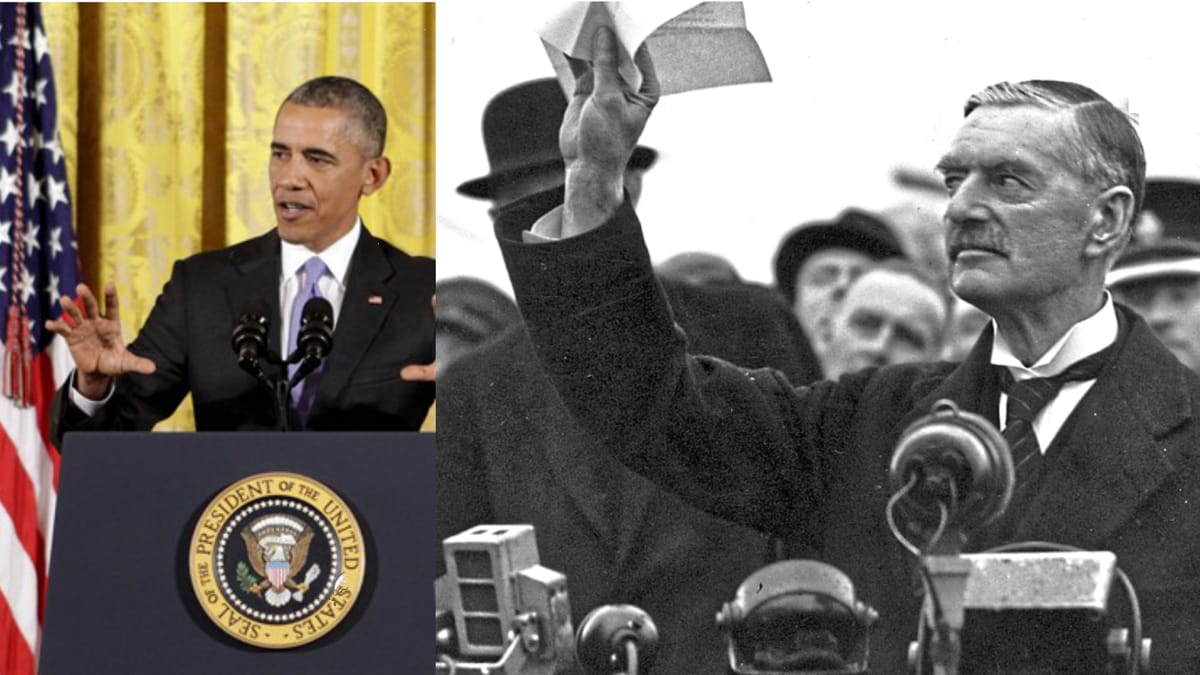
March 6, 2026, 8 am
From Munich 1938 to Vienna 2015: The same delusion of ‘peace’ through concessions. The invoice arrived in Tehran, March 2026.
In March 1854, within the walls of a modest schoolhouse in Ripon, Wisconsin, an event occurred that redefined the moral architecture of the United States. Gathered there were men of diverse origins—former Whigs, disillusioned Democrats, and radical Free Soilers. They were united by a single, burning realization: that one cannot broker a compromise with a tyranny like the “Slave Power.”
The Missouri Compromise, that wretched “breathing room” of its era, had not loosened the chains of bondage; it had merely lubricated them so they might expand more silently. Those men emerged from that schoolhouse not as a mere faction, but as the first generation of a movement that understood that peace without principles is nothing more than a down payment on a later bloodbath. They rejected the diplomacy of delay because they knew that every concession to an aggressive power only made the eventual conflict more horrific.
Today, in March 2026, the world stands before the ruins of a global order that has ignored this very lesson. We are witnessing a crisis in the Middle East that is not the result of a sudden diplomatic glitch. It is the final, bloody invoice for five decades of strategic naivety—a modern rebirth of that Chamberlain Doctrine which was instinctively recognized as lethal as far back as 1854.
I. The Anatomy of Failure: The Chamberlain Doctrine
To understand the catastrophe of 2026, one must look back to September 30, 1938. Neville Chamberlain returned from Munich, waving a worthless scrap of paper, promising “peace for our time.” He believed he had satiated a monster by feeding it pieces of Europe. In reality, he did not buy peace; he financed the time necessary for the industrialization of terror.
This “Chamberlain Doctrine” is built upon three fundamental lies that were already identified as fallacies during the struggle against slavery in the 19th century:
- The Illusion of Rationality: The fatal belief that an ideological aggressor ultimately prioritizes economic stability over total ideological victory.
- The Fear of Confrontation: Mistaking passivity for moral superiority, when it is, in fact, merely an invitation to aggression.
- The Funding of the Enemy: Providing the aggressor with exactly the resources and the time required to build an invincible war machine.
History is relentless: Every hour Chamberlain “won” in 1938 cost millions of lives by 1945. This doctrine did not die in the ruins of Berlin. It became the centerpiece of a misguided foreign policy in the late 20th century, beginning with the fumbled response to the Iranian Revolution under Jimmy Carter.
II. The Carter Catastrophe: The First “Breathing Room” (1979–1981)
The crisis of 2026 has an origin point: the year 1979. The reaction to the fall of the Shah revealed the same paralysis that had afflicted the old political elites before 1854. When the Iranian Revolution transformed a modernizing monarchy into a fanatical theocracy, Washington responded with hesitation. Instead of recognizing Khomeini’s radical movement for what it was—an existential threat to Western liberty—the administration sought “dialogue.”
The seizure of the U.S. Embassy in Tehran in November 1979 was the first test. Fifty-two Americans were held hostage for 444 days. The reaction was a textbook example of appeasement: assets were frozen while officials hoped for reason from men who loved death more than life. The botched rescue attempt, Operation Eagle Claw, revealed not just technical failure, but a deeper moral impotence. The Mullahs were granted their first great “breathing room.” They were given the time to consolidate power, execute dissidents, and elevate the export of terror to a matter of state policy. Without this initial weakness, today’s monster in the Middle East would never have grown beyond its embryonic stage.
III. The Clinton Era: Consolidation Through Moderated Weakness (1993–2001)
In the 1990s, the phantom of Munich returned in the guise of “moderation.” The policy of “Dual Containment” was a policy without teeth. The 1996 Khobar Towers bombing in Saudi Arabia, which murdered 19 U.S. servicemen via Iranian-backed Hezbollah, should have been a turning point. A resolute state would have demanded an immediate, devastating response. Instead, the leadership opted for protracted investigations and diplomatic maneuvers.