Everyone Wants Authenticity. Nobody Can Agree What It Means.
Everyone wants authenticity — from politicians, artists, brands and the people we follow online. Yet vulnerability has become content, imperfection a marketing strategy and spontaneity a liability. Perhaps the problem isn’t that we wear masks, but that we’ve forgotten when we put them on.
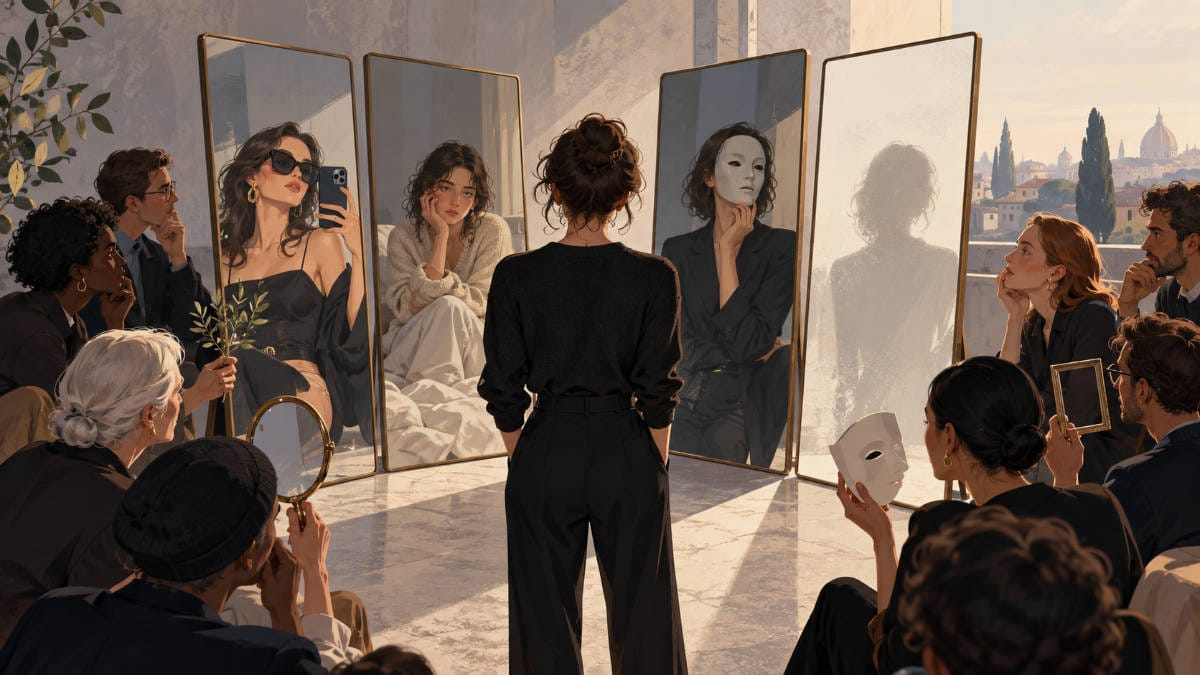
We demand authenticity from politicians, artists, brands, friends and strangers online. But the moment someone shows us who they really are, we often ask them to become someone else.
by Dirk Kirschberger
There may be no more fashionable virtue in modern life than authenticity.
We want authentic restaurants. Authentic travel. Authentic politicians. Authentic artists. Authentic relationships. Authentic brands. Authentic influencers — which may be the strangest phrase of all.
We complain that social media is fake, that advertising is manipulative, that politicians are scripted and that celebrities are manufactured. We say we are tired of filters, publicists, consultants, algorithms and carefully rehearsed personalities.
We want the real thing.
There is only one problem.
Nobody seems able to agree what “real” actually means.
For some people, authenticity means vulnerability. Tell us about your failures. Show us the kitchen before you cleaned it. Admit that marriage is difficult, parenting exhausting and success less glamorous than it looks.
For others, authenticity means consistency. Say what you believe and refuse to change merely because the audience disapproves.
For still others, authenticity appears to mean something much simpler: behave exactly as I expected you to behave.
And that is where the trouble begins.
Authenticity has become a performance
Consider the modern social-media confession.
The lighting is soft. The makeup is minimal enough to suggest that there is no makeup. The speaker looks into the camera and announces that it is time to be “completely honest.”
Then comes the revelation.
Burnout. Anxiety. Divorce. Failure. Loneliness. The difficulty of balancing work and family. The emotional cost of fame.
Sometimes these disclosures are deeply sincere.
But sincerity does not prevent performance.
The camera is still positioned correctly.
The clip is still edited.
The thumbnail is still selected.
The caption is still written.
The disclosure enters an economy in which vulnerability itself has become a form of content.
This does not necessarily make the emotion false. It simply demonstrates how difficult it has become to separate authenticity from presentation.
The moment we communicate ourselves to another person, we are already choosing what to show.
Human beings have always done this.
A Victorian gentleman behaved differently at dinner than he did with his brother. A medieval merchant spoke differently to a customer than to his wife. A teenager in 1985 was not exactly the same person in front of his parents as he was among friends.
None of this required Instagram.
What digital culture changed was not the existence of different selves.
It turned their management into a permanent occupation.
We now curate ourselves professionally
A generation ago, most people needed to maintain perhaps three or four versions of themselves.
Family.
Work.
Friends.
Private life.
Today the number can be considerably larger.
There is the LinkedIn self: competent, energetic, endlessly interested in “exciting opportunities.”
The Instagram self: attractive, interesting and apparently always somewhere worth photographing.
The family WhatsApp self.
The dating-app self.
The professional email self.
The group-chat self.
The public political self.
And somewhere underneath all of them sits the private person, wondering which of these identities counts as the authentic one.
Perhaps the uncomfortable answer is: all of them.
We have accepted a strangely romantic definition of authenticity in which somewhere inside every human being exists one pure and unedited personality.
Remove the social expectations, the job title, the manners, the clothing, the caution, the fear of embarrassment and the desire to impress — and eventually, supposedly, the “real you” appears.
But people do not work that way.
Identity is partly private and partly relational.
We become slightly different people with different people.
That is not necessarily hypocrisy.
It is often simply civilization.
The cult of “being yourself”
Modern culture constantly tells us to “be yourself.”
It sounds liberating.
It is also surprisingly useless advice.
Which self?
The angry one?
The generous one?
The frightened one?
The ambitious one?
The person you are at two in the morning?
The person you are when someone depends on you?
The person you were ten years ago?
People change. They contradict themselves. They grow. They regress. They adapt. They learn new manners, abandon old convictions and occasionally discover that something they once considered essential to their identity was merely habit.
Yet we frequently treat personal change as evidence of insincerity.
A politician who changes an opinion is accused of calculation.
A public figure who becomes more private is accused of hiding something.
A celebrity who becomes more polished is accused of becoming fake.
Someone who becomes less polished is accused of performing authenticity.
It becomes an impossible test.
Change, and you are false.
Remain unchanged, and you are rigid.
Reveal yourself, and you are oversharing.
Protect yourself, and you are hiding behind a mask.
Brands discovered authenticity — and nearly destroyed it
Nothing demonstrates the problem better than advertising.
Companies once promised quality.
Then status.
Then lifestyle.
Now they promise authenticity.
Coffee companies tell us about farmers.
Clothing companies tell us about purpose.
Banks tell us about community.
Multinational corporations adopt the vocabulary of intimate friendship.
“We hear you.”
“We’re listening.”
“We’re on this journey together.”
Usually we are not on a journey together.
They are selling us something.
There is nothing immoral about selling things. Commerce becomes ridiculous only when it pretends to be a spiritual relationship.
Consumers demanded authenticity, and marketing departments responded by industrializing it.
Rough typography.
Unpolished photographs.
Founders speaking directly to camera.
Behind-the-scenes footage.
Carefully placed imperfections.
The aesthetic of spontaneity became one more thing that could be professionally produced.
Even imperfection now has an art director.
Politics has the same problem
Voters frequently say they want politicians who speak naturally rather than from prepared scripts.
Then a politician speaks naturally.
A sentence comes out badly.
A joke lands poorly.
A private irritation becomes visible.
Within minutes, the clip is circulating online.
The same audience that demanded spontaneity now examines every syllable as though it were testimony in court.
The predictable result is more scripting.
More consultants.
More rehearsal.
More caution.
Then voters complain that politicians sound artificial.
This cycle is not unique to politics.
We demand unfiltered people while maintaining an environment in which an unfiltered mistake can become permanent evidence of character.
Perhaps public figures became cautious because the public became unforgiving.
The internet remembers everything except context
Human interaction once came with a useful feature: disappearance.
Most foolish remarks vanished.
Bad jokes evaporated.
Awkward conversations became memories shared by a handful of people.
Digital life abolished much of that mercy.
A seventeen-year-old can make a stupid comment that remains searchable when he is thirty-seven.
A ten-second clip can survive long after the conversation surrounding it has disappeared.
An angry sentence can be detached from the hour that produced it.
This creates another contradiction.
We expect authentic spontaneity from people while documenting it with forensic precision.
The result is predictable: people begin behaving as though they are permanently on record.
Because increasingly, they are.
And a society in which everyone feels permanently observable will not necessarily become more authentic.
It may simply become more careful.
Maybe authenticity is the wrong goal
Perhaps we should ask less often whether someone is authentic and more often whether they are honest.
The difference matters.
Authenticity suggests fidelity to an inner self.
Honesty concerns the relationship between what we say and what we know to be true.
A person can be completely authentic and still be unbearable.
Cruelty does not become admirable because it is sincere.
Selfishness is not improved by being unfiltered.
“I’m just being honest” has probably preceded more unnecessary insults than almost any sentence in the English language.
Civilization depends partly on our ability not to express every impulse.
The person who feels irritation but responds patiently may be behaving less “authentically” in the fashionable sense.
But perhaps they are behaving better.
That should count for something.
The most authentic people rarely announce it
There is also something suspicious about the constant declaration of authenticity.
People who repeatedly insist that they are “real” may simply have discovered another useful identity.
The authentic entrepreneur.
The authentic celebrity.
The authentic politician.
The authentic influencer.
It is a brand like any other.
Truly convincing people usually require fewer declarations.
They admit when they do not know something.
They do not invent enthusiasm.
They change their minds without pretending they never held the previous opinion.
They know the difference between privacy and deception.
They understand that manners are not dishonesty.
They can apologize without turning the apology into a performance.
And perhaps most importantly, they do not need every private experience to become public evidence of sincerity.
We don't actually want the unfiltered truth
There is a final uncomfortable possibility.
Perhaps most of us do not really want authenticity.
We want selective authenticity.
We want other people to reveal enough imperfection to reassure us that they are human — but not so much that they become inconvenient.
We like vulnerability once it has been edited into a coherent story.
We like eccentricity when it remains charming.
We like honesty when it confirms what we already suspected.
We like individuality until it becomes disagreement.
The truly unfiltered human being is messy, inconsistent, occasionally selfish, frequently uncertain and sometimes boring.
That is not a defect.
That is what human beings are.
So perhaps authenticity should not mean displaying every part of ourselves.
Perhaps it means something quieter.
Knowing which parts are real.
Knowing which parts are performance.
And knowing why we chose the performance in the first place.
Because the problem was never that human beings wear masks.
We always have.
The problem begins when we forget that we are wearing one.
Authenticity, Culture, Social Media, Identity, Society, Digital Life
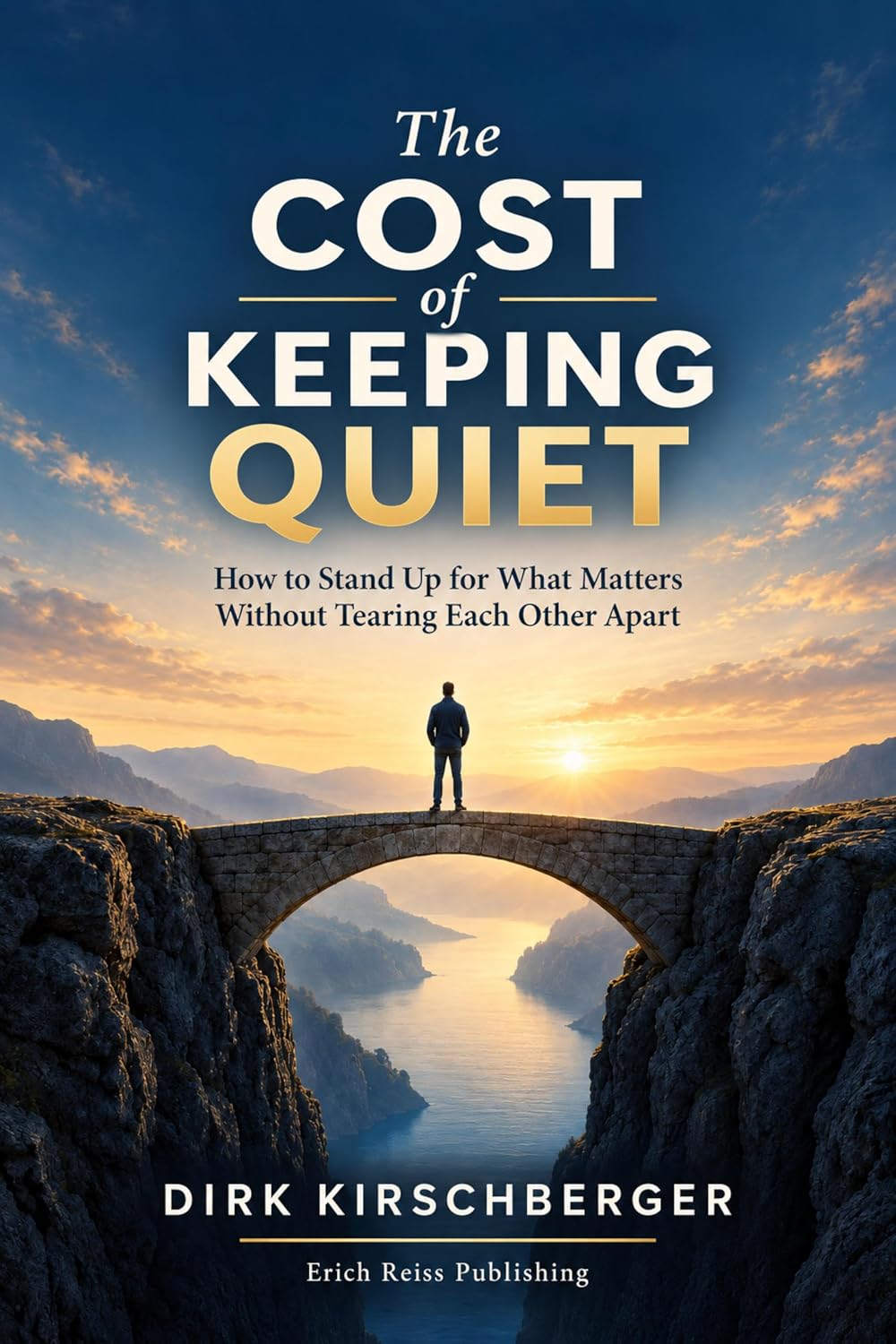
The Cost of Keeping Quiet: The Next Thing You Say
What does it cost when reasonable people decide it is easier to stay quiet?
You know the moment.
Something is said in a meeting, at work, around the dinner table or in public debate that you believe is wrong. You have a question. Perhaps even an objection. But nobody else speaks.
So you let the moment pass.
Sometimes silence is wise. Sometimes it protects a relationship, respects privacy or prevents unnecessary conflict. But sometimes silence has a price — and that price is paid long after the uncomfortable moment has passed.
The Cost of Keeping Quiet is a compelling examination of what happens when individuals, organisations and societies become reluctant to challenge assumptions, confront uncomfortable evidence or defend principles when doing so carries a cost.
Economist, journalist and author Dirk Kirschberger explores the forces that make silence attractive: conformity, institutional pressure, fear of exclusion, political loyalty, economic dependency and the understandable human desire to belong.
But this is not a book about becoming louder.
It is about becoming harder to silence — without becoming incapable of listening.
Drawing on journalism, economics, history, politics and everyday experience, Kirschberger examines questions that reach far beyond the culture wars:
When does tolerance become avoidance?
When does compromise become surrender?
What is an apology actually worth?
How can institutions make disagreement possible without rewarding intimidation?
Why do organisations ignore warnings even when people inside them recognise the danger?
What happens when economic convenience creates political dependency?
And how do we defend convictions without treating those who disagree with us as enemies?
From the Bay of Pigs and the Challenger disaster to journalism, workplaces, schools, religious conflict, political institutions, economic relationships and family life, The Cost of Keeping Quiet follows one recurring question:
Who ultimately pays for the easy answer?
The book rejects two comfortable extremes. An open society cannot survive if every disagreement is treated as harm. But freedom is not strengthened by replacing enforced politeness with contempt, humiliation or a different demand for obedience.
There is another way.
One built on evidence rather than slogans. Conviction without coercion. Tolerance without surrender. Courage without theatre. And institutions strong enough to allow people to ask difficult questions before the consequences make those questions unavoidable.
For readers who believe that freedom requires more than the right to speak — it requires the courage to question, the discipline to listen and the ability to disagree without tearing each other apart.
The Cost of Keeping Quiet is an argument for recovering those skills while we still can.