Why the 500-Page Novel Is Quietly Coming Back
Readers were told their attention spans were dying. Yet huge novels, fantasy epics and long-running series are thriving again. The 500-page book may be succeeding precisely because digital culture has made deep immersion feel rare — and therefore valuable.

For years, publishers were told that our attention spans were collapsing. Then readers began buying enormous novels again. The return of the big book tells us something important about what people actually want from culture.
For an industry supposedly fighting the death of the attention span, publishing has developed a curious problem.
Readers keep buying very large books.
Not pamphlets disguised as novels. Not 220-page airport thrillers engineered to be finished somewhere between boarding and baggage claim. Not necessarily stories stripped down for readers presumed incapable of concentrating beyond the length of a TikTok video.
Big books.
Four hundred pages.
Five hundred.
Six hundred.
Sometimes considerably more.
For much of the past decade, we were repeatedly told that this should not be happening.
The smartphone had destroyed concentration. Streaming had destroyed patience. Social media had rewired the brain. Young people could no longer sit still. Everything had to become shorter, faster and more immediate.
And yet adult fiction continues to outperform many other parts of the book market. U.S. adult-fiction sales grew again in 2025, and in the first half of 2026 the category was up another 5.7 percent in print units. Revenue figures tell an even stronger story: adult-fiction sales among reporting publishers were up 8.2 percent in the first six months of 2026.
Something clearly does not fit the old narrative.
Perhaps readers did not lose the ability to concentrate.
Perhaps they merely became more selective about what deserved their concentration.
The 500-page book should have died
According to conventional wisdom, the long novel ought to be one of the first casualties of digital culture.
Everything surrounding it appears hostile.
Phones interrupt us.
Notifications fragment the day.
Streaming platforms offer thousands of hours of entertainment instantly.
Podcasts fill the commute.
Short-form video occupies moments that once belonged to boredom.
Even newspapers increasingly tell readers how many minutes an article will require, as though reading were a parking meter.
Against this background, a 500-page novel looks almost absurd.
It demands hours.
Usually days.
Sometimes weeks.
It cannot be consumed while half-watching television.
It will not send a notification reminding you to return.
It requires the reader to remember people, places, relationships and events across hundreds of pages.
And millions of people are voluntarily doing exactly that.
That is the interesting part.
BookTok accidentally disproved the attention-span theory
Few cultural developments are more ironic than BookTok.
TikTok represents almost everything critics of modern attention spans dislike: vertical video, rapid cuts, algorithmic feeds and endless scrolling.
Yet it became one of the most powerful engines for selling books.
Circana figures reported by Publishers Weekly showed that books associated with BookTok generated roughly 60 million U.S. unit sales in 2024, up about 20 percent from the previous year. Industry observers continue to describe the platform as a major force in attracting younger readers to fiction.
And these readers are not exclusively demanding shorter books.
Quite the opposite.
Fantasy, romance and the hybrid phenomenon now known as romantasy have produced readers willing to enter long series, elaborate fictional worlds and books substantial enough to double as household objects.
The success of Rebecca Yarros's Onyx Storm offers one obvious example. It sold nearly 1.7 million print copies in the United States in 2025, according to Circana data reported by Publishers Weekly.
The wider fantasy and romantasy boom has also shown how social media can push readers toward immersive, emotionally expansive storytelling rather than away from it. In Britain, the value of science-fiction and fantasy sales rose sharply between 2023 and 2024, with BookTok-linked romantasy identified as an important driver.
TikTok did not destroy the book.
It created millions of conversations about books.
That was not supposed to happen.
Readers are not buying pages. They are buying somewhere to live.
The mistake is assuming that length itself attracts readers.
Nobody buys a 600-page novel because they are excited about possessing six hundred numbered pieces of paper.
A long novel succeeds when those pages create something that a shorter form cannot easily reproduce:
immersion.
A large book gives the reader time to inhabit another world.
Secondary characters can become important.
Relationships can change slowly.
A city can acquire geography.
A family can accumulate history.
A character can disappear for 150 pages and return carrying the emotional weight of everything that happened before.
That is one of the fundamental pleasures of fiction, and it is remarkably difficult to reproduce in a two-hour film or fifteen-second clip.
The appeal of the long novel may therefore be growing not despite digital culture but partly because of it.
A fragmented environment increases the value of experiences that are not fragmented.
The book becomes the escape from the feed.
We misunderstood what people were tired of
When readers say they do not have time to read, they often mean something slightly different.
They do not have time to read a book that fails to hold them.
That distinction matters.
People who supposedly cannot concentrate will watch eight episodes of a television series over a weekend.
They will listen to a three-hour podcast.
They will spend four hours gaming.
They will scroll through a social-media platform for an amount of time they might prefer not to calculate.
Attention has not vanished.
Competition for attention has intensified.
The consequence is not necessarily shorter concentration.
It is harsher selection.
A mediocre 180-page novel may now feel longer than an excellent 600-page one.
The reader is asking a brutal but reasonable question:
Why should I give you my time?
When the answer is convincing, page count suddenly becomes much less important.
The big book also offers value
There is another factor publishers sometimes discuss more quietly.
Books are expensive.
A new hardcover can easily cost as much as several months of a streaming subscription.
Even paperbacks have become significant purchases for many households.
The psychological calculation therefore changes.
A reader standing in a bookstore with two novels in hand may not consciously calculate price per page, but perceived value matters.
A substantial novel promises an experience.
It looks like something that will last.
This is especially important in fantasy, historical fiction, romance sagas and thrillers with large casts — genres in which the reader may actively want to remain inside the story rather than rush toward its conclusion.
The book becomes less like a disposable entertainment product and more like a destination.
Publishing itself is becoming crowded
There is another reason the substantial novel can stand out: there have never been so many books competing for attention.
Bowker statistics reported in 2026 showed that more than four million ISBN-bearing titles were published in the United States during 2025, driven overwhelmingly by enormous growth in self-publishing. Traditionally published output also increased.
Four million books.
Nobody can meaningfully browse that market.
Discovery therefore increasingly depends on recommendation systems, social-media communities, bookstores, trusted reviewers and word of mouth.
Once a reader finally finds a story everyone around them is discussing, there is little reason for them to want the experience to end quickly.
In an overcrowded market, loyalty becomes more valuable.
That helps explain another contemporary publishing obsession:
the series.
The 500-page novel does not merely give readers a story.
It can recruit them into a world.
The series changed the economics of reading
Traditional literary prestige once leaned heavily toward the self-contained novel.
Commercial publishing has increasingly rediscovered something older storytellers already understood:
readers enjoy returning.
The successful fantasy series, romance universe or crime saga transforms the relationship between writer and reader.
The question is no longer:
“Would you like to buy this book?”
It becomes:
“Would you like to come back?”
This is enormously powerful.
A reader who has spent 500 pages with characters does not encounter book two as an unfamiliar product.
They encounter familiar people.
That emotional investment cannot easily be replicated by marketing.
The first book sells the second.
The second sells the third.
And the shelf begins to look increasingly dangerous.
Long books signal confidence
There is also something almost defiant about publishing a large novel now.
A thick book makes a promise before the first page is opened.
This story deserves your time.
Sometimes that promise is spectacularly wrong.
Many long novels would improve considerably after an encounter with an unsentimental editor.
Length is not depth.
A 650-page novel can contain 350 pages of story.
The contemporary publishing boom has certainly produced books that confuse world-building with accumulation and emotional intensity with repetition.
But the existence of bloated books does not invalidate the appetite for expansive ones.
Readers can tell the difference.
Eventually.
The return of reading as identity
Books have also regained a social function that publishing occasionally forgot.
Reading is once again visible.
People photograph bookshelves.
They discuss reading goals.
They join online reading communities.
Independent bookstores host events that sell out.
Specialist romance and romantasy bookshops have appeared because readers want physical spaces in which literary taste becomes community. The opening of dedicated romantasy stores in Britain during 2026 is one indication of how online reading cultures are spilling back into the physical world.
The book is not merely being consumed.
It is being displayed, discussed and shared.
And a large book performs particularly well in this environment.
It has presence.
A 700-page fantasy novel sitting beside a coffee cup communicates something visually that an e-book cannot.
The irony is delicious.
The digital generation helped make the physical book photogenic again.
Short-form culture may have created long-form hunger
This may be the most interesting explanation of all.
For twenty years, technology companies have worked relentlessly to remove friction from entertainment.
Everything arrives immediately.
Skip the introduction.
Increase the playback speed.
Swipe.
Scroll.
Next.
Next.
Next.
Efficiency became the dominant cultural principle.
But entertainment was never supposed to be efficient.
Nobody asks whether falling in love could be completed in fewer minutes.
Nobody leaves a wonderful dinner disappointed because it lasted too long.
Nobody standing before a great painting wishes the experience had been optimized into eleven seconds.
Some things derive value from the time we surrender to them.
Reading is one of them.
The 500-page novel represents almost the opposite of the infinite feed.
The feed has no destination.
The novel does.
The feed offers endless novelty.
The novel asks you to stay.
The feed is designed to prevent completion.
The novel eventually gives you an ending.
That difference may matter more than publishers realize.
We may be witnessing a correction
The prediction that digital life would destroy long-form reading was based on a misunderstanding of human behavior.
Technology changes habits.
It does not eliminate fundamental desires.
People still want stories.
They still want suspense.
They still want romance.
They still want characters sufficiently vivid that finishing a book feels slightly like losing contact with someone.
And increasingly, publishing data suggests that fiction remains one of the strongest parts of the market. Adult-fiction revenue rose 3.9 percent in the United States in 2025, and its growth accelerated among reporting publishers during the first half of 2026.
That does not prove that every reader wants a 500-page novel.
Nor does it mean shorter fiction is disappearing.
It suggests something more useful.
There is no single modern attention span.
There are only things worthy of attention and things that are not.
The thick book survived
The 500-page novel was supposed to become an anachronism.
Instead, it sits on bestseller tables.
It appears in TikTok videos.
Readers carry it onto airplanes.
Book clubs spend weeks arguing about it.
Fans finish one enormous volume and immediately order the next.
Perhaps we should stop being surprised.
The world around us has become faster, louder and more fragmented.
That does not necessarily mean people want their stories to become faster, louder and more fragmented too.
Sometimes the reaction to speed is slowness.
The reaction to distraction is immersion.
The reaction to an endless stream of disposable information is a story large enough to disappear into.
The future of reading may therefore look surprisingly old-fashioned:
a quiet room,
a comfortable chair,
and a book that will not be finished tonight.
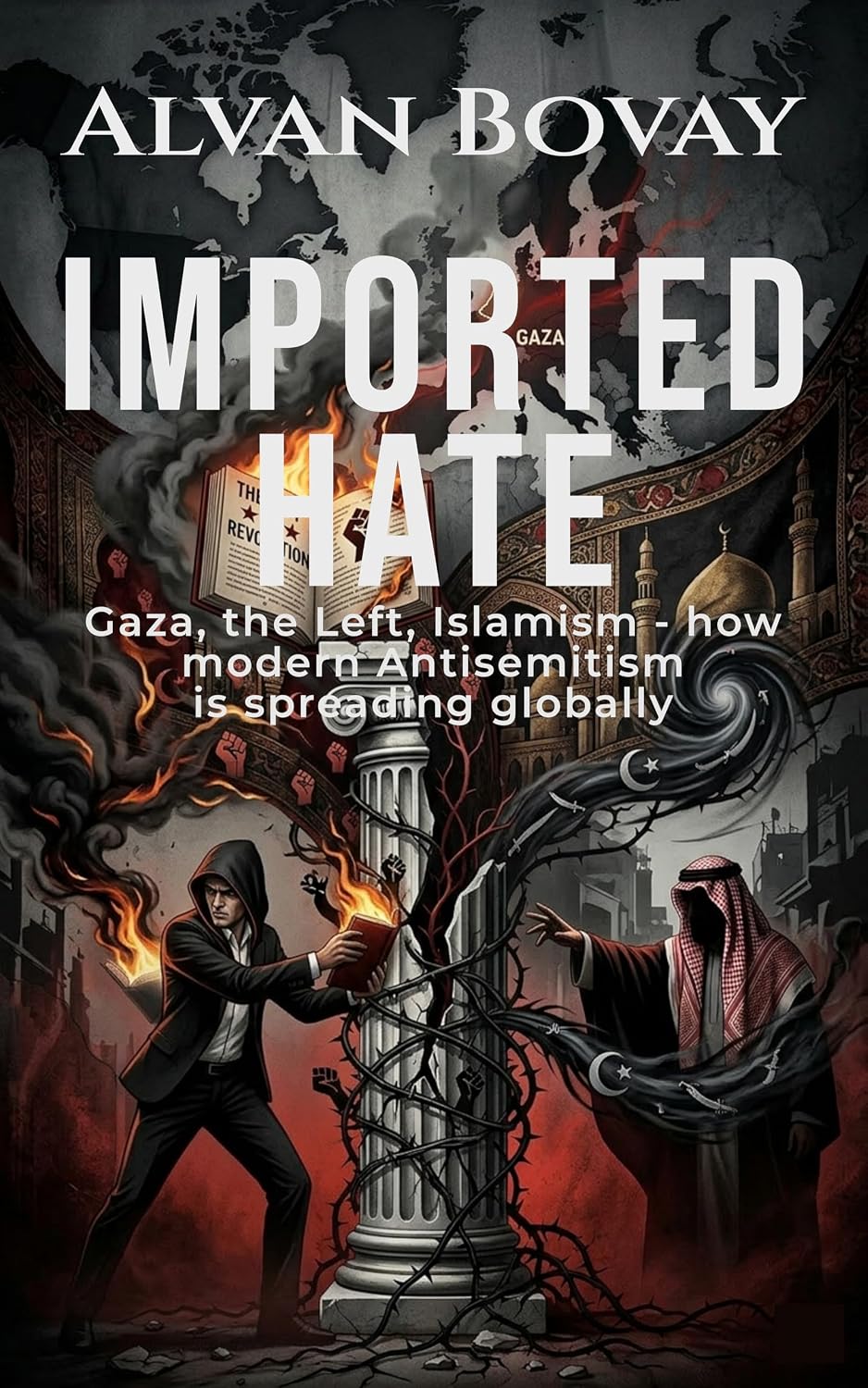
IMPORTED HATE: Gaza, the Left, Islamism – How the New Antisemitism Is Being Unleashed Worldwide
“Jew-hatred dressed as activism is still Jew-hatred.” — Ben Shapiro
On October 7, 2023, a threshold was crossed. While the world watched the horror in Israel, a second front was already being opened—not in the Middle East, but in the streets, universities, and political institutions of the West.
In IMPORTED HATE, investigative journalist Alvan Bovay presents a relentless, 72-chapter examination of the "New Antisemitism." This is not an opinion piece; it is a forensic reconstruction of how an ancient hatred was modernized, imported, and unleashed globally.
Through 71 concise chapters and 7 powerful parts, Bovay documents the systematic betrayal of Western liberal values.
The Forensic Evidence: What the Mainstream Ignores
Drawing on primary sources, intelligence data, and internal reports, this book exposes:
- The UNRWA Files: A deep dive into how international aid and educational systems became breeding grounds for radicalization and terror infrastructure.
- The Red-Green Alliance: Why the radical Left has formed a strategic partnership with medieval Islamism to destabilize democratic societies.
- The Influence War: A technical and psychological analysis of how "activism" is weaponized through decentralized digital networks to silence dissent.
- Gaza as a Catalyst: How the events of October 7 were used to trigger a global wave of pre-planned antisemitism, targeting the heart of Western cities.
- Institutional Collapse: The failure of leadership in politics and academia that allowed the "New Antisemitism" to go unchecked under the guise of diversity and inclusion.
IMPORTED HATE is a wake-up call. It is a strategic "toolbox" for those who refuse to be silenced and a roadmap for leadership in an era of unprecedented ideological warfare.
The evidence is in these pages. The question is: Will we confront the truth, or will we continue to ignore the wolves already inside the city?