The Poison in the Well of Democracy
Adrian Kerr’s ‘Murder at the Agora’ strips the polished marble from ancient Athens to reveal a volatile world of political assassination and systemic corruption. A gripping, cinematic historical mystery that serves as a stark reminder of the fragile, violent origins of democracy itself.
Adrian Kerr’s ‘Murder at the Agora’ and the Shadow of the Golden Age
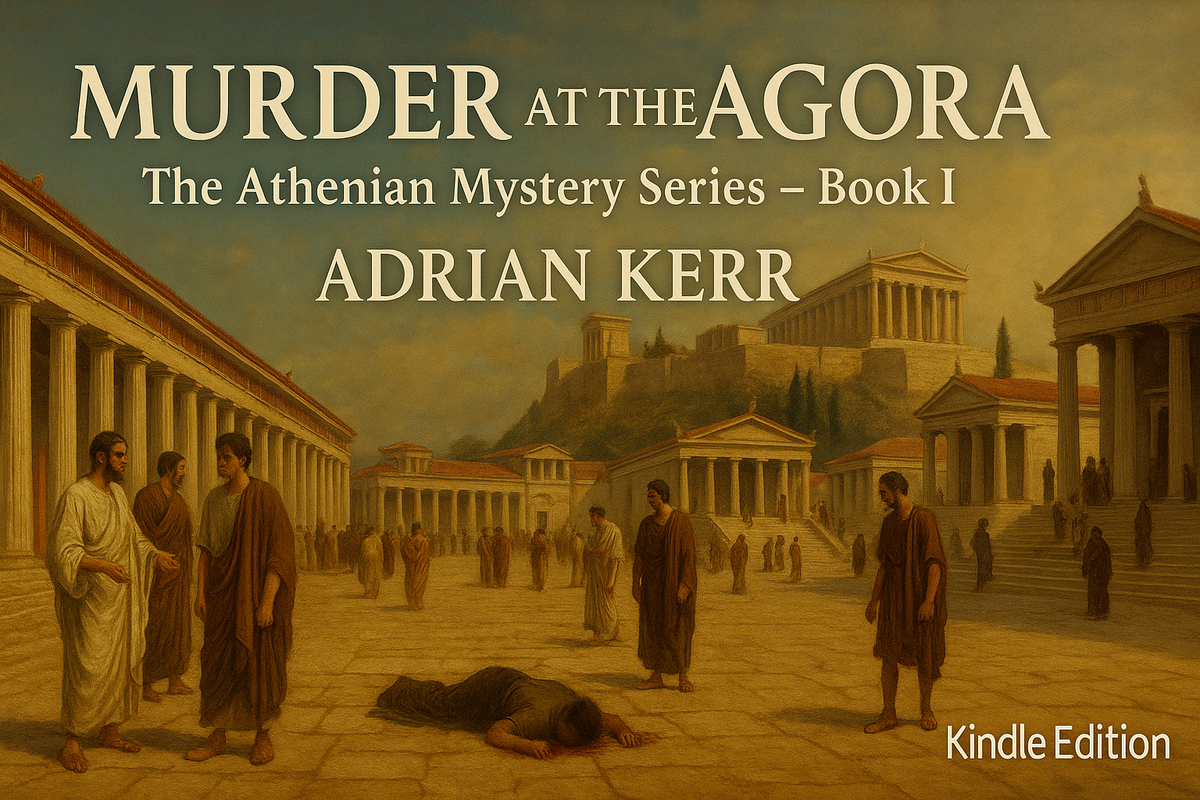
ATHENS — There is an inherent contradiction at the cradle of Western civilization that historians often polish away behind the gleaming white of Pentelic marble. The Athens of 451 B.C.—the precise crucible where Adrian Kerr sets his gripping historical mystery Murder at the Agora—was no sterile seminar room for toga-clad philosophers. It was a highly combustible laboratory of raw power, a city-state where the birth of democracy was soundtracked by political assassination, systemic corruption, and pervasive paranoia.
Kerr’s debut novel in the Athenian Mystery series deploys one of the oldest tropes in crime fiction—a sudden, unexplained death in a highly public square—to systematically strip away the veneer of this ancient political experiment. When a charismatic young orator collapses mid-speech before a crowded Agora, the resulting panic is more than a reaction to a potential crime. It exposes the profound fragility of a society that preaches rational discourse while keeping hemlock and daggers close at hand.
An Investigator Torn Between Reason and Authority
Into this vortex steps Nikandros of Alopeke. As the son of a rising merchant, Nikandros belongs to a nouveau-riche class benefiting immensely from Athens’ maritime empire, yet one still viewed as an invasive species by the old aristocratic families. He is not a cynical, hard-boiled detective of the modern noir tradition, but rather an idealist whose sharpest weapon is observation. He is a true son of an era just beginning to dissect the cosmos through human logic rather than the shifting whims of the Olympian gods.
“Kerr pulls off a difficult literary hat-trick: he neither romanticizes antiquity nor dismisses it as primitive. His Agora smells authentically of olive oil, sweat, cheap wine, and the quiet, ever-present terror of a treason allegation.”
As Nikandros untangles the knot of shifting alliances within the Council of Five Hundred (the Boule), Kerr expertly guides the reader through the stratified layers of the polis. We are taken far from the pristine temple steps and into the smoky, claustrophobic workshops of potters, the shadowy corners of the assembly grounds, and the private quarters where the fate of empire is bartered under the flicker of low-grade oil lamps.
The Weaponization of the Word
What elevates Murder at the Agora above standard historical genre fare is Kerr’s acute understanding of the political weight of language. In a nascent system built entirely on the right to speak (Isagoria), rhetoric was the period's most potent—and lethal—technology. A well-timed accusation or a devastating metaphor delivered before the Assembly could dissolve a dynasty or trigger a regional war. The silencing of the orator, therefore, is not merely a crime of passion; it is a calculated assault on the political apparatus itself.
Kerr’s prose is sharply cinematic without succumbing to the sensationalist tropes of contemporary historical pop-fiction. His style remains measured, elegant, and deeply committed to embedding historical context organically into the narrative. The meticulous research is palpable on every page; the friction between old oligarchic factions and radical democrats forms a tense, invisible infrastructure that keeps the plot moving at a breakneck pace.
The Verdict
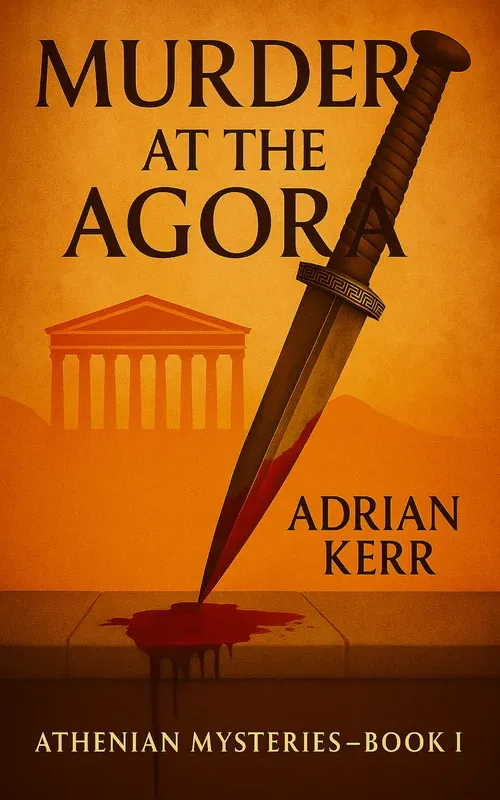
Murder at the Agora offers an intellectual feast for those who savor historical fidelity, and a taut, fast-paced thriller for readers fascinated by the anatomy of power and betrayal. Kerr serves a timely reminder that democracy was a compromised, vulnerable construct from its very inception—guarded by flawed men and constantly stalked by those who profit from the dark.
For readers of The Voss who study institutional crises and the perennial war between truth and authority, this opening volume of a planned quartet comes highly recommended. The curtain has risen on the underbelly of classical Athens, and one looks forward to seeing how much darker the night gets in the upcoming sequels, Shadows of the Acropolis and Blood at the Symposium.
Adrian Kerr, Murder at the Agora (The Athenian Mystery Series – Book I). Kindle Edition. Available on Amazon and Kindle.