Trump's 2026 Geopolitics: Arming Global Autocrats
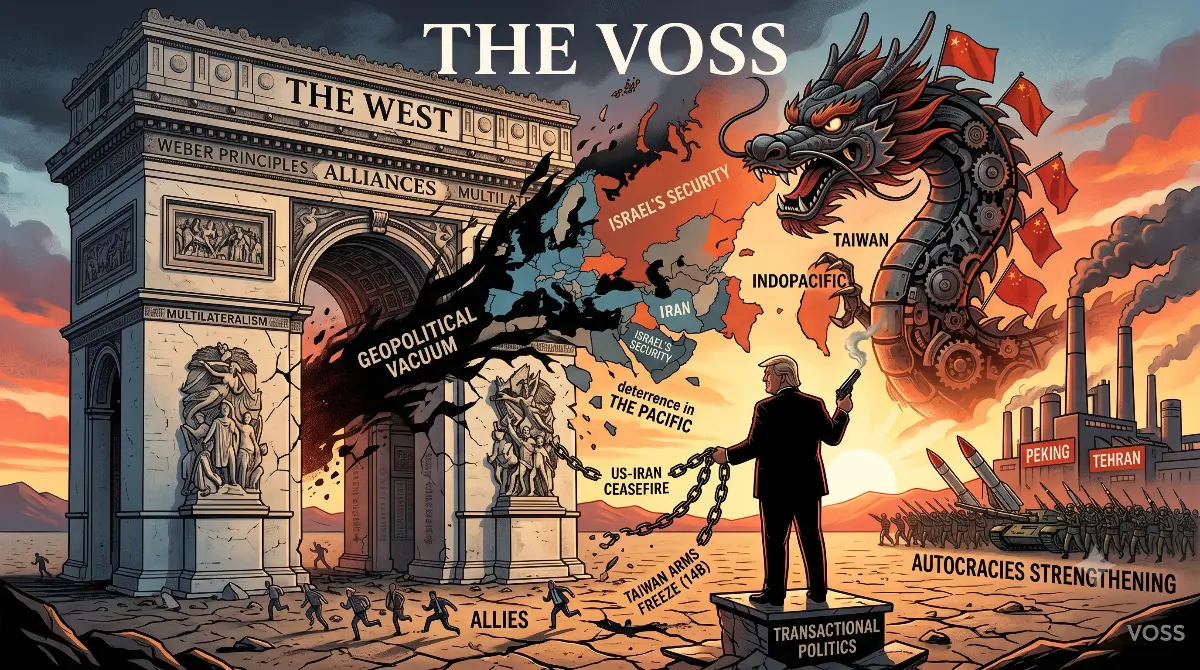
US foreign policy under Donald Trump in 2026 sacrifices long-term alliances for short-term deals. From the unilateral Iran ceasefire to halting Taiwan's arms, this transactional zigzag creates a dangerous vacuum that plays directly into the hands of autocracies like China and threatens the West.
The Geopolitical Vacuum
True "geostrategy" implies foresight, continuity, and the calculated orchestration of alliances to secure global supremacy. Yet, the reality the international community is facing in the first half of 2026 marks a radical break from these foundational principles. Following the outbreak of the US-Iran war in February 2026 and his subsequent state visit to Beijing in May, President Donald Trump’s foreign policy maneuvers reveal a clear, undeniable pattern: the replacement of long-term alliance loyalty with erratic, headline-driven transactional politics.
This collaborative report for The Voss analyzes hard data and recent intelligence to expose why these unpredictable zigzag courses are not strokes of "Madman Theory" genius, but rather the creation of a dangerous geopolitical vacuum. It is a void that damages Israel's core interests, erodes deterrence in the Pacific, and serves as an open invitation for the People's Republic of China to establish a new world order.
1. The Iran Conflict (2026): From Ultimatum to Unilateral Retreat
When open conflict with Iran erupted on February 28, 2026, Washington initially operated under a doctrine of maximum pressure. Trump issued strict deadlines to Tehran, threatened the "total destruction" of its nuclear and economic infrastructure, and demanded the regime's unconditional surrender. The ensuing military escalation—most notably Iran’s immediate blockade of the Strait of Hormuz—sent global markets and energy supplies into a tailspin.
However, instead of consistent military or diplomatic containment, a series of disruptive U-turns followed, reaching their peak in June 2026:
- The Unilateral Ceasefire: On April 8, 2026, the US agreed to a two-week, Pakistan-mediated truce, which Trump indefinitely extended shortly after. By June 11, the President announced via Truth Social that the final terms for a deal had been accepted by "all parties," abruptly canceling planned airstrikes. While the White House celebrates this as a "historic settlement," reports from Tehran indicate the regime is merely reviewing the draft.
- The Fracture with Israel: The strategic divide between Washington and Jerusalem has rarely been deeper. Prime Minister Benjamin Netanyahu's government views the US pivot with profound alarm. While Israel sees the conflict as an existential necessity to permanently dismantle Iran's nuclear program and its proxy networks (Hezbollah, Houthis), Trump pushed for a rapid, presentable deal. Jerusalem’s accusation is severe: the US relieved the pressure during a critical window simply to reopen the Strait of Hormuz, aiming to score domestic political points with dropping gas prices.
- Loss of Trust in the Gulf: Regional powerhouses like Saudi Arabia and the UAE are realizing that American security guarantees are now pegged to short-term US economic indicators. Consequently, these nations are quietly hedging their bets, strengthening diplomatic and economic ties with Beijing and Moscow.
2. The Beijing Summit (May 2026): Sacrificing Taiwan for Trade
From May 14 to 15, 2026, President Trump traveled to Beijing for a historic summit with Chinese President Xi Jinping. Instead of robustly defending US economic and military supremacy in the Indo-Pacific, the administration utilized Taiwan as a geopolitical bargaining chip.
Under the newly coined diplomatic framework of "Constructive Strategic Stability," fundamental pillars of American foreign policy were quietly dismantled:
- The $14 Billion Arms Freeze: For months, a bipartisan-approved defense package awaited the White House's final green light. The weapons—including critical Patriot missiles (PAC-3), HIMARS artillery systems, and Javelin anti-tank missiles—were designed to fortify Taiwan's "Porcupine Strategy." Immediately following the summit, Acting Navy Secretary Hung Cao confirmed to Congress that deliveries to Taiwan were "paused." The official justification? The munitions are required for US operations in the Iran conflict (Operation Epic Fury).
- Taiwan on the Trading Block: In post-summit interviews, Trump openly tied the fate of these arms deliveries to China’s concessions on trade and import quotas. This effectively abandons the historic "Six Assurances" of 1982, which explicitly forbid Washington from consulting with Beijing over arms sales to Taiwan.
- A Signal of Fading Resolve: By publicly suggesting Taiwan must "pay for its own protection" and treating military aid as leverage, trust in America's readiness to defend its allies has severely eroded. In Taipei, this sparked a bipartisan shockwave, accelerating a desperate push for self-reliance in asymmetric warfare, such as independent drone production.
3. The Erosion of Deterrence: When Will Beijing Strike?
The primary risk of this erratic policy is the catastrophic miscalculation by authoritarian regimes. The assumption that Trump's unpredictable course is a calculated deterrence strategy fails the test of Realpolitik. Geopolitical analysts at the Center for Strategic and International Studies (CSIS) warn that the prolonged Iran conflict, combined with capitulation on the Taiwan issue, has drastically shortened the window for Chinese aggression.
The threat of a premature invasion of Taiwan by the PRC skyrockets the moment Beijing concludes that the cost of an attack is lower than the risk of relying on an unreliable negotiating partner in Washington. When the US signals an unwillingness to bear economic or military risks to defend a democracy in the Western Pacific, the strongest deterrent of the last seventy years vanishes.
4. Washington's Systemic Shock: The Bipartisan Failure
Frustration with the current administration's actions falls short if viewed in isolation. It is symptomatic of a profound structural failure across Washington's political elite.
- The Silence of the Democrats: The Democratic opposition has failed to articulate a coherent strategic alternative. Paralyzed by internal ideological battles and terrified of being branded "warmongers" ahead of the midterms, Democratic leadership offers no real counterweight. They criticize the President's rhetoric while implicitly co-signing budget cuts and the prioritization of domestic economics over geopolitical hard power.
- Bipartisan Resistance in Congress: The only glimmer of hope is the growing, cross-party resistance on Capitol Hill. On May 13, 2026, the House Foreign Affairs Committee unanimously passed (45:0) the PORCUPINE Act, legally mandating the delivery of defense articles to Taiwan to bypass the White House's veto. Senior Senators from both sides of the aisle have penned scathing letters demanding an immediate end to the arms moratorium. Yet, these legislative countermeasures are merely treating the symptoms while the executive branch dismantles the superpower’s strategic foundation.
The Bottom Line: Symbolic Politics Over Global Leadership
What apologists for the current US trajectory label as "economic rehabilitation" and the "avoidance of endless wars" is, upon closer inspection, a fundamental hemorrhaging of Western influence.
When short-term market stabilization and rushed deals come at the expense of the existential security of allies like Israel and Taiwan, it is no longer geostrategy. It is a capitulation to the complexities of a multipolar world. The true victors of this policy do not reside in Washington; they sit in Beijing and Tehran. They do not need to win wars—they simply need to wait for the West to demolish its own foundations out of impatience and domestic political calculation.
Sources & Documentation
- Center for Strategic and International Studies (CSIS): Briefing Report: The Trump-Xi Summit in Beijing and the G2 Reality (May 2026).
- U.S. House of Representatives: Committee on Foreign Affairs, Voting Record on H.R. 7146 (PORCUPINE Act) (May 13, 2026).
- The Guardian / Congressional Hearing Records: Testimony of Acting Navy Secretary Hung Cao on Arms Export Status and Operation Epic Fury (May 22, 2026).
- Center for American Progress (CAP): Policy Analysis: The Strategic Fallout of the $14B Indo-Pacific Defense Freeze (June 2026).
- Official Truth Social Records / White House Press Pool: Executive Declarations on the United States-Iran Pakistan-Mediated Ceasefire Framework (April–June 2026).