America 2026: Trump, Mamdani and an Empire Adrift
Donald Trump’s Iran war lacks an endgame. Zohran Mamdani is pushing New York further left. JD Vance waits to inherit MAGA, while Gavin Newsom prepares for 2028. America still has extraordinary power—but no unifying direction.
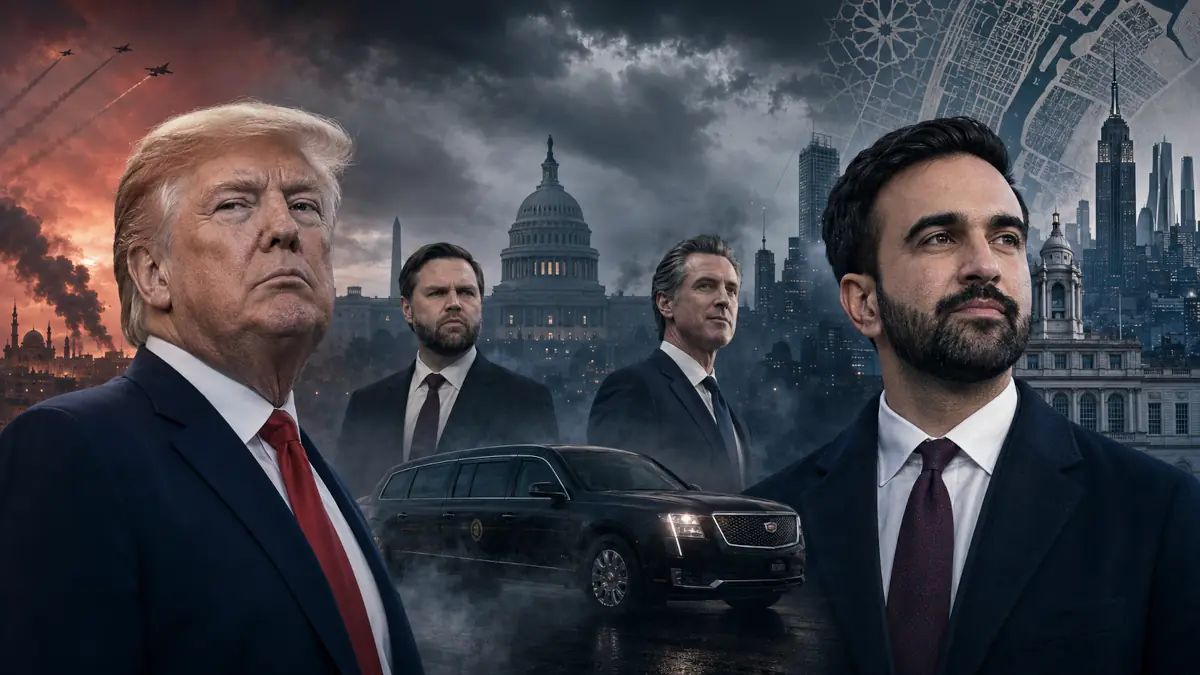
As Donald Trump leads the United States into an Iran war with no clear endgame, Zohran Mamdani pushes New York Democrats further left. JD Vance waits to inherit MAGA, Gavin Newsom waits for the cameras—and the world’s most powerful nation loses its direction.
Washington in the summer of 2026 looks like the capital of an empire that still possesses immense power but no longer knows what to do with it. The U.S. military can destroy targets on the other side of the world within hours. The dollar still dominates global trade. The world’s largest technology companies remain American. Yet the nation’s political class is staggering between military escalation, socialist activism, religious identity politics and made-for-camera performance.
The United States is not finished. Its economic, military and technological reserves are far too deep for that. But America is running on empty.
While Washington announces one new “historic success” after another, other nations are filling the spaces America leaves open. China is expanding economic dependencies. The Gulf states are conducting their own diplomacy. India is confidently pursuing its national interests. Europe is slowly beginning to understand that American protection is not a law of nature.
The world is no longer waiting for Washington. It is already planning for an America that may do tomorrow the opposite of what it promises today.
Donald Trump and an Iran War With No Clear Endgame
Donald Trump returned to office promising to end wars, deter America’s enemies and impose peace through uncompromising strength. In Iran, that promise has produced a military conflict whose objectives are becoming harder to identify by the week.
First, the goal was to destroy Iran’s nuclear and military infrastructure. Then maximum pressure was supposed to force Tehran back to the negotiating table. The White House later presented a memorandum as a historic diplomatic breakthrough. In June, Trump celebrated an extended ceasefire and what he described as a framework for a lasting settlement.
By July, the bombs were falling again.
The U.S. Air Force is striking Iranian targets. Iran is attacking American bases and allies. At least 17 American service members have been killed and hundreds wounded, according to the latest figures cited in the original reporting. Trump has threatened to avenge every American death “many times over.” The promised peace initiative has become precisely the cycle of escalation it was meant to prevent.
What is the political endgame?
Regime change? Iran’s total disarmament? Securing the Strait of Hormuz? Protecting Israel? Or merely trying to contain the consequences of each previous decision?
Military force can destroy capabilities and buy time. Without an achievable political objective, however, it mainly creates the next justification for the next strike. Trump confuses unpredictability with strategic superiority. But a leader who constantly threatens everything does not only unsettle his enemies. He also rattles allies, markets and his own armed forces.
“Peace through strength” works only when strength is followed by a durable peace. Otherwise, what remains are bombs, casualties and a victory announcement unlikely to survive the next news cycle.
China: Tariffs Are Not a Strategy
The grand gesture also dominates Trump’s China policy. He raised tariffs, threatened additional trade barriers and presented economic pressure as proof that the United States would no longer allow itself to be exploited.
Beijing did not buckle.
When U.S. tariffs temporarily reached roughly 145 percent, China retaliated and used its dominant position in rare-earth processing as leverage. Washington was forced to acknowledge that economic dependency runs in both directions. What followed were exemptions, delays, truces and another round of negotiations.
Tariffs can be a tool. They are not an industrial policy. They do not build factories, train engineers, secure raw materials or create resilient supply chains.
China thinks in ports, resources and decades. Washington thinks in press conferences.
JD Vance: Trump’s Heir Without a Doctrine of His Own
Vice President JD Vance is waiting in Trump’s shadow. Trump at times called him the likeliest heir to his movement, then declined to choose between Vance and Secretary of State Marco Rubio. In June, he floated a joint Vance-Rubio ticket for 2028 and declared it unbeatable. Trump himself keeps the Republican succession contest alive.
Vance is intelligent, rhetorically disciplined and keenly attuned to the anger of millions of Americans. What remains unclear is what his political project would be beyond loyalty to Trump.
He criticizes global intervention while supporting the Iran war. He condemns elite decline while occupying the center of the new Republican elite. Vance may be the more intellectual face of Trumpism. That does not yet make him its strategic evolution.
Democrats Are Losing the American Middle
Democrats should be benefiting from Trump’s Iran war, his erratic tariff policy and the exhaustion visible even among conservative voters. Yet their advantage ahead of the 2026 midterm elections remains remarkably narrow.
That is less a sign of Republican strength than a vote of no confidence in the Democratic Party.
For years, Democrats have created the impression that language, race, gender and group identity matter more than a shared civic experience. They explain in exhaustive detail what separates Americans—and say increasingly little about what still binds them together.
Progressive and democratic-socialist candidates have put genuine concerns back on the agenda: unaffordable housing, child care, health care costs and declining purchasing power. But they often attach those issues to radical foreign-policy positions and identity-based demands that repel voters outside large progressive cities.
The clearest symbol of this shift now sits in New York City Hall.
Zohran Mamdani’s Muslim-Inflected Socialism in New York City
Zohran Mamdani has governed the most important financial metropolis in the Western world since January 2026. He promises affordable housing, fare-free buses, city-run grocery stores, higher corporate taxes and a sweeping redistribution of wealth toward low-income New Yorkers.
His housing plan calls for 200,000 new affordable homes and the long-term preservation of another 200,000 units over a decade. The proposal would spend $22 billion in its first five years alone, financed in part through higher taxes on corporations and wealthy residents.
In Brooklyn’s left-wing circles, that sounds like justice. In a city whose budget depends disproportionately on a relatively small number of high earners and successful companies, it is also a dangerous experiment.
There is not yet statistical proof of a mass Wall Street exodus. But investment decisions are beginning to shift. Citadel wants to expand more aggressively outside New York. JPMorgan now employs more people in Texas than in New York. Apollo Global Management is planning a second headquarters in the South. Mamdani did not create this trend, but his tax agenda and rhetoric against the wealthy could accelerate it.
Capital does not need political permission to leave a city. It needs only a better address.
Mamdani, Israel and the Antisemitism Debate
It would be journalistically irresponsible to label Mamdani personally and without qualification an antisemite. What is documented, however, is a political pattern: He treats Israel with a degree of hostility he applies to almost no other country and has repeatedly minimized the concerns of Jewish New Yorkers.
Mamdani supports the Boycott, Divestment and Sanctions movement. He has refused to recognize Israel specifically as a Jewish state. During the campaign, he initially would not unequivocally condemn the slogan “Globalize the Intifada.” Only after sustained pressure did he say that he would not use the phrase himself and would discourage others from using it.
For Jewish New Yorkers, the intifada is not an academic metaphor. It is associated with suicide bombings, terrorism and murdered civilians. A candidate seeking to govern the city with the largest Jewish population outside Israel needed only two words: unacceptable here.
At first, Mamdani would not say them.
After taking office, he rescinded executive orders from his predecessor that barred city agencies from boycotting or divesting from Israel. He also reversed the city’s adoption of the International Holocaust Remembrance Alliance definition of antisemitism. Mamdani retained the Mayor’s Office to Combat Antisemitism, but the contradiction is difficult to ignore: He protects Jewish residents institutionally while adopting political positions associated with a movement many of those residents view as threatening.
His administration is now even examining whether the NYPD could arrest Israeli Prime Minister Benjamin Netanyahu during a visit to the United Nations General Assembly. The United States does not recognize the jurisdiction of the International Criminal Court, and foreign policy is the responsibility of Washington, not New York City Hall. Mamdani nevertheless appears determined to turn the possible arrest of Israel’s prime minister into a municipal prestige project.
Netanyahu and the Gaza war can be criticized fiercely. But when a mayor focuses obsessively on Israel while synagogues are attacked and Jewish citizens are intimidated, legitimate criticism begins to look like ideological fixation.
Iftar at City Hall: Religion as a Symbol of Government
Mamdani’s Muslim identity is not a private footnote. In March, his administration hosted the first official iftar at New York City Hall. Additional Ramadan events with city employees and Muslim staff followed.
At one iftar, Mamdani greeted participants with “As-salaam alaykum” and “Ramadan Kareem,” quoted the Quran and spoke about the faith that guides him in office. An imam led the Maghrib prayer. The mayor’s office published the address in full.
There is nothing objectionable about sharing an iftar with Muslim residents in a religiously diverse city. The political context is what matters: Mamdani has made Islam a recurring element in the public presentation of his administration.
If a conservative Christian mayor gathered officials for an official communion service, quoted Bible verses and made Christianity a guiding theme of his administration, many of the same media outlets would immediately raise questions about the separation of church and state.
Mamdani is not merely a socialist who happens to be Muslim. He is a practicing Shia Muslim who visibly combines religion, immigrant mobilization and socialist social policy. That does not make him an Islamist. It does make his administration a political project distinctly shaped by Islam.
Rama Duwaji and Mamdani’s Political Milieu
Mamdani’s wife, Rama Duwaji, is also part of this political and cultural environment. She is not a public official and is not responsible for her husband’s decisions. But as first lady, a political artist and a contributor to the visual identity of his campaign, she is not entirely removed from it either.
The Syrian American illustrator has focused heavily on Arab identity, Gaza, Palestine and Western power. Earlier posts surfaced in the spring in which she reportedly glorified Palestinian militants and attacked Israel in aggressive terms. Her reactions to posts following the Hamas massacre of October 7, 2023, also drew criticism. Duwaji later apologized for “hurtful” remarks from her youth without individually addressing every post.
Old posts can reflect youthful radicalism. But considered alongside Mamdani’s support for BDS, his positions on Israel and his focus on Netanyahu, they form a broader political and cultural picture that can no longer be dismissed as a series of unrelated misunderstandings.
The Mamdani Family and Money From Qatar
The image of Mamdani as a humble socialist outsider is equally misleading. His father, Mahmood Mamdani, is an internationally prominent postcolonial scholar and Columbia University professor. His mother, Mira Nair, is a successful, Oscar-nominated filmmaker. Mamdani himself has described his upbringing as privileged.
More politically sensitive is the funding several of his mother’s projects received from Qatari state-controlled institutions. The Doha Film Institute reportedly invested about $15 million in Nair’s The Reluctant Fundamentalist, effectively covering its entire production budget. A stage adaptation of Monsoon Wedding received support from Qatar Airways and Qatar Creates. The short film Nafas was commissioned by the National Museum of Qatar.
None of this proves that Qatar directly financed Mamdani’s campaign. It does show that his family’s cultural and economic success was supported for years by institutions tied to an authoritarian Gulf state.
Qatar has hosted Hamas officials, restricts political opposition and homosexuality, and uses culture, universities, media and sports to project influence abroad. Mira Nair, meanwhile, boycotted Israeli cultural events over alleged religious discrimination.
Israel is subjected to a moral boycott. Millions from Qatar are accepted.
Socialism is Mamdani’s brand. Privilege is his biography.
New York’s Immigrant Enclaves Map and Selective Memory
New York City’s official “Immigrant Enclaves” map shows how selective the new identity politics can be. It highlighted 30 immigrant neighborhoods, including Little Palestine, Little Yemen, Little Pakistan, Koreatown and Little Odessa.
Little Italy was missing. So were historically Irish neighborhoods and long-established Jewish communities.
The project began in 2023 under Mayor Eric Adams. Mamdani’s administration adopted, expanded and promoted the map in 2026. Only after an intense backlash did Mamdani promise to add Little Italy.
Such a map is never just a map. Selecting 30 communities from thousands of neighborhoods means deciding which immigrant histories remain visible.
Italian, Irish and Jewish immigrants did not merely live in New York. They built its businesses, unions, churches, synagogues, fire departments and political institutions. Under the new identity-based logic, however, they disappear as soon as their integration succeeds.
Little Palestine is celebrated as vibrant diversity. Little Italy is forgotten.
Gavin Newsom: California Cracks Beneath the Gloss
Gavin Newsom is positioning himself as an alternative to Mamdani’s leftward course. The California governor has not yet declared a 2028 presidential campaign, but he is openly considering one.
Newsom is media-savvy, combative and exceptionally comfortable in front of a camera. California remains his greatest liability. More than 180,000 people are homeless. The state’s high-speed rail project has become a national symbol of exploding costs, funding gaps and years of delay. In 2025, Washington withdrew $4 billion after a federal review cited missed deadlines and a $7 billion funding shortfall for the first segment alone.
California is not a failed state. But neither is it the gleaming model Newsom wants to sell to the country.
America Still Has Power—but No Unifying Idea
The United States is not facing an ordinary partisan crisis. It is suffering from a failure of strategic imagination.
Trump has energy but no coherent foreign policy. Vance has ambition but no independent project. Mamdani mobilizes socialism, Muslim identity and anti-Israel activism. Newsom has the most polished packaging but no convincing model of government.
Who can still rally America?
A global superpower can make mistakes, lose elections and correct its strategy. What it cannot afford indefinitely is uncertainty about its purpose.
Washington continues to play the director. The world has noticed that there is no script.
The American empire is not finished. But it is consuming credibility faster than it creates order. And credibility is the one imperial resource no government can simply print more of.