Trump’s Middle East Volatility: Strategic Loss for All?
Trump’s Middle East policy shatters all diplomatic norms. What began as "maximum pressure" on Iran has degenerated into an erratic zigzag that undermines Israeli security and alienates key allies. Is this calculated chaos or mere stubbornness? A raw analysis of Washington’s strategic failure.
A Critical Analysis of US Middle East Policy
International politics in the early 21st century is defined by tectonic shifts, at the center of which lies the volatile and unpredictable maneuvering of the United States. This dynamic manifests most glaringly in American foreign policy toward the Middle East, specifically within the volatile triangle involving the Islamic Republic of Iran and the State of Israel. Under the Trump administration, a pattern has emerged that leaves global observers bewildered: a foreign policy of erratic zigzags that destabilizes the global order without producing sustainable, constructive results. What began as a doctrine of uncompromising hardness now threatens to lose itself in the web of a conceptless negotiation tactic.
The Illusion of Strength: From a Hard Line to a Strategic Dead End
Any sound analysis of this era must begin with the phenomenon of the political opening move. Donald Trump has long cultivated the image of the disruptive dealmaker who breaks with established diplomatic conventions to force supposedly advantageous starting positions for the United States. At the onset, this manifested as a rhetoric of uncompromising toughness. The unilateral withdrawal from the Joint Comprehensive Plan of Action (JCPOA) and the subsequent establishment of a "maximum pressure" campaign were staged as monumental displays of strength. Economic sanctions of historic proportions were intended to bring the Iranian regime to its knees.
Yet, the structural flaw of this approach lies in its sustainability—or rather, the total lack thereof. The roaring start is routinely followed by a phase of strategic disorientation. Instead of translating the accumulated leverage into a tangible, long-term agreement, the administration increasingly loses itself in a maze of pointless negotiations, erratic unilateral actions, and unrealistic maximalist demands.
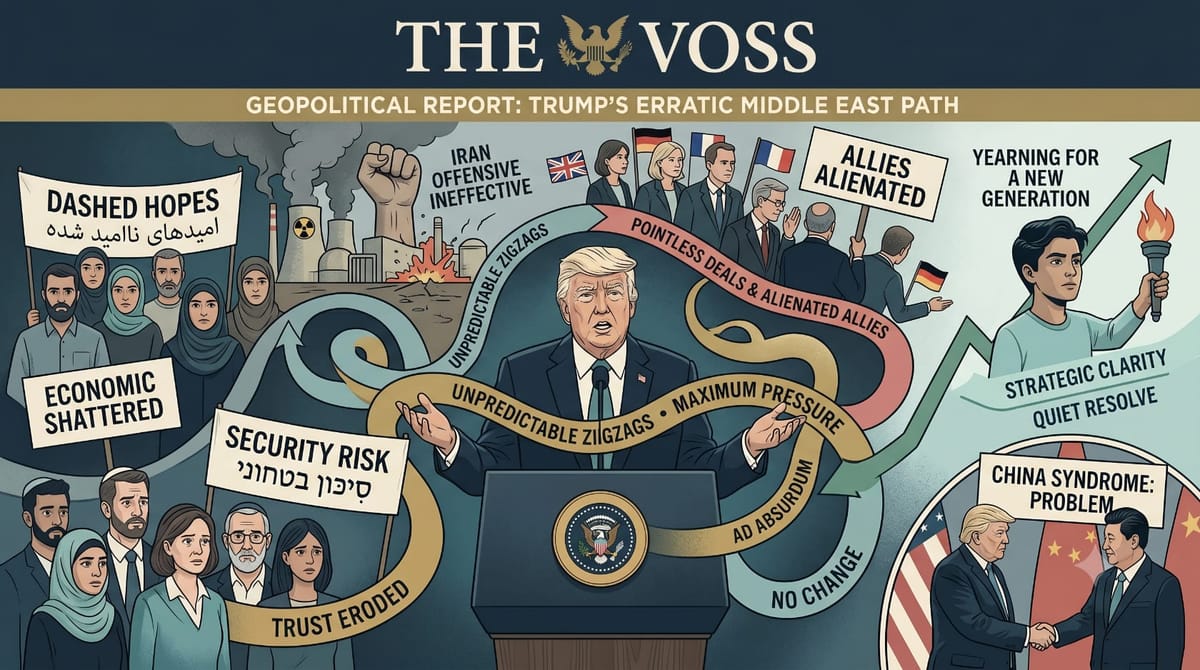
The initial hardness degenerates into a political end in itself because, lacking clear milestones and diplomatic exit strategies, it leads into a vacuum. The offensive against Iran is thus rendered absurd: executing maximum pressure while simultaneously signaling a desperate desire for negotiations at any cost—simply to showcase a quick, media-friendly "deal"—completely debases one's own deterrent. Nothing has fundamentally changed; Iran's nuclear program continues, while the strategic bargaining position of the US has been severely weakened by its own flip-flopping.
Dashed Hopes: A Global Loss of Trust
The consequences of this erratic course are fatal and affect actors across the entire geopolitical spectrum. Foremost among them is the Iranian population. Draconian sanctions have shattered the economic existence of millions of innocent citizens. Many people in Iran, suffering deeply under the repressive regime of the mullahs, initially harbored a quiet hope that a consistent and unyielding line from Washington might lead to a genuine internal transformation, or at least a significant weakening of the apparatus of power.
These hopes have been bitterly disappointed. The American pendulum between threats and negotiation offers did not topple the regime; instead, it weakened the democratic opposition and handed the hardliners in Tehran the perfect narrative to defame any legitimate domestic protest as the work of foreign powers. The suffering of civil society has been prolonged, while the leadership in Tehran has quietly shifted its geopolitical axes toward Beijing and Moscow.
Parallel to this, an equally sobering picture emerges among the supposed beneficiaries of this policy: the Israelis and the global Jewish community. While highly symbolic acts like the relocation of the US embassy to Jerusalem or the brokering of the Abraham Accords were celebrated as historic victories, a closer, long-term examination reveals Washington’s fundamental unpredictability to be an extreme security risk for Israel. An ally that threatens war one day and unexpectedly offers bilateral summits to regional adversaries the next does not provide a reliable security umbrella.
The strategic depth that Israel requires for its long-term survival is undermined by the theatrical spotlight of a volatile US foreign policy. Trust in the transatlantic security promise has suffered profound global damage because of this posturing.
Dogged Stubbornness or Method? The Profile of an Unpredictable Actor
This raises the pressing question of the root causes behind this foreign policy malaise. Political science debates often invoke the "Madman Theory"—the deliberate staging of irrationality to keep adversaries guessing and thereby force maximal concessions. However, in this case, that charitable interpretation falls short. The dynamic has crossed the line from calculated unpredictability into a concerning form of political stubbornness.
What we are witnessing is the psychological profile of a leader who acts with increasing resistance to advice, marginalizes established diplomatic advisory bodies, and makes geopolitical decisions primarily based on gut instinct or patterns of domestic self-staging. This stubbornness is most evident in the fact that strategic errors are never corrected, but rather drowned out by even louder bluster. When a strategy fails—such as Iran’s refusal to capitulate despite economic isolation—the concept is not adjusted; instead, the system lapses into a mode of permanent, contradictory demands. For what, then, were alliances sacrificed and global trust squandered? The result is not substantial change, but the personal indulgence of an erratic exercise of power that keeps the international community on edge without achieving real progress.
The Global Pivot: Alienating Allies and the China Syndrome
The destabilization of the Middle East does not exist in a vacuum. It radiates directly into the entire web of global flows and traditional alliances. By unilaterally tearing up international treaties and moving forward recklessly, the US has deeply alienated its closest European allies. France, Germany, and the UK have been forced into damage-control mode, causing deep fractures within the Western community of values. A fractured West, in turn, is the greatest geopolitical gift to the autocratic challengers of the 21st century.
This malpractice becomes particularly clear when looking at American policy toward China. Trump’s engagements and visits to China demonstrate the exact same pattern as his Middle East policy: a loud trade war and sharp rhetoric, followed by sudden flattery toward Beijing and a desperate attempt to close a superficial, symbolic deal. While the US leaves a power vacuum in the Middle East and alienates its partners, China consistently seizes the opportunity. Beijing is expanding its influence in Iran through long-term investment and energy agreements, positioning itself as a new, rational mediator in the region. Through its erratic course, the US has brought upon itself a geopolitical situation that is highly problematic, isolating, and characterized by waning influence.
The Paralyzing Alternative: The Failure of the Democratic Party
In a functioning democracy, the opposition should act as a corrective force, formulating a clear and consistent counter-strategy. Yet, the tragedy of contemporary American politics is that the Democrats offer no compelling alternative whatsoever. The Democratic Party presents itself as deeply divided on foreign policy, ideologically stagnant, and incapable of developing a coherent vision for global leadership in the 21st century.
Instead of building a bridge between necessary firmness toward autocracies and a return to reliable multilateralism, the Democrats' criticism often exhausts itself in mere anti-Trump rhetoric without offering any strong, actionable concepts of their own. There is a total lack of programmatic clarity. Voters and international partners are merely offered a vague return to the rhetoric of the past, which fails to address altered global realities—specifically the rise of China and Iran's renewed nuclear assertiveness. This conceptual vacuum within the opposition cements the global misery, leaving the American electorate without a genuine foreign policy alternative.
Outlook: The Yearning for a New Generation and Strategic Clarity
At the end of this deep analysis, one realization remains, shared equally by analysts, allies, and affected populations: the current foreign policy leadership of the Western superpower has outlived its strategic and historical relevance. The loud bluster, disguised by its supporters as revolutionary diplomacy, reveals itself upon sober inspection to be the aimless thrashing of an unpredictable system on the verge of self-demolition.
The hope of the global community—and of many Americans themselves—is moving inevitably toward the future. There is a fundamental yearning for a younger generation of politicians to take the helm within democratic structures. The world needs leaders who are no longer trapped in the mindsets of the past century or pure media staging, but who understand the global flows and interconnectedness of the modern world. This new leadership must be defined by strategic clarity, intellectual depth, and genuine, quiet resolve. The Middle East, Israel, and the global security architecture no longer need unpredictable ego trips and meaningless zigzags; they require a predictable, partnership-driven, and, above all, far-sighted strategy that measures true strength not by the volume of its rhetoric, but by the sustainability of its results.