
Redrawing New York: Controversy Erupts Over NYC’s New Immigrant Map
A fierce debate has erupted over New York City’s new official immigrant map. The document completely omits historic communities like Little Italy and the Jewish Quarter, while adding new enclaves. Critics accuse Mayor Zohran Mamdani of using modern identity politics to erase city history.
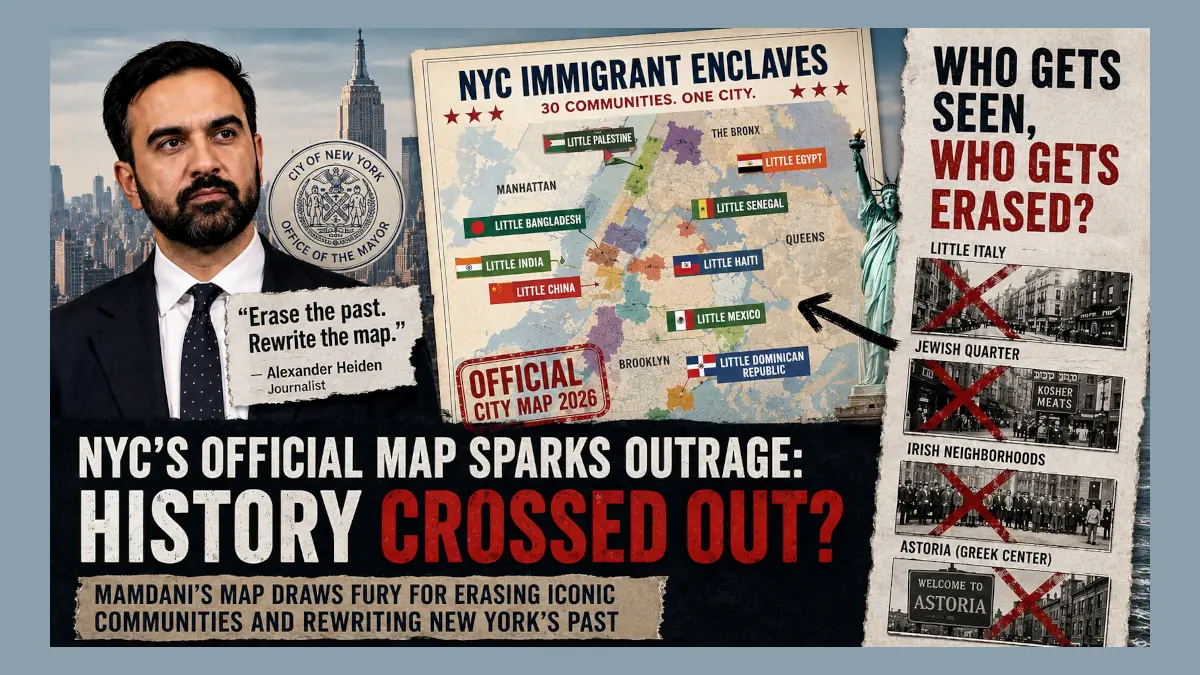
New York City is locked in a fierce debate over identity, history, and representation. The catalyst is a newly released official map from City Hall under Mayor Zohran Mamdani, designed as a tourist guide for the upcoming World Cup. However, the document has sparked intense backlash: historically foundational communities—including Jewish, Italian, and Irish neighborhoods—have been completely omitted, while newly designated enclaves are prominently featured. Critics are calling it a calculated rewriting of the city's history.
The "New York City Immigrant Enclaves" Map: Visibility vs. Erasure
Titled “New York City Immigrant Enclaves,” the new map published by the city administration uses distinct flags and markers to highlight 30 immigrant communities across the boroughs. The stated goal of the initiative is to celebrate the immense diversity of the metropolis for both tourists and locals.
Yet, a closer look reveals that the traditional map of New York’s immigrant history has been radically altered. While new designations such as “Little Palestine,” “Little Egypt,” and “Little Senegal” have appeared, world-famous historic neighborhoods were simply left off the canvas.
Historic Neighborhoods Missing from the Official Map:
- Little Italy: The globally recognized symbol of Italian immigration in Lower Manhattan.
- The Jewish Quarter: Historically one of the most significant centers of Jewish life, culture, and resilience in the world.
- Irish Neighborhoods: Foundational communities that built the city's infrastructure over generations.
- Astoria (Queens): For decades, the undisputed heart of the Greek-American community.
"Identity Politics with an Eraser": Sharp Criticism for Mayor Mamdani
In a scathing op-ed, journalist Alexander Heiden condemned the administration’s cartographic choices. He accuses the left-wing mayor, Zohran Mamdani, of pushing a biased ideological agenda at the expense of historical truth.
"It is obvious why someone like this would gladly erase Jews from the city map. [...] It was Mamdani’s team that turned these into a citywide map—and inserted entirely new 'neighborhoods' in the process."
— Alexander Heiden, Journalist
Mayor Mamdani defended the map, claiming the designs were based on preliminary work inherited from his predecessor. However, investigative reports reveal that the previous administration had only created disconnected illustrations for a one-time cultural week. Under the current leadership, these elements were synthesized into an official, authoritative city map—and, according to critics, selectively filtered.
Culture War and the Exclusion of "Established" Groups
The debate strikes at the very heart of the modern American culture war. Critics argue the map demonstrates how rigid identity politics can distort historical realities. Groups currently classified as "established" or "privileged" are being erased from official recognition—completely ignoring their own histories of poverty, struggle, and severe discrimination upon arrival.
- Forgotten Struggles: Italian, Irish, and Eastern European Jewish immigrants arrived under brutal conditions, facing systemic xenophobia and religious marginalization.
- Fractured Alliances: In 20th-century New York, deep alliances existed between Black civil rights activists and Jewish community leaders fighting for shared recognition. This interconnected history is rendered invisible by selective cartography.
"This targets the old, historically successful immigrant communities that no longer fit the victim narrative of today's identity politics. [...] The fact that they arrived destitute, faced massive discrimination, and built New York with blood, sweat, and tears—all of it is wiped away with a single stroke of a pen."
— Alexander Heiden
Conclusion: History Cannot Be Erased
The controversy surrounding the “Immigrant Enclaves” map proves that urban heritage remains a deeply sensitive battleground. A city map is far more than a geographical aid; it is an official declaration of who belongs and who is remembered.
While City Hall may attempt to redefine New York’s demographic landscape by administrative decree, the metropolis remains what it has always been: a massive, defiant, and deeply rooted melting pot. New York's rich Jewish, Italian, Irish, and Greek histories are woven into the very concrete of the city—and no eraser can change that.
Sources and Further Reading:
- Official New York City Administration publications on the “NYC Immigrant Enclaves” initiative (2026).