Why America in 2026 is Facing its Constantinople Moment
The Byzantine Mirror
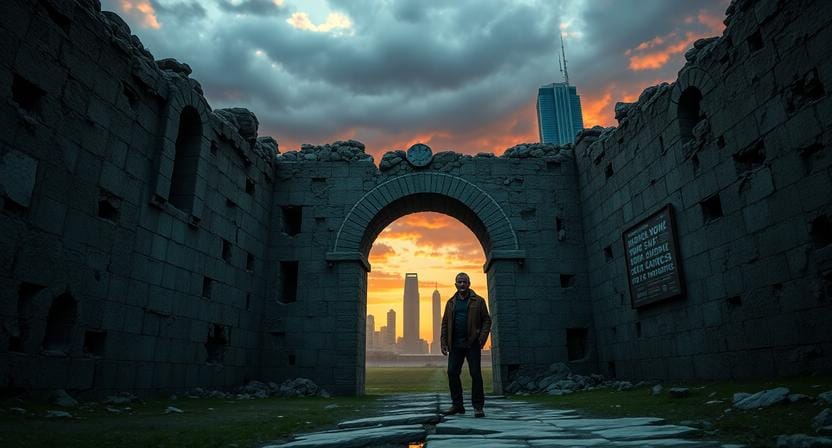
March 15, 2026: A civilization rarely falls to the strength of its enemies; it collapses when the spirit inside the walls turns to envy and ideological rot. As the sun sets on the American century, the mirror of Byzantium reveals a chilling truth: the greatest threat to the Republic isn't at the gates—it's already
On a spring morning in 1453, the sun rose over the most sophisticated fortifications the world had ever known. The Theodosian Walls of Constantinople had stood for over a thousand years, rebuffing Huns, Avars, and Persians. They were more than stone and mortar; they were the physical manifestation of an empire that believed it was eternal. But as the Ottoman cannons began their rhythmic thunder, the tragedy wasn’t in the strength of the walls. It was in the hollowed-out spirit of the people standing behind them.
Inside the city, the atmosphere was toxic. Decades of internal strife had replaced civic duty with a corrosive, tribal resentment. In the markets, men didn’t talk about the encroaching threat of Mehmet II. They argued bitterly over theological purity—the 15th-century equivalent of our modern “Influence Wars.” The common man, once the backbone of the Byzantine middle class, looked at the glittering villas of the Dynatoi—the landed elite—not with the hope of joining their ranks, but with a burning desire to see them liquidated.
What happened on the shores of the Bosphorus isn’t just a lesson for dusty textbooks. It is the precise, high-definition blueprint for the United States in March 2026. While many analysts point to the collapse of Western Rome, they miss the mark. West Rome fell to external shocks. Byzantium died of a slow, internal rot—a cancer of the soul that mirrors the American condition today.
The Death of Aspiration: From “The Dream” to the Cult of Envy
The American experiment was never fueled by a shared ethnicity or a single religion; it was fueled by a unique psychological engine: Aspiration.
In my own life, I remember the era when a man could sit on a beach, point to a grand villa on the horizon, and tell his son, “If you work hard and play by the rules, you can own that house.” There was no malice in his voice, only the fire of the possible. This wasn’t greed; it was the belief in a fair system where merit was the primary currency.
Today, that engine has seized. In 2026, the gaze has shifted from the horizon to the neighbor’s pocket. When the modern American looks at that same villa, the question isn’t “How do I get there?” but “Why does he have that, and why hasn’t the government taken it from him yet?”
This is the Byzantine Trap. In the empire’s twilight, the Dynatoi leveraged their political connections to exempt themselves from the burdens of the state, while the middle class was hollowed out by taxation and inflation. When the ladder of upward mobility is kicked away, aspiration curdles into envy. Envy is the most potent solvent of a republic. It turns neighbors into combatants and citizens into “the oppressed,” seeking a socialist savior to level the playing field by force. We have replaced the “Self-Made Man” with the “Permanently Aggrieved,” a demographic shift that signals the end of imperial vitality.
The Influence War: Ideology as a Trojan Horse
Byzantium was a society obsessed with “Correct Thinking.” The Iconoclast Wars weren’t just about religious art; they were a battle for the total control of the narrative. It was an era where the state’s survival was secondary to the enforcement of dogma.
In 2026, we see the same fracturing. We are caught between two millstones: a radical, secularized socialism that seeks to deconstruct the foundations of the West, and a rising, aggressive Islamism.
Let’s be direct, because the stakes are too high for polite euphemisms: The West continues to treat Islam as “just another religion,” a private matter of faith. But historical Byzantium knew better. They understood that the forces at the helm—those who “determine” the direction of the movement—view it as a total political and legal ideology. It is a system that does not seek a seat at the pluralistic table; it seeks to replace the table entirely.
Just as the Byzantine elites were paralyzed by theological hair-splitting while the Ottomans were literally measuring the height of their walls, our modern leadership is obsessed with “inclusive” rhetoric while an illiberal, anti-Western ideology takes root in our institutions. This is not the Islam of the individual seeking God; it is the Islam of the ideology seeking the State. We are witnessing an “Islamization” not of the person, but of the power structure—a strategic displacement of Western values by those who realize that a society that stands for everything actually stands for nothing.
The Economic Mirage: Gold, Copper, and the Trillion-Dollar Interest
Byzantium’s strength was anchored by the Solidus, the “Bezant.” It was the global reserve currency for centuries because it was honest money. But as the bureaucracy grew bloated and the wars became endless, the Emperors began “debasement.” They mixed gold with copper. They lied about the value of their currency to pay for their excesses.
In 2026, the U.S. Federal Reserve is the modern mint of Constantinople. With a national debt that feels like a countdown clock to a supernova and interest payments now eclipsing the entire defense budget, we are living in a hall of mirrors. Inflation is the “Hidden Tax” of the Byzantine era. It punishes the saver, enriches the connected Dynatoi of Wall Street, and fuels the very envy that is tearing the social fabric apart. When money dies, the truth isn’t far behind. We are financing our own funeral, and the bill is coming due in a currency that no longer commands respect.
Global Flows and the End of Deterrence
The Eastern Empire survived as long as it did because it mastered “Global Flows”—trade, diplomacy, and the “Greek Fire” of technological superiority. But eventually, they made the fatal mistake of outsourcing their security to mercenaries and allowing their borders to become porous to ideologies that were fundamentally hostile to the Roman state.
Today, the U.S. faces a crisis of sovereignty. It isn’t just about physical borders; it’s about the border of the mind. When a civilization no longer believes its own story, it stops defending its gates. We see “No-Go-Areas” in European capitals and the slow erosion of the rule of law in American cities—parallels to the late-Byzantine “quarters” where the Emperor’s law stopped at the gatehouse. The dominance of the “influence war” means that our adversaries no longer need to storm the gates; they simply need to wait for us to unlock them from the inside.
The Verdict: 1453 or 2026?
The walls of Constantinople didn’t fail because the stone was weak. They failed because the spirit of the people inside was gone. On the final night, the last Emperor, Constantine XI, stood not as a god-king, but as a man who realized that his people had already surrendered their identity to the “inevitable.”
America is not there yet, but the shadows are lengthening. We are currently losing the Influence War because we are afraid to name the threats—be it the soul-crushing envy of neo-socialism or the civilizational challenge of political Islam. We have the data, we have the history, and we have the tools. What we lack is the collective will to prioritize our own survival over the comfort of our delusions.
If we want to “beat” the narratives of decline, we must reclaim the beach. We must return to a society where the villa on the hill is a lighthouse of what can be achieved through merit, not a target for the taxman. We must recognize that the West is a unique, precious, and fragile inheritance that requires more than just “tolerance” to survive—it requires the courage to be defended.
The mirror of Byzantium is clear. The question is: do we have the clarity to look away before the gates are unbolted from the inside?
Thanks for reading Defending Liberty Daily! This post is public so feel free to share it.
#CivilizationalCollapse, #NationalDecline, #CulturalMarxism, #PoliticalIslam, #InflationCrisis, #WealthEnvy, #Geopolitics, #GreatReset, #WesternValues, #HistoricalParallels, #Constantinople, #USPolitics, #Substack, #LongReads, #Sovereignty, #IdentityPolitics