Why Europe's Richest Nation Always Thinks It's About to Collapse
Germany is Europe's largest economy, yet millions believe the country is falling apart. From Hamburg's legendary complainers to the phenomenon of "German Angst," discover why pessimism has become part of Germany's national identity—and why Americans often misunderstand it.

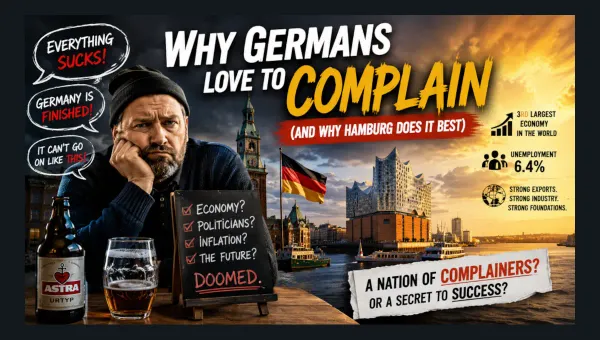
The Art of the 'Miesepeter': Why Germans Love to Complain (And Why Hamburg Does It Best)
A birthday party in a cozy tavern just outside of Hamburg. The local Astra beer is flowing, and the mood is technically festive. Yet, a local craftsman is holding court, explaining to anyone who will listen why Germany is fundamentally doomed. He cites the recession, inflation, the struggling automotive sector, and the rise of geopolitical tension. "It can’t go on like this," he sighs, embodying a decade of support for the right-wing AfD.
When asked if his own business or quality of life has actually deteriorated over the last fifteen years, he looks genuinely baffled. "No, why would it? My business is booming, and my family is doing great."
This is the central paradox of modern Germany. Statistically, the country remains Europe’s economic powerhouse and the third-largest economy in the world. Unemployment, while at a post-2020 high of 6.4%, is far from apocalyptic. Yet, the national mood suggests the country is standing on the precipice of ruin.
The Merz Melancholy and the AfD Record
Of course, the current political landscape feeds right into this collective anxiety. Approval ratings for the federal government have plummeted to a historic low of 13% in May 2026, down from an already bleak 40% a year prior. Chancellor Friedrich Merz has managed to secure the title of the most unpopular chancellor since modern polling began. Sensing the vacuum of optimism, the far-right AfD recently surged to a record 28% nationwide—leaving Merz’s unloved CDU four points behind.
But to blame the current government for the lack of good cheer would be missing a deeper cultural truth. Germans have never been known for their joie de vivre.
Look no further than their football heritage. Germany has won four World Cups, but they rarely looked like they enjoyed the journey. Oliver Kahn, one of the greatest goalkeepers in history, is celebrated not for a triumphant smile, but for his legendary, red-faced furious rants. No samba, no flair—just grim efficiency and discipline. Le panzer, as the French call them.
Today, Kahn is an internet icon among Gen Z, his angry outbursts gaining hundreds of thousands of views on TikTok. He shares this digital pantheon with the literary giant Thomas Mann, whose depressing, meticulous diary entries are shared as viral memes on X (formerly Twitter). "Rootless and daily exasperated after three hours of work," Mann wrote in 1921. "Breakfast in bed offered little advantage, is uncomfortable and shall not be repeated," he noted in 1937.
Nietzsche, Kafka, Schopenhauer, Brecht—the German pantheon of thinkers consists almost entirely of doubters, cynics, and professional brooding minds. And they are celebrated precisely for it.
'German Angst' and the Prussian Ghost
This psychological phenomenon is so unique that the English language adopted a specific term for it: German Angst. For over thirty years, annual studies have tracked the specific fears of the German populace. Whether it was the Iraq War in 2003, the Euro crisis in 2012, the refugee crisis of 2015, or skyrocketing inflation in 2023—Germans will always find a reason to shiver. By early 2025, a third of the country feared the literal collapse of society.
Psychologists often trace this collective undercurrent back to the Prussian heritage: a deep-seated belief in state authority combined with a lack of individual optimism. In the German subconscious, there is a constant craving for state protection, leading to an inevitable cycle of high expectations, government disappointment, and renewed anxiety.
But unlike the post-war Wirtschaftswunder (economic miracle) era, where complaining was done with the implicit belief that things would ultimately get better for the next generation, today’s pessimism feels stagnant. Social mobility has slowed. The slow, grinding decline of German industrial productivity and the structural crisis of its beloved car industry are realities hitting home. The tree still bears fruit, but the trunk is visibly crooked.
Hamburg: The Epicenter of Elb-Melancholy
If you want to experience this mindset in its purest, most distilled form, you must leave the sunny valleys of the South and head north to Hamburg.
While Berlin yells and Munich boasts, Hamburg nörgelts (complains) with an unparalleled, stoic elegance. The hanseatic Miesepeter is a distinct breed. Blessed with a beautiful harbor, magnificent architecture, and immense wealth, the typical Hamburger will still find a way to ruin a perfectly sunny day by reminding you that "it’s bound to rain tomorrow anyway."
In Hamburg, complaining isn’t a sign of misery; it’s a form of high-level social bonding. To praise something too enthusiastically is considered unrefined, almost suspicious. A Hamburg resident doesn't say "This is fantastic." They say, "We can't complain"—which, in their linguistic economy, is the highest form of flattery.
Perhaps that is why figures like Kahn and Mann remain so deeply revered by a younger generation looking for anchors in a volatile world. They didn't smile, they didn't have fun, and they certainly didn't pretend everything was fine. But under that thick layer of complaints, they were exceptionally good at what they did.
When a reporter asked Oliver Kahn in 2002 if he lacked self-confidence after a tough loss, Kahn looked at him with utter disdain and replied: "Me? Why?"
That, ultimately, is the German secret. They will tell you the world is ending, but they will still show up on Monday morning, perfectly on time, to make sure the collapse is handled efficiently.
Written by
Read next
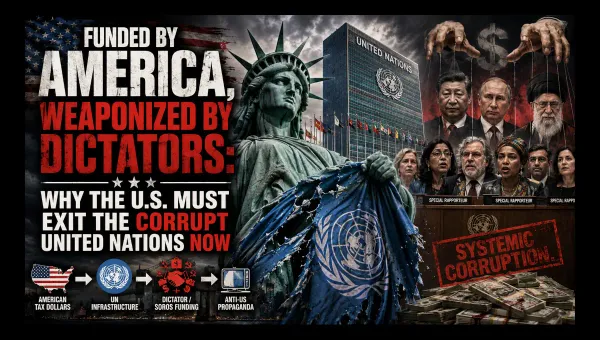
Time for AmExit: Why the U.S. Must Leave the Corrupt UN
The UN is broken. A devastating 100-page report by UN Watch reveals that UN experts are acting as highly paid propaganda agents for brutal dictatorships and radical Marxist groups. Funded by America but controlled by Beijing, it’s time for the United States to execute a total AmExit.Epstein's Death: Systemic Failure or Elitist Conspiracy?
The death of Jeffrey Epstein remains a severe stress test for public trust in the U.S. justice system. When personal, technical, and bureaucratic failures align with surgical precision to serve the interests of the global elite, the word "coincidence" loses all mathematical legitimacy.
The Price of Cowardice
How the West Funds Its Own Enemies and the Strategic Path to Decoupling The Hook:
The Great Amnesia: Why We Ignored the Pandemic’s Final Warning
The Architecture of Self-Inflicted Dependency
A Torrent of Evidence in a Darkening World
In Imported Hate, Alvan Bovay demonstrates how global antisemitism was unleashed following October 7, 2023. Through evidence on UNRWA, the Red-Green Alliance, and digital influence warfare, this book review analyzes the systemic failure of Western leadership and offers a roadmap for freedom.
The Unstoppable Fracture: Is the Democratic Party Splitting?
The Michigan primary between Haley Stevens and Abdul El-Sayed exposes a fatal divide. Why analysts predict a formal split in the Democratic Party that will change America forever.
TikTok’s Double Standard: ‘Israel Will Live’ Removed
TikTok removed TaktGEFLECHT’s song “Israel Will Live,” released through Die Vossische. At the same time, Salafist influencers and radical channels reach millions of viewers. The article examines whether the platform applies unequal standards when moderating political and religious content.