
AI Saves Us Hours. So Why Does Work Feel More Exhausting?
AI is already saving American workers measurable amounts of time. Yet many employees feel more anxious, not more liberated. The real workplace revolution may depend on one overlooked question: when technology saves an hour of human labor, who actually gets to keep that hour?
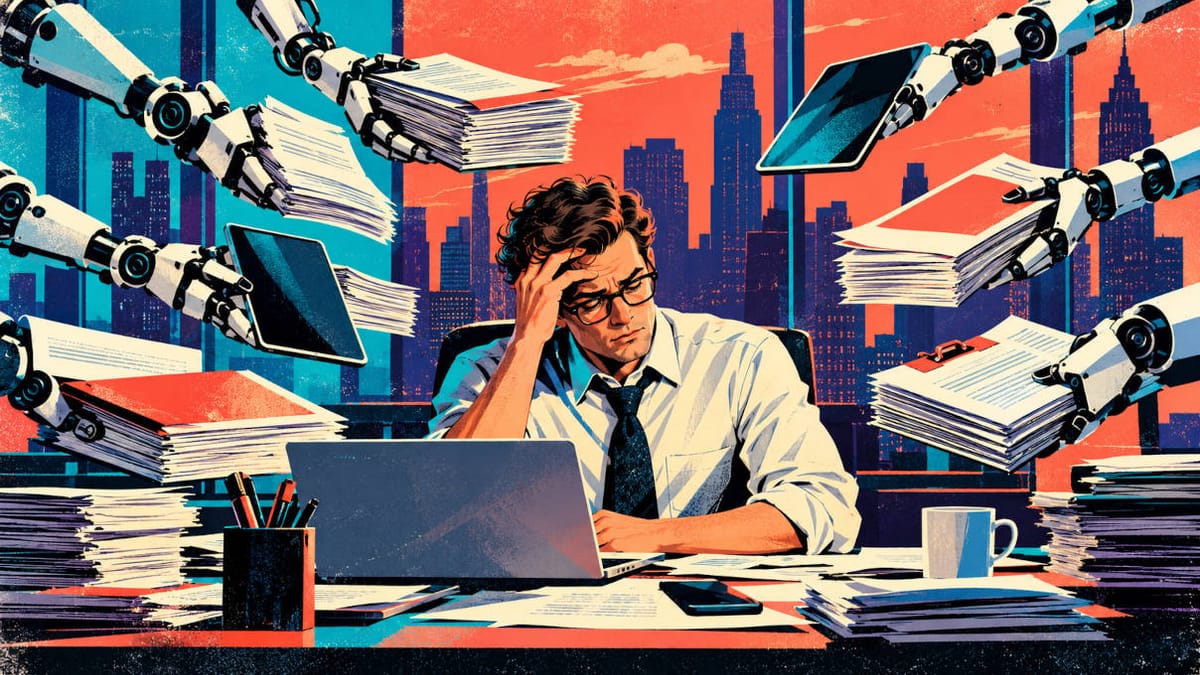
Artificial intelligence is already saving American workers measurable time. The uncomfortable question is what happens to those saved hours once employers discover them.
For years, the promise of technology was wonderfully simple.
The machine would do more. We would do less.
Computers would remove paperwork. Email would eliminate waiting. Smartphones would eliminate distance. Artificial intelligence would take the repetitive, boring and mechanical parts of office work and give human beings something increasingly precious in return:
time.
That future has begun to arrive.
The U.S. Census Bureau reported in August that about 56 percent of American workers had used AI for at least one work activity. Among people who had used it during the previous week, 31 percent estimated that AI had saved them between one and two hours; another 30 percent said it had saved three hours or more.
That sounds like the productivity revolution we were promised.
So why doesn't work feel easier?
The missing hours
The problem may be hidden inside the word productivity.
When a worker finishes a two-hour task in twenty minutes, there are two possible outcomes.
The first is the future technology companies implicitly sell us.
The worker has gained one hour and forty minutes.
The second is the future modern organizations are considerably more likely to choose.
The worker receives another task.
This distinction matters because technology has done this before.
Email did not give us fewer letters.
It gave us hundreds of emails.
The smartphone did not free us from the office.
It put the office in our pocket.
Videoconferencing did not eliminate meetings.
It made it possible to schedule them without anybody leaving a chair.
Artificial intelligence may now be repeating the same pattern on a far larger scale.
We aren't necessarily automating work.
We may simply be accelerating it.
The better AI gets, the higher the expectation
Imagine a marketing employee who once produced three campaign concepts in an afternoon.
AI allows her to produce ten.
For a brief moment, she appears extraordinarily productive.
Then ten becomes the expectation.
Next quarter, someone asks why she cannot produce twenty.
Yesterday's technological miracle has become tomorrow's performance baseline.
This is the quiet mechanism through which efficiency stops feeling like freedom.
The technology succeeds.
The worker does not receive the dividend.
The organization does.
Gallup's recent research adds another complication. Workers who use AI frequently are more than twice as likely to fear that their jobs could disappear within five years as people who use it only occasionally. Gallup also found links between AI-related job anxiety and lower job satisfaction, weaker engagement and higher burnout.
That produces an extraordinary workplace psychology.
Employees are encouraged to use the tool that makes them more productive while simultaneously wondering whether demonstrating that productivity is helping prove they are replaceable.
AI doesn't remove decisions
There is another misconception buried inside the automation story.
AI may remove typing.
It does not necessarily remove thinking.
Someone still has to decide what the machine should do.
Someone has to formulate the request.
Someone has to read the result.
Someone has to catch the fabricated citation.
Someone has to notice that the supposedly polished paragraph says almost nothing.
Someone has to choose between five headlines, three strategies and four versions of the same presentation.
The physical task gets shorter.
The decision environment gets larger.
That distinction is important because human beings are not exhausted merely by moving their fingers across keyboards.
We are exhausted by attention.
By interruption.
By deciding.
By being available.
By the strange modern sensation that every completed task immediately produces three more.
AI can reduce production time while increasing cognitive traffic.
An old mistake in a new machine
We have spent decades treating technological efficiency as though it automatically produced human benefit.
History suggests otherwise.
Factories became more efficient long before working hours became humane.
Computers became faster while corporate communication multiplied.
The internet reduced the cost of information while dramatically increasing the amount of information people were expected to process.
Technology changes what is possible.
Institutions decide who benefits.
That is the political economy hiding inside what often gets presented as a software story.
The important question is therefore not:
How much time can AI save?
We already know it can save time.
The better question is:
Who owns the time it saves?
The productivity trap
There is an obvious danger in raising this question.
It can sound anti-technology.
It isn't.
AI is genuinely useful.
It can eliminate miserable administrative work, accelerate research, help small businesses perform tasks they previously could not afford and give individuals capabilities that once required entire departments.
The problem isn't the machine.
The problem is the assumption that every efficiency gain must immediately be converted into more output.
A society could make a different decision.
If AI allows the same amount of work to be completed in six hours rather than eight, perhaps six hours should occasionally be enough.
That suggestion sounds almost radical in 2026.
Which tells us something.
The most important AI question
Watch almost any demonstration of generative AI and eventually someone will say:
“This used to take two hours. Now it takes ten minutes.”
Everyone applauds.
They should.
It is impressive.
But almost nobody asks what happens to the remaining one hour and fifty minutes.
That missing question may determine whether the AI revolution eventually feels liberating or exhausting.
If every saved minute simply becomes available for another task, artificial intelligence will still succeed.
Companies will become more productive.
Output will rise.
More work will happen faster.
But the great technological promise will have quietly changed.
The machine will indeed save us time.
We just won't be allowed to keep it.