The Democratic Party’s Uneasy Coalition Is Showing Its Fault Lines
Democrats enter the midterms with electoral opportunity but unresolved disputes over ideology, economics, Gaza, crime and political strategy. The coalition remains intact—but its internal fault lines are becoming increasingly visible.
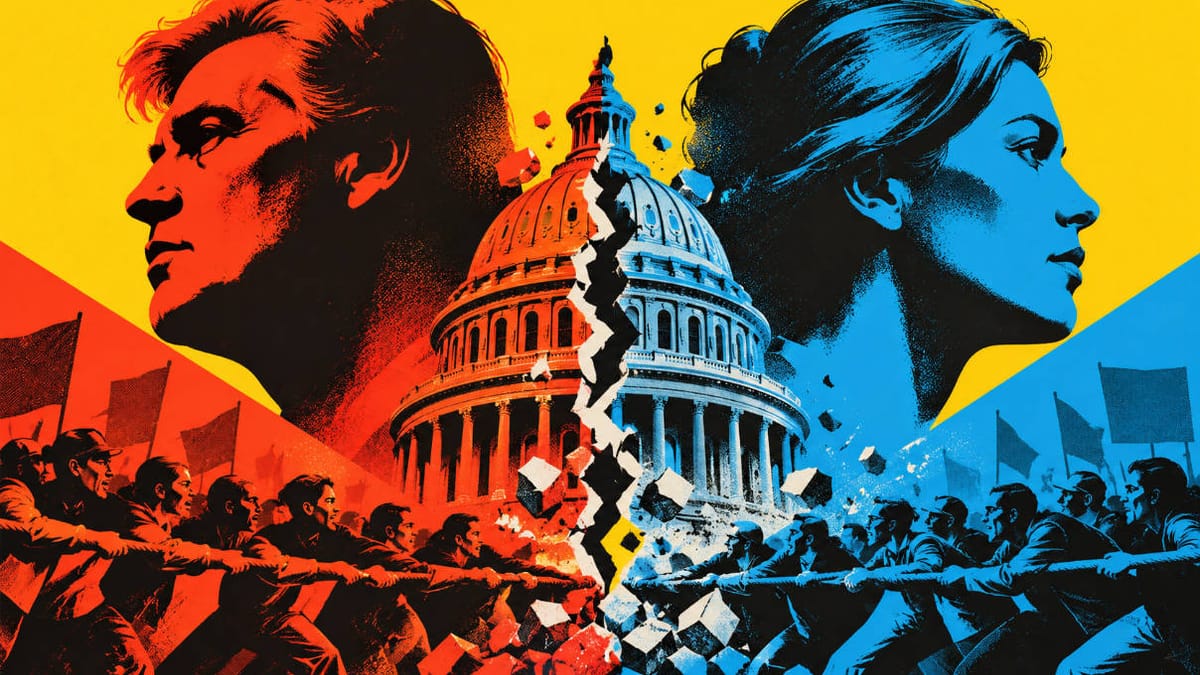
Democrats head toward the 2026 midterms with electoral opportunity—but also with unresolved arguments over ideology, economics, Gaza, crime and what kind of party they want to become.
The Democratic Party is approaching November with a paradox.
On the electoral map, Democrats have reasons for confidence. Inside the party, however, the argument over what Democrats are supposed to represent has hardly been settled.
The dispute is sometimes described as another round in the familiar battle between progressives and moderates. That description is no longer sufficient. The divisions now cut across ideology, geography, generation and political strategy.
Candidates running in Republican-leaning states are deliberately distancing themselves from parts of the national Democratic brand. Progressive activists want a sharper ideological break with the party's establishment. Other Democrats are less interested in either camp than in finding candidates who appear capable of producing tangible economic results.
The coalition still exists. The question is what continues to hold it together.
The Red-State Democrats Are Running Their Own Campaign
Perhaps the clearest evidence comes from Democrats competing in places Donald Trump carried.
Associated Press reporting this month found Democratic candidates in North Carolina, Alaska, Kansas and Iowa emphasizing moderation, bipartisan credentials and independence from the national party. North Carolina Senate candidate Roy Cooper has stressed his willingness to work across party lines and his opposition to "defund the police." Alaska's Mary Peltola has supported stronger border security and resource development, including the Willow oil project.
That is not merely a difference in campaign vocabulary.
It reflects a political calculation that the Democratic label means different things in different parts of the country—and that candidates in competitive or conservative territory cannot necessarily campaign on the cultural and ideological positions associated with the party's progressive wing.
Republicans are trying to erase that distinction by tying Democratic candidates to the party's most progressive figures and policies. Democrats in difficult states are doing the opposite: presenting themselves as local candidates first and national Democrats second.
That tension becomes more significant if Democrats gain congressional seats in November. A larger caucus assembled from very different constituencies would contain members elected on substantially different mandates.
Democratic Voters Are Divided Too
The divide is not limited to politicians.
Pew's 2026 political typology, based on a survey of more than 10,000 Americans, identified four distinct Democratic-leaning groups rather than a single coherent ideological bloc.
Those groups differ notably on crime, attitudes toward democratic socialism, gender issues, business and the role of government. One Democratic-leaning group described by Pew is substantially more socially moderate and more supportive of the military and police than the party's progressive wing. Another is younger, more progressive and considerably less satisfied with the Democratic Party itself.
This helps explain something that otherwise appears contradictory.
Democratic voters may vote for the same candidates in November while disagreeing profoundly about what those candidates should do once elected.
A party can survive that contradiction for a long time when the overriding objective is defeating the opposing party. Governing is harder.
The Primary Voters Sent a Different Message
The 2026 Democratic primaries have complicated the picture further.
Several contests showed voters rejecting candidates closely associated with the existing party establishment. Progressive candidates scored important victories, including in Senate primaries in Michigan and Minnesota. Yet the same primary season did not produce a straightforward nationwide progressive sweep.
Associated Press reporting described the common denominator less as ideological movement to the left than as dissatisfaction with the status quo. Democratic voters frequently appeared to be demanding change without agreeing on precisely what that change should mean.
That distinction matters.
An electorate rejecting establishment candidates is not automatically endorsing every component of the progressive platform.
Anti-establishment politics can move left, right or simply away from existing institutions.
And that appears increasingly relevant inside both American parties.
Congress Has Already Provided a Preview
The ideological dispute is not theoretical.
Earlier this month, Democratic Representatives Jared Golden of Maine and Marie Gluesenkamp Perez of Washington sided with Republicans on a procedural vote that allowed legislation to reach the House floor.
The decision generated anger within the Democratic caucus and demands from some liberals for consequences. Democratic leadership called the episode a significant breach of trust.
The dispute illustrated the structural problem facing the party.
Golden and Gluesenkamp Perez represent constituencies where political independence can be an electoral asset. Progressive members represent districts where confrontation with Republicans—and sometimes with Democratic leadership itself—can be rewarded.
Both types of politician can legitimately claim to be responding to their voters.
A national party must accommodate both.
That becomes considerably more difficult when congressional margins are narrow and individual members possess greater leverage.
Economics May Be the Temporary Glue
There is one issue around which Democrats are trying to construct a more unified message: affordability.
Health-care costs, housing, groceries, energy and household finances have become central themes heading into the midterms.
Democrats are developing a health-care agenda centered on affordability, although disagreements remain over how far government involvement should extend. Proposals under discussion reportedly include lowering the Medicare eligibility age, expanding Medicare benefits and creating additional government-run insurance options. Different Democratic factions are already competing over which policies should take priority.
The political logic is obvious.
Economic pressure crosses ideological categories.
A voter worried about a health-insurance premium does not necessarily need to identify as progressive, centrist or democratic socialist to support measures intended to reduce it.
The same applies to food prices, rent and wages.
Democrats therefore have an incentive to make material economics the bridge connecting otherwise disparate groups.
Whether they can agree on the remedies is another question.
Gaza Has Opened Another Fault Line
Foreign policy, particularly Israel and Gaza, remains another source of internal strain.
The divide is visible not only in Washington but in local Democratic politics.
The current Los Angeles mayoral contest between Karen Bass and Nithya Raman has highlighted significant differences within the Democratic coalition over Gaza, Israel and the broader direction of the party's left flank. Raman has support from the Democratic Socialists of America, while Bass represents a more established Democratic tradition.
The argument reaches beyond foreign policy.
For different Democratic constituencies, the issue intersects with questions of antisemitism, Palestinian rights, campus activism, protest politics and the limits of ideological coalition-building.
These are not disagreements easily resolved by changing a campaign slogan.
And 2028 Has Already Begun
There is another complication: the next presidential campaign is effectively beginning before the midterm campaign has ended.
Potential Democratic contenders are already raising their national profiles.
Kamala Harris, Pete Buttigieg, Alexandria Ocasio-Cortez, Gavin Newsom, Ro Khanna and others have taken steps commonly associated with preparing for a presidential campaign—travel, fundraising, endorsements, speeches, books and appearances in early-primary states—although most have not formally declared presidential candidacies.
That emerging contest will inevitably reopen the argument Democrats never fully resolved after 2024:
Should the party move toward economic populism?
Toward the political center?
Toward a younger progressive generation?
Toward institutional liberalism?
Or toward something that does not fit neatly into any of those categories?
Different prospective candidates will offer different answers.
Division Does Not Necessarily Mean Collapse
There is a temptation in political journalism to interpret every intraparty disagreement as evidence of imminent rupture.
The evidence does not justify that conclusion.
Democratic voters can be dissatisfied with the party while remaining highly motivated to vote for Democratic candidates. A September Washington Post report found substantial frustration among Democratic voters but also strong stated intention to participate in the midterms.
The electoral coalition therefore remains capable of functioning even when the ideological coalition is unsettled.
Indeed, large political parties have always contained contradictions. Franklin Roosevelt's Democratic coalition, Ronald Reagan's Republican coalition and Barack Obama's electoral coalition all combined constituencies whose interests were not perfectly aligned.
The relevant question is not whether disagreements exist.
It is whether a party can manage them without forcing every faction to pretend that they do not.
The Test Comes After November
For the moment, opposition to Republicans provides Democrats with a powerful common incentive.
November may reveal how effective that is electorally.
The more consequential test could come afterward.
If Democrats gain congressional power, disputes currently conducted through campaign rhetoric will become disputes over legislation, committee assignments, spending, immigration, health care, policing, Israel and the authority of party leadership.
Winning elections can temporarily conceal ideological contradictions.
Governing exposes them.
The Democratic Party is therefore not best understood as a party necessarily breaking apart. It is a coalition whose component parts are becoming easier to see.
Moderates want room to survive in conservative and competitive states. Progressives want structural change. Institutional Democrats want a coalition broad enough to govern. Younger voters are demanding generational turnover. Working-class voters remain intensely focused on prices and economic security.
All of them may vote under the same party label in November.
What they expect that label to mean remains an open question.