New York’s New “It Couple” and the Abyss Behind the Smile
The "It Couple," Radical Ideology, and the Trojan Horse of Aesthetics: How Zohran Mamdani and Rama Duwaji are Redefining New York’s Political Future.
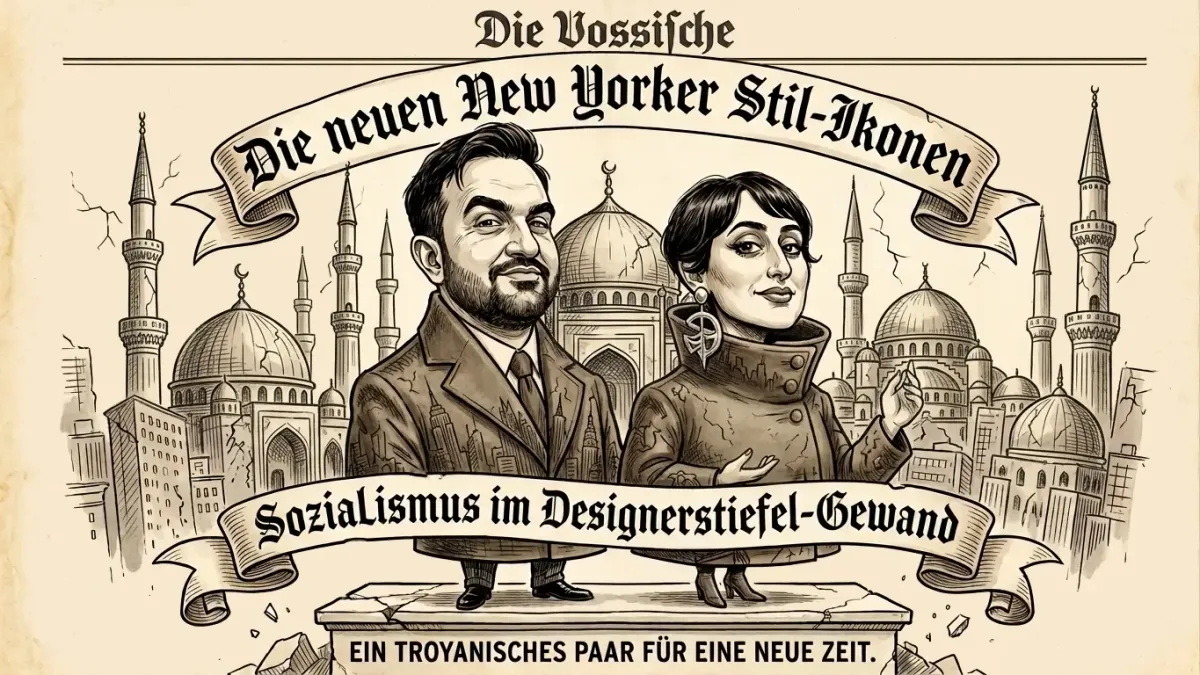
The morning on the Lexington Avenue Line is exactly as you know it from the movies. The light is sallow; the air smells of metal and stale coffee. Amidst this urban apathy stands Zohran Mamdani. He wears a perfectly tailored blazer that strikes the exact balance between “working class” and “Upper East Side.” He laughs. It is a smile that wins elections—radiant, empathetic, disarming. In his hand, a caffè latte, as if he were on his way to pitch an eco-friendly start-up rather than leading a metropolis of eight million.
Beside him, often only an Instagram post away, is Rama Duwaji. The press celebrates her as the “It-girl of the hour.” She wears designer boots that set trends on the streets of Brooklyn and gazes into Vogue’s cameras with a blend of intellectual rigor and feminine elegance. Together, they are the ultimate power couple of the “new” New York: young, diverse, chic.
But while glossy magazines swoon and liberal journalists outdo each other with adjectives like “fresh” and “inspiring,” a political construct is growing behind the facade of street style and social justice—one that threatens everything Western, liberal civility stands for.
The Trojan Horse in Designer Clothing
One must look closely to find the cracks in the smooth plaster of this production. It is in the moments when the smartphone becomes a weapon. While Mamdani plays the man-of-the-people savior in subway cars, a completely different communication takes place in the digital channels of his wife and inner circle.
It’s not about rent or public transport. It’s about the ideological underpinning of a movement that has donned the cloak of socialism to carry a deep-seated, religiously motivated radicalism and overt antisemitism into the heart of Western power.
- The Facts Behind the Glamour: While New York debates Rama Duwaji’s boots, her digital footprints testify to a chilling lack of empathy for the victims of October 7th. “Likes” for posts that dismiss atrocities as fiction; approval for slogans calling for the end of the State of Israel.
- Strategic Charm: Mamdani is no political accident. He is the result of years of precise image-making. He utilizes the codes of Western progressivism—diversity, inclusion, climate protection—to legitimize an agenda that, upon closer inspection, sacrifices individual freedom and the security of the Jewish community.
We are not witnessing a new chapter of the American Dream. We are witnessing the perfect camouflage. This couple is the Trojan horse of an ideology that uses liberalism to hollow it out from within. It is time to look behind the filters of the Vogue photographers.
The Digital Trail of Coldness – When “Likes” Become Weapons
There is an old journalistic wisdom: if you want to know who someone truly is, don’t look at what they say in the spotlight, but at what they quietly approve of. In the case of Rama Duwaji, the wife of the New York Mayor, that “silence” is a click on the heart symbol on Instagram and X. But these clicks have the force of a political manifesto.
While Zohran Mamdani lectures on talk shows about affordable housing, his wife left a digital trail in the dark hours after October 7, 2023, that should shatter any liberal citizen. It is the trail of a woman who does not merely sympathize with suffering but legitimizes annihilation.
The Anatomy of Denial
Our research in the archives of her interactions paints a picture that the New York glossy press studiously ignores. While the world was still processing the images of burning kibbutzim and the desecrated bodies from the Supernova Festival, Rama Duwaji signaled approval under posts celebrating the bloodbath as a “necessary act of resistance.”
- The “Mass Rape Hoax”: One of the most disturbing details is her “like” under a post that described the systematic sexual violence of Hamas as a Zionist invention—a “hoax.” Here, political difference ends and moral depravity begins. It is an attempt to violate the victims a second time—by erasing their history.
- The Aesthetics of Terror: Duwaji interacted multiple times with accounts sharing images of the bulldozers breaking through the border fence into Israel. For the “It-girl” of the New York art scene, this was apparently not an act of terror, but—as a comment she liked stated—“tearing down the walls of apartheid.”
- Extermination Rhetoric: The infamous slogan “From the river to the sea,” which in its consequence demands the destruction of the Jewish state, appears in her interaction list with a regularity that excludes any coincidence.
The Silence of the Mayor
The truly scandalous part, however, is not just the wife’s mindset, but the reaction of the man at her side. When US media outlets like The Free Press confronted Mamdani with these facts, he did not respond with distancing, but with a rhetorical smoke screen. He spoke of “freedom of expression” and the “pain of the Palestinian people.”
For a liberal observer, this is a moment of truth. Anyone who not only tolerates antisemitism in their own home but protects it under the guise of socialism is not a mayor for all New Yorkers. He is a political actor using the tools of democracy to promote an ideology that despises that very democracy.
The Mamdani/Duwaji couple utilizes a perfidious division of labor: he provides the populist charm for the masses, she solidifies the radical base in the background. Together, they form a unit that makes antisemitism socially acceptable again—packaged in designer boots and served with a smile.
The Rapper and the Radicals – The Dark Lyrics of Zohran Mamdani
New York loves stories of transformation. From dishwasher to millionaire, from activist to mayor. But in the case of Zohran Mamdani, the transformation is not a shedding of skin, but a professional camouflage. Before he became an icon of liberal naivety in a subway car with a caffè latte, his heart beat to a rhythm that lies far outside the democratic consensus.
Under the pseudonym “Zohran Kwame” and later “Mr. Cardamom,” Mamdani crafted a career as a rapper. But his lyrics were no mere milieu studies from Queens or Kampala. They were political manifestos that provide deep insight into the worldview of a man who today occupies the levers of power.
“Free the Holy Land Five”: Anthems for Terror Financiers
In 2017, Mamdani released the song “Salaam.” Musically, it was an homage to 80s synth-pop, but lyrically, it was a declaration of war against the rule of law. In the song, he explicitly demands: “Free the Holy Land Five / My guys.”
Who are these “guys” Mamdani sings about so comradely? They are the leadership of the Holy Land Foundation, convicted in 2008 in one of the largest terror-financing trials in US history. They had funneled over $12 million to Hamas—an organization whose charter calls for the destruction of Israel and the murder of Jews.
That a sitting mayor of a world city, home to the largest Jewish community outside Israel, once sang songs of praise for convicted Hamas supporters is dismissed by the New York press today as youthful “artistic freedom.” But Mamdani is not a child of art; he is a child of ideology.
The “Shibboleth” of Palestine
Mamdani himself makes no secret of his roots when the mainstream media cameras are off. In a speech before the Democratic Socialists of America (DSA), he admitted bluntly: “The reason I came to the DSA was Palestine.” For him, the struggle against the Jewish state is not a foreign policy detail, but the “shibboleth”—the distinguishing mark—that separates a “real” socialist from a liberal follower.
Already during his studies at Bowdoin College, he co-founded the radical group Students for Justice in Palestine (SJP). There, he agitated in op-eds against Israeli universities and called for academic boycotts. What he sells today as a “struggle for equality” was from the beginning the consistent pursuit of the BDS agenda (Boycott, Divestment and Sanctions)—a movement that delegitimizes Israel’s right to exist.
The Calculus of Camouflage
The strategy is obvious: Mamdani uses the language of the West—human rights, justice, anti-racism—to execute a policy that is inherently illiberal and sectarian. He is the prototype of the modern political activist who has learned that “class struggle” and hatred of the West are best packaged in catchy beats and stylish Instagram reels.
While Die Vossische and its readers hold fast to the values of the Enlightenment, Mamdani works to decompose them from within. He is not the mayor who unites New York; he is the ideologue using the city as a stage for a global radical Islamic and socialist experiment.
New York as a Testing Ground for Overthrow
Anyone who believes Zohran Mamdani is satisfied with PR-effective subway rides and fashionable photo spreads fails to recognize the efficiency with which he transforms New York City’s institutions into an ideological laboratory. What he sells as “modernization” and “justice” is, upon closer inspection, the targeted gutting of civic administrative structures. Within his first 100 days, Mamdani has turned City Hall into a “Governance Lab” where the principles of the free market and individual responsibility are systematically suspended.
The Architecture of Dependency
Mamdani’s first official acts were no accident, but a signal. Through Emergency Executive Orders, he laid the foundation for a policy that no longer perceives the state as a service provider, but as an omnipotent actor:
- The Attack on Property: Under the guise of tenant protection, Mamdani is pushing for “universal rent control.” His goal is nothing less than the dismantling of the private housing market. He plans to massively expand the share of city-controlled apartments and drive private landlords into ruin through draconian regulations—only to then, in the style of socialist planned economies, present “common-good oriented” nationalization as the only solution.
- Redistribution as a State Objective: Mamdani openly calls for a “millionaire’s tax” and pressures Governor Kathy Hochul to shift the city’s tax system radically to the left. For Mamdani, wealth is not a sign of achievement, but a distributable injustice. In his “Governance Lab,” success is punished to cement a clientelist base of transfer recipients.
Personnel Policy as Infiltration
Particularly concerning is the filling of key positions. Mamdani does not appoint experienced administrators, but ideological companions from the circles of the Democratic Socialists of America (DSA) and radical activist groups:
- Strategic Advisors: Individuals like Bitta Mostofi, known for work in organizations that often blur the lines between humanitarian aid and political activism, now hold strategic advisor posts directly surrounding the mayor.
- Ideological Watchdogs: In offices for pension funds and investments, he places actors like Ahmer Qadeer to instrumentalize the city’s vast financial resources for “Economic Justice” projects. The goal is clear: the city’s capital should no longer be invested profitably but misused to finance socialist experiments.
The Trojan Horse of “Affordability”
Mamdani’s master plan operates under the term “Affordability.” But behind this well-sounding word lies a strategy of total state paternalism. From free public transit to state-run grocery stores—Mamdani is building a system in which the citizen is demoted to a petitioner.
For the liberal readership, this must be a warning: New York is not an isolated case. It is the testing ground for a new form of radical socialism that uses the language of justice to undermine the foundations of freedom. In Mamdani’s Governance Lab, the city is not being repaired—the free citizen is being abolished.
The Aestheticization of Radicalism
It is a lesson in modern propaganda: whoever controls the lens controls reality. While classic demagogues of the past relied on shouting and uniforms, the Mamdani/Duwaji duo utilizes the subtle language of Instagram aesthetics and high-fashion journalism. They are fighting an “Influence War,” a war for minds, in which sympathy serves as a shield against factual criticism.
The “Vogue” Defense
The calculus behind appearing in magazines like Vogue or New York Magazine is as brilliant as it is malicious. By staging themselves as fashionable icons, they automatically push any political criticism into the corner of the “old-fashioned” or “stuffy.” When a journalist asks critical questions about Mamdani’s connections to radical groups, the PR machine counters with images of Rama Duwaji in designer boots.
The message to the liberal elite is subliminal: “How can these beautiful, young, stylish people have evil intentions?” It is the total depoliticization of discourse through aestheticization. Criticism of antisemitism is thus downgraded to a mere question of style.
The Algorithmic Wall
Rama Duwaji functions in this war as the “soft” front. Her art, her fashion, and her lifestyle serve as bait to draw a young, progressive audience into an ideological environment where radicalism becomes the new normal.
- Shadow-Boxing with Criticism: When reports of her “likes” regarding the October 7th atrocities surface, the couple does not respond with arguments. They rely on a flood of “human touch” content: Zohran eating pizza, Rama in the studio.
- The Echo Chamber: Through the targeted use of platforms like SNUPTOO and encrypted channels, they build a following immune to facts from “mainstream media.” Every investigative report from the NZZ or Die Vossische is reinterpreted there as an attack by the “establishment” on the “voice of the people.”
The Trojan Horse of Empathy
The most dangerous weapon in the couple’s arsenal is hijacked empathy. They exploit the liberal bourgeoisie’s deep need for justice and diversity to mask their actual agenda. Mamdani never speaks of “overthrow,” he speaks of “healing.” Duwaji doesn’t post hate speech, she posts “solidarity.”
But behind these well-sounding terms lies the ice-cold strategy of infiltration. They have understood that in the 21st century, you don’t have to storm the Bastille if you control the editorial offices and the social media feeds. Whoever possesses the “coolness” possesses the sovereignty of interpretation—and whoever possesses that can sell antisemitism as a “liberation struggle” and socialism as “progress” while the audience applauds.
The Art of Selective Solidarity
In a city that for centuries celebrated the ideal of the “Melting Pot,” Zohran Mamdani acts as the architect of a new, dangerous fragmentation. His policy is not classic pluralism, but a radical tribalism that draws deep trenches between citizens under the guise of identity politics. This becomes particularly clear—and particularly painful—in the treatment of the largest Jewish community outside Israel.
Dividing the Community
Mamdani’s strategy is as old as power politics itself: Divide et impera—divide and rule. He specifically seeks out fringe groups within the Jewish community, such as the radical-progressive offshoots of the “Jewish Socialists,” to instrumentalize them as alibi witnesses for his agenda.
By elevating these splinter groups, he isolates the bourgeois, Zionist mainstream of Jewish New Yorkers. The calculus is cold: anyone who brands support for Israel as a “racist hierarchy system”—as Mamdani regularly does in his statements—declares the majority of the Jewish population to be second-class citizens. In Mamdani’s worldview, Jewish identity is only welcome if it renounces its historical and religious ties to the State of Israel.
The Veto of Indifference
A current example of this selective solidarity is Mamdani’s hesitation on bills to protect houses of worship. While the City Council demands security perimeters around synagogues and schools by an overwhelming majority to protect worshippers from harassment and intimidation by radical protesters, the mayor is stalling.
He speaks of “constitutional concerns” and the protection of free speech. But for the attentive observer, it is clear: it is a signal to his radical base. In Mamdani’s New York, the right to glorify terror in front of a synagogue carries more weight than the right of the Jewish community to pray in safety.
The New Tribalismus
Mamdani uses the language of “intersectionality” to forge new alliances of resentment. He relies on a “politics of new majorities” in which ethnic and religious origin are no longer seen as part of a common whole, but as battle terms against a supposed “white, capitalist establishment.”
In doing so, he does not shy away from playing religious traditions against each other. While he panders to ultra-Orthodox communities with promises of autonomy for their schools (yeshivas) to secure votes, he simultaneously allows his closest confidants to spread rhetoric comparing Zionists to the worst criminals in history.
The question arises: can a city survive whose head uses the identity of its citizens not as a connecting element, but as a wedge? Mamdani is not building a New York for all—he is building a system where loyalty to the ideology is the only currency that counts.
The Global Web Behind the “Meteoric Rise”
New York is the epicenter of capitalism, but since Zohran Mamdani’s entry into Gracie Mansion, a red flag has flown over the city, its threads reaching far across the Atlantic and the Indian Ocean. Mamdani’s rise from the stateless child of Ugandan-Indian parents to the most powerful mayor in the world is no American fairy tale—it is the result of a globally orchestrated campaign by radical networks.
Whoever wants to understand Mamdani must not only look at his poll numbers in Queens. One must analyze the “International of Resentment” that views him as its most important Trojan horse in the Western Hemisphere.
The International of Radical Thinkers
Mamdani is not a classic politician; he is a student of “Third Worldism.” His ideology feeds on a post-colonial moral project that views the Western world not as a haven of freedom, but as a haven of oppression.
- Thinkers in the Background: It is no coincidence that Mamdani invokes the spirit of the Algerian Revolution in his speeches. He transforms the rhetoric of anti-colonial liberation struggle onto the asphalt of Manhattan. For him, the occupation of City Hall is a form of “decolonizing” the metropolis.
- Overseas Support: European leftist parties and radical movements, from the British Socialist Party to activists of the Italian left, celebrate Mamdani as the man who “led socialism to triumph in the heart of the empire.” They see New York as the testing ground for a global overthrow in which liberal values are discarded as “bourgeois luxury.”
The Web of “NGO Diplomacy”
In his City Hall, Mamdani has already begun to reorganize the international department. With the appointment of Ana María Archila as head of the Mayor’s Office of International Affairs, he has placed an experienced activist specialized in building “international networks of resistance.” These offices now function as interfaces to organizations that often operate under the guise of humanitarian aid but pursue an anti-Western agenda at their core. Mamdani uses city funds to finance identity NGOs that serve as an extension of his ideological base—a patronage system that critics say funnels millions into opaque channels.
The Alliance of Extremes
Perhaps the most disturbing element in Mamdani’s international web is the symbiosis between academic Marxism and radical religious currents. Observers warn that Mamdani uses the language of “wokeness” to unite the most radical margins of the Muslim community in New York with downwardly mobile, academic elites. It is an alliance that uses the “shibboleth” of Palestine as a common denominator. While Rama Duwaji maintains the aesthetics of resistance on social media, Mamdani solidifies structural connections to global actors who view October 7th not as a break with civilization, but as a “necessary event” on the path to a new world order.
Mamdani is not the mayor who builds bridges to the world. He is the governor of a global movement aimed at destabilizing the liberal order from within. If New York falls, the bulwark of freedom falls.
The Endgame: When Freedom Dies Beneath the Smile
We have analyzed the designer boots, exposed the digital records of sin, and deciphered the radical poetry of the past. But at the end of this journey through the universe of Zohran Mamdani and Rama Duwaji stands a realization that goes far beyond a mere politician’s portrait. The “It-couple” from City Hall is not a phenomenon of the zeitgeist—they are the symptom of a deep exhaustion of the liberal West and, at the same time, the instrument of its planned liquidation.
The Erosion of the Bourgeoisie
Mamdani’s endgame targets the core of what makes a free society: trust in neutral institutions. In his world, there is no neutrality. Whoever is not for the “total upheaval” is an accomplice of the oppressor.
- The Capitulation of Reason: That seasoned journalists and liberal elites cheer the couple while, in the background, the arsonists of antisemitism and state socialism light the torches, is the actual scandal. It is a collective delusion that confuses beauty with truth and eloquence with integrity.
- The New Intolerance: Under Mamdani, New York is becoming a city where free debate has been replaced by moral blackmail. Anyone who points to the facts—the support for terror financiers, the relativization of October 7th—is branded a “racist” or “stuck in the past.” It is the establishment of a dictatorship of mindset in the guise of an “inclusive” movement.
The Trojan Legacy
What remains when the Mamdani era eventually ends? It will be a city more deeply divided than ever before.
- Structural Damage: An administration purged according to ideological criteria and a real estate market collapsed by planned-economy interventions cannot be repaired overnight.
- Fashionable Hate: The most dangerous legacy, however, is the normalization of antisemitism in the heart of the Western world. By carrying radical narratives into the salons of the Upper East Side, Mamdani and Duwaji have torn down the ramparts that our civilization laboriously erected after 1945.
A Wake-up Call for the Liberal World
The story of Zohran Mamdani and Rama Duwaji is a warning to all liberal democracies. It teaches us that we must not allow ourselves to be corrupted by aesthetics. A smile in the subway does not make a radical agenda any less harmful; an exclusive shoot in Vogue does not undo antisemitic “likes.”
We must learn to recognize the “Trojan horse” before it rolls through the gates of our institutions. New York currently serves as a monument. The city that never sleeps is in danger of waking up in a nightmare of ideological paternalism and sectarian hatred. For the liberal world, there is only one consequence: stand firm against the glamour of the demagogues. For freedom does not always die with a bang—sometimes it dies under the flashbulbs of photographers, accompanied by the applause of those who were supposed to protect it.
This article originally appeared in German in Die Vossische.
Disruptions, Global Flows, The Influence War, Identity & Culture, Perspectives, The Governance Lab, Uncovered