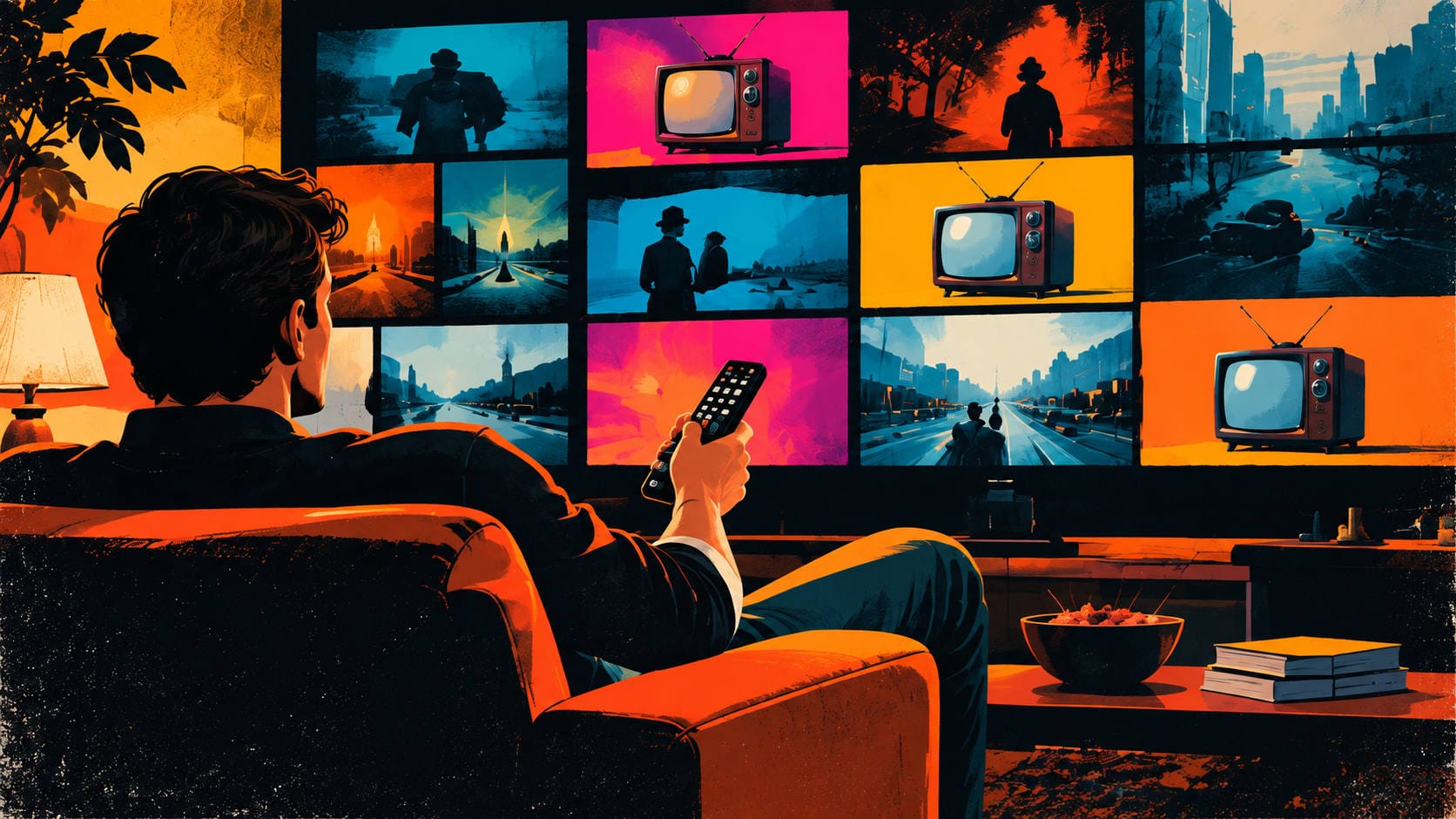
Prestige TV Is Becoming Homework
Prestige TV promised freedom from network rules. Instead we got movie-length episodes, three-year gaps, tangled timelines and recap videos just to remember the plot.
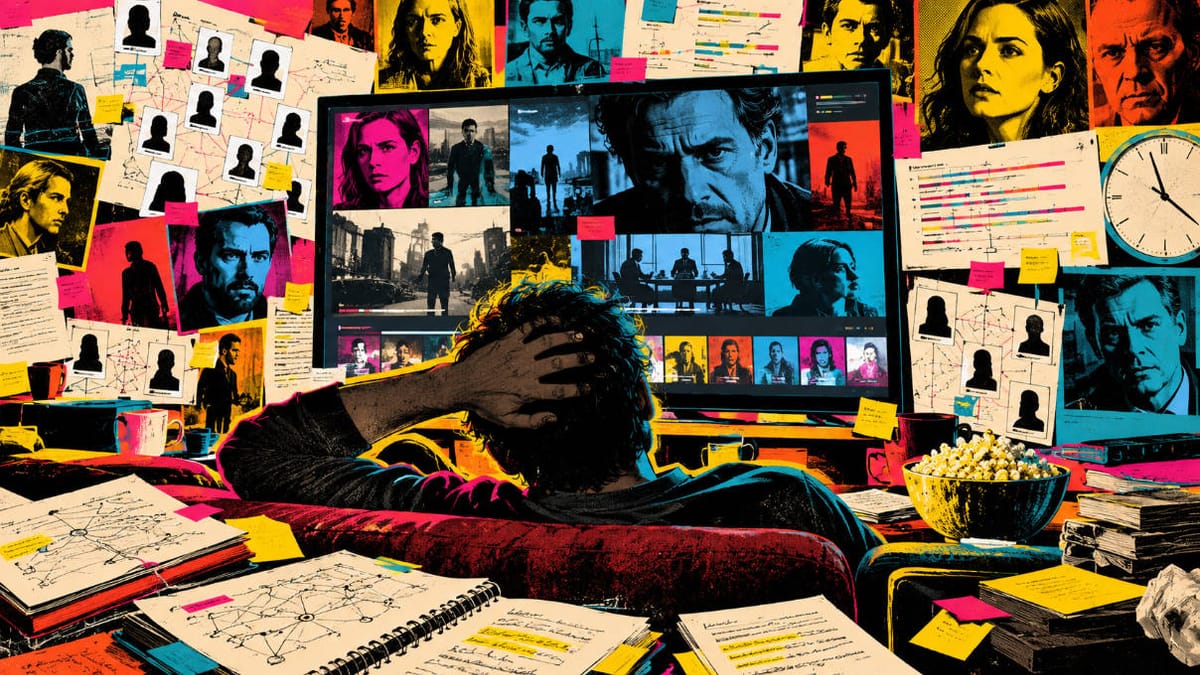
Television was supposed to be easier than reading a novel. Now the best shows arrive with hour-long episodes, three-year gaps, six timelines and a recap video you’re expected to watch before pressing play.
By Kelly Mara | The Voss
At some point, television stopped asking us to watch.
It started asking us to prepare.
You know the ritual.
A new season of a supposedly essential prestige drama arrives after two or three years. You vaguely remember loving the previous season. You definitely remember the mood. You remember one actor’s face. You remember that somebody betrayed somebody else in a corridor.
The details are gone.
So before watching episode one, you search for a recap.
“Everything You Need to Remember Before Season Three.”
Twenty-eight minutes.
You watch eleven.
Then you open Wikipedia.
Then you look up the name of the man with the beard.
Then you discover there were actually two men with beards.
By the time the episode begins, you have already done homework.
Welcome to prestige television in 2026.
Television used to understand the evening
There was once a simple bargain between television and its audience.
You gave it an hour.
It gave you a story.
Sometimes forty-two minutes, once the commercials were removed. Sometimes twenty-two if it was a sitcom.
The architecture was restrictive, but restriction created discipline.
Writers had to enter a scene late and leave early.
Plot had to move.
Characters had to reveal themselves efficiently.
Episodes needed beginnings, middles and endings because another program was starting at nine.
Streaming broke that clock.
At first, this felt like liberation.
No commercials.
No rigid thirty-minute or sixty-minute slots.
No reason an episode could not be 47 minutes one week and 58 the next.
Creators could supposedly let the story determine the runtime.
And then the story began determining that every episode needed seventy-two minutes.
Freedom is wonderful.
Editors are also wonderful.
Every episode thinks it is a film
The visual ambition of contemporary television is extraordinary.
There are series whose cinematography would have been unimaginable on network television twenty years ago. Sets are larger. Locations are more elaborate. Actors who once reserved themselves for cinema now move freely between film and television.
But prestige television has absorbed one unfortunate assumption from cinema:
importance requires duration.
A scene cannot simply establish that a marriage is unhappy.
It must linger.
A character cannot walk into a building.
We must watch the car arrive.
The door open.
The character cross the street.
The security guard glance up.
The elevator rise.
Some of this is atmosphere.
Some of it is excellent filmmaking.
Some of it is television that has forgotten there is another episode next week.
The result is a strange form of narrative inflation.
A season may contain only eight episodes, yet several feel longer than feature films.
The old hour-long drama knew it had forty-something minutes.
The modern prestige drama knows nobody can stop it.
The eight-episode paradox
Streaming was supposed to free television from the old twenty-two-episode season.
And in many ways, that was sensible.
Network schedules routinely forced writers to stretch ideas beyond their natural lifespan. Filler episodes existed because broadcasters needed programming.
But prestige television may have overcorrected.
Now we wait two or three years for eight episodes.
Sometimes six.
They look beautiful.
They cost fortunes.
Then they disappear before the audience has developed the weekly familiarity that older television created almost accidentally.
The strange outcome is that television has become both shorter and harder to follow.
There are fewer episodes.
But the episodes are denser.
There are fewer hours overall.
But the gaps between seasons are longer.
There is less filler.
But also less time simply to spend with characters.
Older television let audiences know people.
Prestige television often gives us dossiers.
Then it disappears for three years
This may be the larger problem.
Modern television increasingly behaves like a film franchise.
Production is elaborate.
Post-production is lengthy.
Actors have competing schedules.
Visual effects take months.
The next season eventually arrives long after the emotional momentum of the previous one has cooled.
This is especially difficult for shows built around intricate mythology, hidden motives and large casts.
“I loved it” is no longer sufficient.
Now you must remember it.
The burden of remembering
Serialized storytelling depends on memory.
Who knew what?
Who betrayed whom?
Who was secretly working for which organization?
What did the photograph in episode five mean?
Why was that woman staring at the red folder?
A show can make such complexity rewarding.
But complexity accumulates interest.
When a series returns after thirty months, the audience inherits a debt.
The creators remember everything.
The writers’ room remembers everything.
The obsessive fan community remembers everything.
The ordinary viewer remembers that the opening credits were excellent.
This creates the absurd modern phenomenon of watching explanatory content in order to consume entertainment.
Recap podcasts.
Timeline videos.
Character guides.
Season summaries.
Reddit threads.
“Ending explained” articles.
A television show has somehow acquired prerequisite reading.
We confuse confusion with sophistication
Prestige television also developed a taste for withholding basic information.
Sometimes this produces mystery.
Sometimes it merely produces fog.
Who is speaking?
Where are we?
What year is this?
Is this a flashback?
Is this another timeline?
Is the character dead, dreaming or remembering?
Why are there six men between forty and fifty with identical haircuts?
The assumption seems to be that disorientation is evidence of artistic seriousness.
It is not.
Great storytelling can be complicated.
Great storytelling is rarely careless about orientation.
Audiences enjoy solving puzzles.
They enjoy it less when they are unsure which puzzle they have been given.
There is a difference between mystery and administrative confusion.
Prestige television occasionally forgets that difference.
The prestige trap
The label “prestige television” once meant something useful.
It distinguished ambitious serialized drama from conventional programming.
It suggested cinematic craft, complex writing and adult themes.
Then prestige became a genre in itself.
Muted color grading.
Slow conversations in expensive kitchens.
A troubled protagonist staring through architectural glass.
A cello somewhere in the soundtrack.
A corporation with sinister branding.
At least one dinner where nobody eats.
The visual grammar became recognizable enough to parody.
And once prestige became a category, every show began needing to prove it belonged there.
That proof often took the form of seriousness.
Longer scenes.
Longer episodes.
More ambiguity.
More silence.
Less explanation.
Less humor.
The danger is obvious.
A show can become so determined to resemble important television that it forgets the primitive requirement of television:
make us want to watch the next episode.
The lost pleasure of the episode
One of the great achievements of older television was the episode itself.
Not merely a fragment of an eight-hour movie.
An episode.
A distinct piece of storytelling.
It could have a theme.
A structure.
A beginning and conclusion.
It might advance the season-long plot, but it also justified its own existence.
Streaming frequently weakened this form.
Episodes became arbitrary stopping points in one continuous narrative.
This encouraged bingeing, but it also created strangely shapeless television.
If episode four ends because the eighth hour of the screenplay happened to require a cut there, is it really an episode?
Or did somebody simply divide a very long film?
The best television understands that serialization and episodic structure are not enemies.
An episode can satisfy and still leave you wanting more.
That is not old-fashioned.
That is craft.
There is nothing wrong with slow television
To be clear, slowness is not the enemy.
Some of the greatest television ever made moves slowly.
A long conversation can be riveting.
A silent reaction can reveal more than a page of dialogue.
An episode can spend an hour barely advancing the plot and still be extraordinary.
But slowness has to be earned.
The viewer can tell when a story is breathing.
The viewer can also tell when it is waiting.
Those are different experiences.
One creates tension.
The other creates the temptation to look at your phone.
The phone is winning
This is the irony prestige television should fear.
The longer a show demands passive patience without sufficient narrative reward, the more likely the viewer is to divide attention.
The phone comes out.
The television continues playing.
The audience technically remains.
The attention does not.
Streaming platforms may record the minute as viewed.
But the scene has lost.
This is particularly dangerous because television is no longer competing only with other television.
It competes with everything.
Messages.
Games.
YouTube.
TikTok.
Podcasts.
News.
Shopping.
Work emails that should not have been opened at 9:47 p.m.
Prestige television occasionally reacts to this competition by becoming more elaborate.
It should consider becoming more compelling.
Maybe television needs constraints again
Constraints are unfashionable in creative industries because freedom sounds inherently superior.
But almost every art form benefits from boundaries.
A sonnet has fourteen lines.
A pop song traditionally ends before the listener grows old.
A newspaper column has a deadline and a hole to fill.
Broadcast television had commercial breaks and fixed slots.
Those limitations could be crude.
They also forced decisions.
What matters?
What can be cut?
Where does the episode turn?
Where should it end?
Streaming removed many of those external pressures.
Perhaps some need to be recreated internally.
Not every episode deserves seventy minutes.
Not every finale deserves ninety.
Not every character requires a backstory.
Not every mystery improves by remaining unexplained for six hours.
And not every successful first season needs to return after thirty-four months as though the viewer has spent those thirty-four months maintaining a case file.
Television should not require revision
A good series can reward close attention.
It can contain details that become clearer on rewatching.
It can trust the audience.
But trust is reciprocal.
The audience should also be able to trust the storyteller to distinguish complexity from clutter.
Because entertainment changes when the first question is no longer:
“What happens next?”
and becomes:
“Wait — who was that again?”
Prestige television is at its best when it gives us the depth of a novel with the immediacy of performance.
At its worst, it gives us the administrative burden of a novel we forgot to read.
There is an easy test.
When a new season arrives, does the audience feel excitement?
Or does it feel the faint anxiety of discovering there is an exam tomorrow?
Television should challenge us.
It should surprise us.
It should occasionally confuse us.
But it should never make pressing play feel like opening a textbook.