
The Bahamas Real Estate Trap: Why Buying Property in Paradise is a Financial Disaster
The Bahamian real estate market is a highly predatory illusion. Driven by real estate agents who paper over systemic risks, naive buyers systematically underestimate the true, long-term cost of ownership, from paralyzing market stagnation and hidden fees to the physical collapse of the coastline.
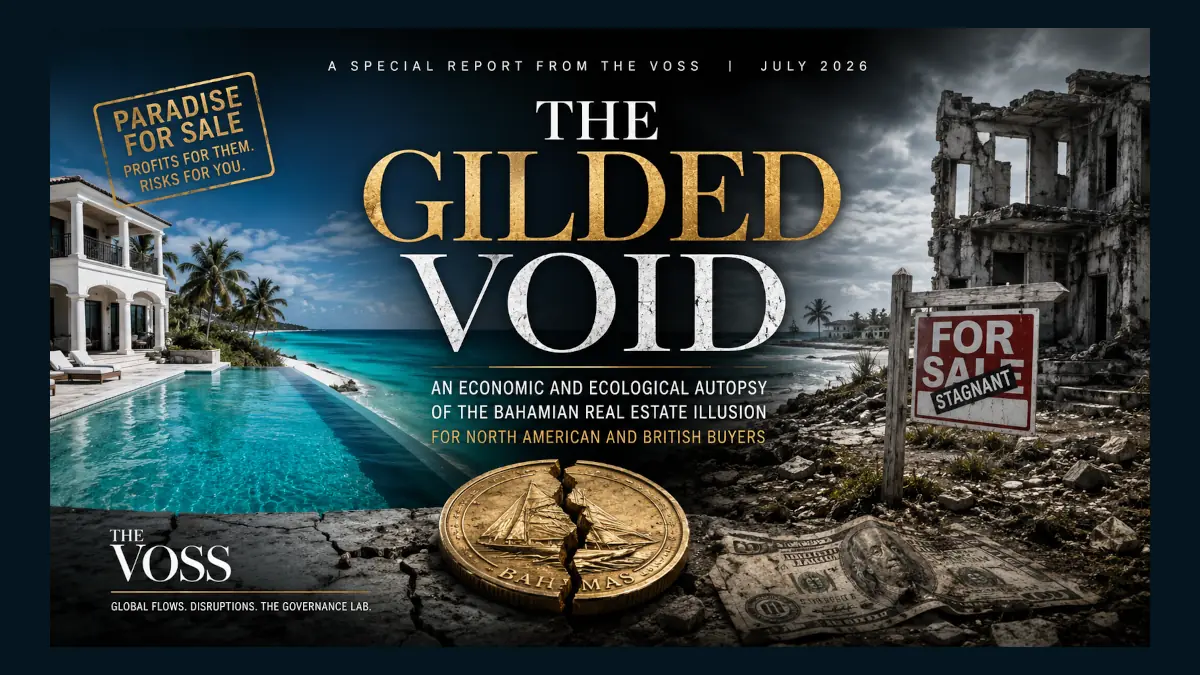
The Gilded Void
An Economic and Ecological Autopsy of the Bahamian Real Estate Illusion for North American and British Buyers
For decades, the marketing machinery surrounding the Bahamian property market has spun a flawless, highly seductive narrative. Glossy brochures and high-definition drone videos present an unblemished paradise: crystalline turquoise waters, pristine pink-sand beaches, and ultra-exclusive residential enclaves where the global elite can safely park their capital. In these digital showcases, cheerful, tan real estate agents present themselves as trusted lifestyle sherpas. They promise double-digit annual appreciation, tax-sheltered security, and an idyllic escape from the rising costs and regulatory burdens of North America and Europe.
Yet behind this polished veneer lies a brutal physical and financial reality that more closely resembles a high-stakes, rigged casino game than a sound wealth-preservation strategy. Far from a safe haven, the Bahamian real estate market has devolved into a massive, illiquid capital trap. This special report by The Voss provides a comprehensive autopsy of this market, exposing the colossal chasm between fabricated asking prices and real transactions, the ecological erasure of the islands’ physical foundations, the crippling infrastructural decay, and the predatory, hidden carrying costs that routinely turn retirement dreams into ruinous financial nightmares.
I. The Mirage of Liquidity: Autopsying the 2025–2026 Transaction Data
The primary myth sustained by the Bahamian brokerage class is that of a highly active, liquid market where premium properties are eagerly snapped up by international cash buyers. However, an analysis of the official data from the Bahamian Multiple Listing Service (MLS)—the centralized transactional database—for the full year of 2025 and the first half of 2026 reveals a staggering state of paralysis.
The Glut of Ghost Inventory
To grasp the scale of market stagnation, one only needs to compare the volume of active listings with the trickle of actual closed transactions. The inventory is bloated to unprecedented levels:
- A single localized brokerage firm on Grand Bahama Island currently advertises 843 active listings for sale.
- H.G. Christie, the self-proclaimed oldest and largest real estate firm in the jurisdiction, actively lists approximately 2,673 properties nationwide.
When aggregating the inventory of all other major and boutique brokerages—including Damianos Sotheby’s, Coldwell Banker, and local independent agencies—there are consistently thousands of residential properties sitting on the market. In any healthy property market, this level of inventory would represent a massive oversupply, but in the Bahamas, it represents something far worse: permanent stagnation.
The Real Hard Data: Completed vs. Active Listings
When contrasted with actual, legally recorded and completed sales (where deeds are stamped, Value Added Tax is paid, and the title is officially transferred), the market’s true liquidity is exposed as practically non-existent. The table below outlines the real activity across the entire country:
| Transaction Category (Nationwide Bahamas) | Full Year 2025 (Actual) | First Half 2026 (Actual & Q2 Trend) |
|---|---|---|
| Completed Residential Sales (Houses/Villas) | 348 units | 164 units |
| Completed Land Sales (Vacant Lots) | 304 units | 132 units |
| Average Days on Market (DOM) - Urban Areas | 201 – 337 days | 250 – 420 days |
| Average Days on Market (DOM) - Out Islands | 450 – 780 days | 510 – 900+ days |
The implications of these numbers are devastating for anyone holding Bahamian real estate. With over 2,600 listings held by just one major brokerage, and only 348 completed residential sales per year across the entire country, the mathematical probability of a seller liquidating an advertised property within a 12-month window is well under 10%. The vast majority of properties sit on the market for years, slowly deteriorating in the tropical climate while their owners continue to bleed carrying costs.
Furthermore, local brokerages frequently manipulate statistics by highlighting "rising average sale prices." This is a classic quantitative sleight of hand. The average price is heavily skewed by a tiny handful of ultra-high-net-worth transactions (often in cash, valued at $15 million or more) taking place within hermetically sealed mega-enclaves on New Providence. For the remaining 95% of the market, transactions have dried up entirely. The apparent value is purely academic; the properties are, for all practical purposes, unsellable at their listed values.
II. Historical Wealth Destruction: The $3.7 Million Decimation
Because there is no transparent, public registry of historical sales prices accessible to the consumer, buyers must rely entirely on the representations of real estate agents whose livelihood depends on keeping prices artificially inflated. This lack of transparency hides a historical trend of massive wealth destruction for foreign buyers.
Consider the typical life cycle of an Out Island beachfront villa:
- The 2008 Peak: At the height of the pre-financial crisis speculative bubble, an American buyer purchases a newly constructed, luxury beachfront home on Eleuthera for $3,700,000.
- The 2016 Realignment: After eight years of paying exorbitant holding costs, battling continuous decay, and failing to secure consistent rental income, the owner is forced to liquidate. The home sits on the market for 36 months before finally closing at $900,000—a catastrophic 75% loss of principal.
- The 2026 Reality: Today, the second owner attempts to sell the same property. Heavily eroded, facing astronomical insurance premiums, and requiring complete structural remediation, the property receives no serious bids. If sold today, it is highly unlikely to command even $500,000.
This $3.7 million to $500,000 trajectory is not an anomaly; it is the standard path for high-end properties built outside of artificially protected zones. The asking prices displayed on brokerage sites are not valuations based on comparable market data—they are desperate, arbitrary figures chosen by sellers who are trying to recoup their losses, completely disconnected from what any rational investor is willing to pay.
III. Physical Erasure: The Geomorphological Collapse of the Coastline
Even if a buyer is willing to accept the financial illiquidity of the Bahamian market, they cannot escape the laws of physics. The Bahamian archipelago is one of the most ecologically vulnerable regions on Earth. The very asset that buyers pay millions for—the immediate proximity to a white sand beach—is actively disappearing.
The Post-Pandemic Coastal Shift
Over the last ten years, a dramatic and visible shift has occurred along the shorelines of New Providence, Grand Bahama, and the Out Islands. Due to a combination of rising sea levels, ocean warming, and the escalating frequency of major category 4 and 5 hurricanes, the natural balance of sand deposition has been shattered. Once-wide, gently sloping sand dunes have been permanently stripped away, exposing the sharp, jagged limestone bedrock known locally as ironshore. During regular high tides—and particularly during seasonal "King Tides"—the beach is completely submerged. The ocean does not merely lap at the shore; it crashes directly against the boundaries of waterfront properties.
The Illusion of Seawalls
To combat this erosion, property owners spend hundreds of thousands of dollars constructing concrete seawalls. This is a futile, counterproductive endeavor due to the unique geology of the Bahamas:
- Porosity of the Bedrock: The islands are composed of highly porous oolitic limestone. Constructing a seawall on this substrate is equivalent to building a barrier on a sponge. Water does not simply hit the wall; it penetrates through the porous stone underneath, undermining the structure from below.
- Reflected Wave Energy: A vertical concrete wall does not absorb wave energy; it reflects it back. This reflected force violently sweeps away any remaining sand in front of the wall, accelerating the erosion of the beach and eventually causing the wall itself to crack, tilt, and collapse.
- Land Loss and Structural Risk: Waterfront homes that were safely positioned 50 feet back from the high-water mark a decade ago now find their patios and foundations mere feet from the active surf. Multiple properties on Nassau’s Eastern Road and Grand Bahama's southern coast are currently facing imminent structural collapse as their protective walls crumble into the sea.
IV. The $300,000 Apartment Trap: A Financial Black Hole
Frightened by the multi-million dollar price tags of freestanding luxury estates, many middle-class retirees and buyers from the US, Canada, and the UK opt for what appears to be a conservative, low-risk alternative: purchasing a beachfront condominium or apartment for $300,000 on Grand Bahama or New Providence. They assume that by scaling down their purchase price, they are insulating themselves from financial ruin. In reality, they are stepping into a highly predatory, low-yield trap.
The Mathematics of the $1,000 Monthly Fee
In almost every beachfront condominium complex on Grand Bahama or New Providence, owners of $300,000 units are hit with mandatory, monthly Homeowners Association (HOA) or Condominium Fees ranging from $1,000 to $1,500 per month ($12,000 to $18,000 annually). This fee is completely independent of the owner's personal electricity or water consumption.
For a retired couple on a fixed income, this represents an unmitigated disaster. The monthly cash bleed is driven by structural forces that the owner has absolutely no power to control:
| Expense Category | Monthly Allocation (Typical $300k Condo) | The Underlying Reality & Structural Risk |
|---|---|---|
| Master Property Insurance | $500 – $700 | Driven by global reinsurance markets reacting to catastrophic hurricanes (e.g., Dorian). Oceanfront structures are categorized as extreme-risk, making insurance a non-negotiable, sky-rocketing expense. |
| Administration & Management | $200 – $300 | Funds the bloated, inefficient operational apparatus of local management companies. Lack of transparency leads to routine overpayments to preferred local contractors. |
| Common Area Utilities & Maintenance | $150 – $200 | Pays for the desalination of pool water, lighting, and basic landscaping. High salinity in the air requires constant, expensive repainting and structural patching. |
| Reserve Fund Contribution | $150 – $200 (Often Zero) | Ideally reserves capital for major repairs. In reality, most older complexes have completely depleted reserves, leaving them highly vulnerable to sudden, massive "Special Assessments." |
When an owner purchases a $300,000 condominium with a $1,000 monthly fee, they are effectively agreeing to pay 4% to 6% of the asset's total value every single year in non-equity-building carrying costs. Over a twenty-year period, the owner will pay more in fees and insurance than the original purchase price of the property, with absolutely no guarantee that the building will still be standing or that the association will not go bankrupt in the interim.
V. Infrastructural Decay and the Predatory Expat Tax
The marketing narrative suggests that the Bahamas offers a modern, high-standard infrastructure comparable to South Florida. The physical reality of living on the islands quickly shatters this illusion.
The Power Monopoly and the Chilling Cost
Electricity is provided by state-controlled or tightly regulated monopolies, such as Bahamas Power and Light (BPL) on New Providence and the Grand Bahama Power Company (GBPC) on Grand Bahama. These utilities rely almost exclusively on imported heavy fuel oil. As a result, the cost of electricity in the Bahamas is among the highest on the planet, frequently exceeding Pe = $0.40 per kWh.
For a homeowner, this is not a minor inconvenience; it is a major financial drain. Due to the extreme humidity, any property left closed and un-airconditioned will be completely consumed by black mold within weeks. To preserve the interior, furniture, and electronics, the central air conditioning must run continuously, even when the property is vacant. This results in baseline utility bills of $400 to $800 per month for a modest home, simply to prevent the property from rotting.
The "Florida Refugee" Phenomenon
The vast majority of buyers targeting the sub-$300,000 market are retirees from the United States and Canada. Many of them are "Florida refugees"—individuals who planned to retire to cities like Fort Lauderdale or Sarasota, but were priced out by Florida's skyrocketing real estate prices, soaring HOA fees, and surging insurance rates.
These buyers look across the Gulf Stream, see a $250,000 beach condo in Freeport, and believe they have found a clever backdoor to a tropical retirement. What they fail to realize is that the cost-of-living differential completely wipes out any initial purchase-price savings:
- The Import Tariff Wall: The Bahamas produces virtually no consumer goods or food. Everything must be shipped in from Florida, and the government funds its budget through steep import duties (*Customs Duties*) that average 35% to 45% on electronics, vehicles, and building materials, plus a 10% Value Added Tax (VAT) on almost all goods and services.
- The Medical Void: For retirees, access to high-quality healthcare is critical. While Florida offers world-class medical facilities, the Bahamas lacks advanced care on the Out Islands and has highly strained hospital capacity in Nassau. US Medicare does not cover medical treatment in foreign countries. A retiree facing a serious medical emergency must pay $15,000 to $25,000 out of pocket for a private air ambulance evacuation to Fort Lauderdale.
VI. Conclusion: The Mathematical Honesty of the Casino
The Bahamian real estate market is a beautifully packaged, highly predatory illusion. It operates by exploiting the deep, naive desires of North American and British retirees who wish to secure their own slice of the warm, tropical South. Drawn in by "gesundbeter" brokers who paper over systemic risks with sunny smiles and prestigious brand names like HG Christie, buyers systematically underestimate the true, long-term cost of ownership.
From a rational wealth-management perspective, purchasing real estate in the Bahamas is an incredibly poor bet. The assets are highly illiquid, the carrying costs are astronomical and guaranteed to rise, the infrastructure is failing, and the physical land itself is being actively reclaimed by the ocean.
If your goal is simply to gamble with your capital in the hope of a favorable outcome, you would be far better served taking your funds directly to the nearest casino floor at Baha Mar or Atlantis. At the roulette table, the rules of the game are transparent, the probability of winning is a mathematically guaranteed Pwin = 47.3% (on a single-zero wheel), and if you lose, the pain is immediate and clean. When you buy Bahamian real estate, the game is rigged, the rules are hidden, the carrying costs ensure you bleed capital every day you play, and when you finally try to walk away from the table, you will find that you are locked in, watching your wealth slowly wash away into the sea.