
Bahamas Debt Crisis: A New Security Threat Off Florida?
Drowning in a $12.5B debt, the Bahamas faces a critical turning point under Prime Minister Davis. As a bloated cabinet rewards political loyalty, historical drug cartels, human smuggling rings, and aggressive Chinese capital are filling the vacuum—just 50 miles off the coast of South Florida.
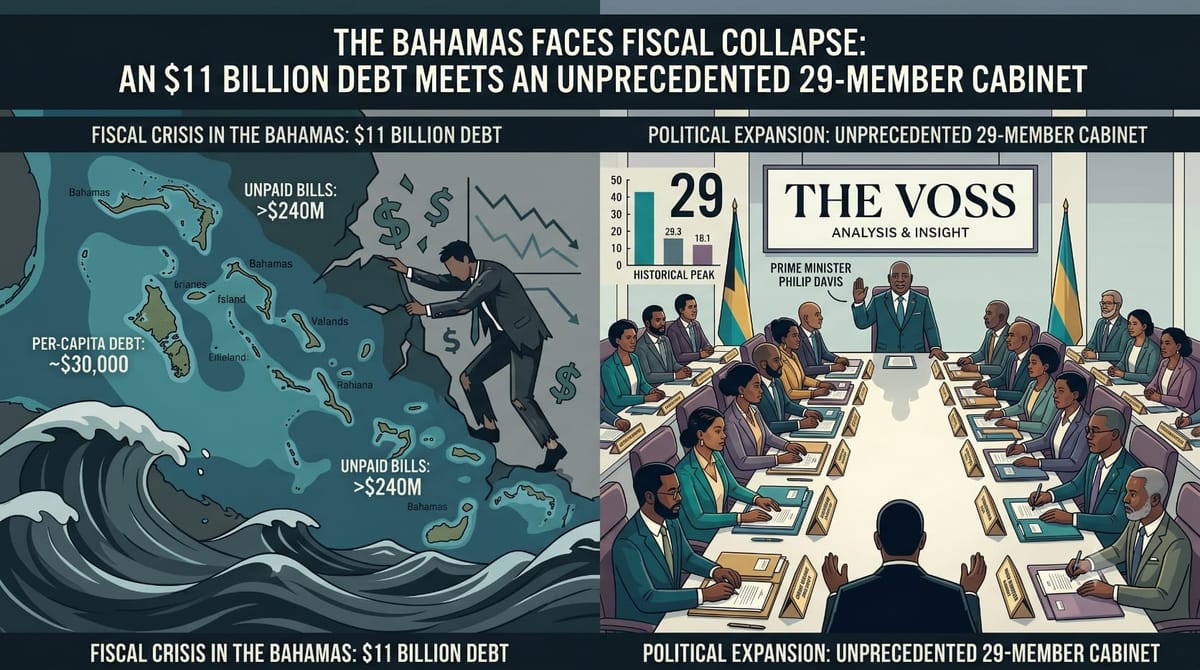
Red Alert at Florida’s Doorstep: Deep Debt, China’s Foothill, and the Bahamas Smuggling Pipeline
FORT LAUDERDALE, FL — Just 50 miles off the pristine, sun-drenched beaches of South Florida, a geopolitical and security time bomb is ticking. For millions of American and Canadian tourists, The Bahamas is an idyllic paradise of turquoise waters and luxury resorts. But beneath the postcard-perfect surface lies a harrowing reality that Washington can no longer afford to ignore.
Following the May 2026 re-election of Prime Minister Philip “Brave” Davis and his Progressive Liberal Party (PLP), the archipelago is steering into a perfect storm: a crushing $12.5 billion sovereign debt, a massive executive cabinet expansion that signals rampant political patronage, and a deep-seated historical entanglement with transnational crime that is shifting into hyperdrive.
For residents of Florida, this isn’t an abstract foreign policy debate—it is a direct threat to regional stability.
The Ghost of "Narco-Colonialism": The PLP’s Dark Legacy
To understand the current crisis, one must look at the genetic makeup of the ruling Progressive Liberal Party. The shadow of the late Sir Lynden Pindling—the PLP godfather and the nation’s first Prime Minister—still looms large over the country’s institutions.
[Historical Timeline: The Bahamas Smuggling Nexus]
1980s: The Pindling Era -> Carlos Lehder & Medellin Cartel buy Norman's Cay -> Systematic state bribery.
2000s: Traditional Drug Routes -> Go-fast boats bypass coast guard via fragmented Out Islands.
2025-2026: The Transnational Pipeline -> Integration of Human Trafficking and Fentanyl/Cocaine logistics.
During the 1980s, Pindling’s administration famously turned a blind eye while Carlos Lehder and the Medellín Cartel effectively purchased Norman’s Cay, transforming a Bahamian island into a heavily armed fortress to pump cocaine into the United States. A 1984 Royal Commission of Inquiry confirmed systemic corruption reaching the highest echelons of the PLP government.
Fast forward to 2026, and federal prosecutors in the Southern District of Florida are fighting the modern mutation of this legacy. In May 2026, a federal jury in Fort Lauderdale convicted a Bahamian national for operating a multi-vessel transnational pipeline. The operation didn't just smuggle hundreds of kilograms of cocaine; it moved dozens of unauthorized migrants directly onto South Florida’s shores.
The strategy is clear: the fragmented topography of the Bahamian Out Islands, combined with weakened local law enforcement under a bloated, distracted bureaucracy, makes it the ideal launchpad for criminal networks.
The Human Cost: Human Smuggling and the Florida Frontier
While the Davis administration inflates its government apparatus to an unprecedented 29 members to reward political loyalists, the operational capacity of the state to secure its maritime borders is fracturing. The result is a thriving, multi-million-dollar human smuggling trade.
It is a trade fueled by human desperation and criminal opportunism. Stripped of economic prospects in a nation where per-capita debt has skyrocketed past $31,250, local maritime operators are increasingly lured into the lucrative networks of human trafficking.
Go-fast vessels, packed to capacity with migrants from across the Caribbean and Asia, routinely attempt perilous night crossings through the volatile Straits of Florida. When US Customs and Border Protection or the Coast Guard intercept these vessels, the grim reality of this proximity becomes undeniable. The Bahamas has effectively become a staging ground for unregulated migration, directly testing the domestic security limits of the United States.
Beijing’s Backyard: The Growing Dependency on China
Perhaps the most alarming development for Western intelligence agencies is how the Davis administration is choosing to balance its books. Desperate for capital to service its astronomical $12.5 billion debt, Nassau is turning increasingly to Beijing.
Under the banner of China’s "Community of Common Destiny" and its active 15th Five-Year Plan (2026–2030), the Chinese Communist Party is aggressively expanding its foothold in the Western Atlantic. The signs are no longer subtle:
- Infrastructure Dominance: Chinese state-owned enterprises hold massive stakes in critical Bahamian infrastructure, including the massive $4.2 billion Baha Mar resort and strategic maritime port developments.
- Diplomatic Alignment: In February 2026, Prime Minister Davis openly praised the "strong partnership" with Beijing, explicitly reaffirming adherence to the One-China principle and welcoming deeper "people-to-people exchanges."
- Economic Leverage: As traditional Western lenders tighten credit lines due to the Bahamas' elevated sovereign risk, Beijing’s deep pockets offer a seductive but dangerous debt-trap alternative.
Intelligence Assessment: A sovereign state suffocating under debt, highly vulnerable to institutional corruption, and physically located 50 miles from the US mainland is the ultimate geopolitical leverage point. Beijing isn't just investing in tourism; it is securing a front-row seat to the United States' maritime eastern flank.
Verdict: The Cost of Complacency
The United States and Canada can no longer view the Bahamas strictly through the lens of a vacation destination. The Davis administration’s decision to prioritize political clientelism—funding a historically bloated 29-member cabinet while critical infrastructure like Bahamas Power and Light (BPL) crumbles—is creating a failed-state trajectory.
When a government ceases to function as a lean, transparent democracy and morphs into an institution of self-preservation, a vacuum is created. In the Caribbean, that vacuum is instantly filled by drug cartels, human smugglers, and Chinese state capital.
The crisis in Nassau is rapidly becoming a crisis for Florida. Without radical internal reform, aggressive debt restructuring, and a decisive decoupling from illicit networks, the Bahamas faces the total erosion of its sovereignty. And the price for that failure will be paid in full by the communities along the American coastline.