
China’s Cold War: Why Beijing Is an Adversary, Not a Partner
Sixty years after the horrors of Mao’s Cultural Revolution, the West remains blind to Beijing. Driven by corporate greed and political naivety, we mistake an adversary for a partner. China’s goal is unchanged: total control at home and the systematic dismantling of American global leadership.
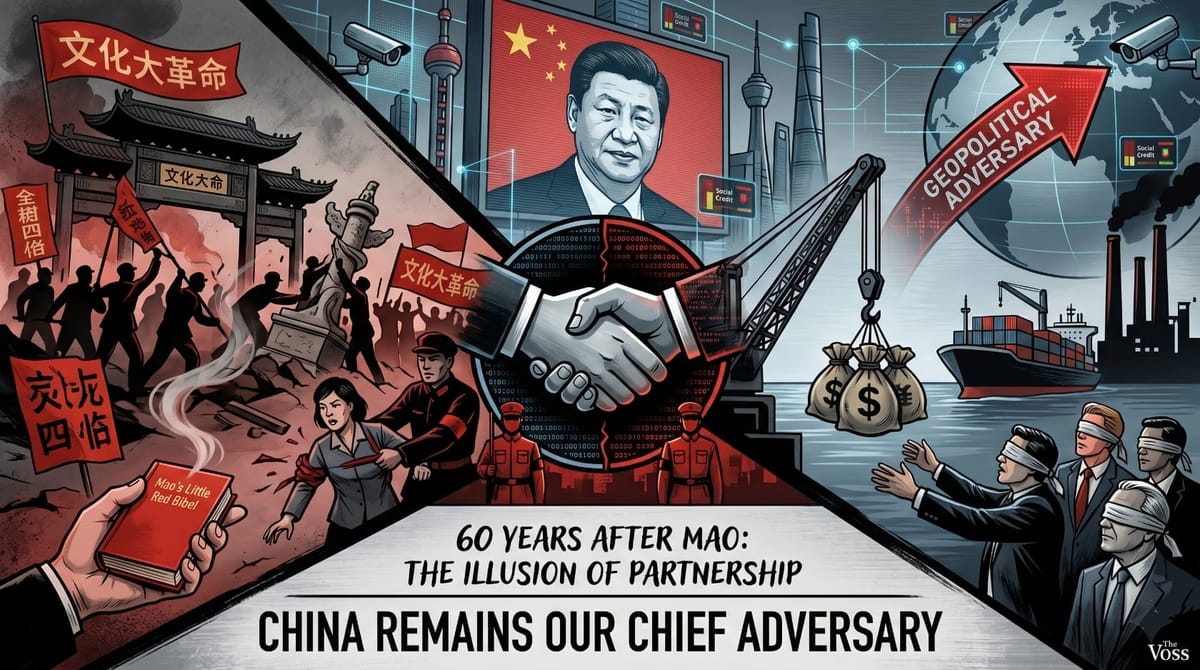
60 Years After the Cultural Revolution, China Remains Our Chief Adversary
WASHINGTON, D.C. — It began sixty years ago with a single, brutal act of violence that foreshadowed a decade of state-sponsored madness. On August 5, 1966, at an elite girls' high school in Beijing, a mob of students turned on their vice-principal. Armed with wooden clubs and leather belts studded with brass, they tortured, humiliated, and beat Bian Zhongyun to death. She was the first prominent victim of Mao Zedong’s Great Proletarian Cultural Revolution.
Mao’s utopian dream of forging a "New Man" by obliterating the "Four Olds" (Old Ideas, Old Culture, Old Customs, and Old Habits) threw China into a decade of cannibalistic terror, denunciation, and mass murder. Millions perished. Yet, while China tore itself apart, a romanticized version of this madness captivated the Western Left. Red Guards were cheered in Berkeley, Paris, and West Berlin, and Mao’s "Little Red Book" became a chic accessory for intellectual elites who chose to look past the mountain of corpses.
Six decades later, the Western blind spot remains. The romantic radicals of the 1960s have been replaced by short-sighted politicians, greedy corporate boards, and Wall Street managers. Driven by quarterly profits and naive geopolitical theories, they have ignored a hard truth: the Chinese Communist Party (CCP) has never been a partner, and it never will be. It is, and always has been, a systemic adversary.
The Fatal Flaw of "Change Through Trade"
For thirty years, Washington consensus dictated that bringing Beijing into the global economic fold—culminating in China’s entry into the WTO—well-meaning capitalists could liberalize the regime. It was a colossal strategic error. We believed market access would change China; instead, China used our markets to fortify its autocracy.
Under Xi Jinping, China has not abandoned the totalitarian roots of the Cultural Revolution; it has simply perfected them using American-pioneered technology.
| The Mao Era (1966) | The Xi Era (Today) |
|---|---|
| Enforcers: Red Guards, public shaming, physical terror. | Enforcers: AI surveillance, Facial Recognition, Great Firewall. |
| Method: Violent destruction of traditional culture. | Method: Absolute digital control and the "Social Credit System." |
| Geopolitical Goal: Exporting global peasant revolution. | Geopolitical Goal: Achieving global technological and military hegemony. |
The core DNA of the regime is unchanged. The CCP’s paramount objective remains the absolute monopoly on power at home and the systematic subversion of Western democratic leadership abroad.
The Strategy of Corporate and National Takeover
While American CEOs travel to Beijing to pay homage for continued market access, the CCP is executing a patient, cold-blooded grand strategy to hollow out the American economy.
- Weaponized Subsidies: Beijing floods global markets with state-subsidized electric vehicles, solar cells, and legacy semiconductors to bankrupt Western competitors and monopolize critical supply chains.
- Forced IP Theft: American companies are forced into joint ventures and systematic intellectual property transfers just to operate in China, effectively training their own executioners.
- The Long Economic Game: Through predatory lending, critical infrastructure acquisitions, and espionage, China is cornering the market on the future.
The ultimate price for this greed is already being paid. American manufacturing towns were the first casualties. Next will be our high-tech sectors, biotechnology firms, and defense industries. Western corporations that think they are "partnering" with Chinese firms are merely holding an expiration date. They will be copied, underpriced, and either acquired or driven into bankruptcy.
Facing the Reality
The brutal murder of Bian Zhongyun sixty years ago should have served as a permanent warning about the length to which the CCP will go to enforce its ideological vision. Today, Beijing operates with immense economic leverage and global reach, but with the exact same disregard for human dignity, liberty, and international law.
To call China a "competitor" or a "partner" is a dangerous delusion. They are a geopolitical adversary playing a zero-sum game. They are leveraging our own corporate greed and political short-sightedness against us. If Washington and Wall Street do not immediately decoupling critical sectors and confront this threat with cold-eyed realism, the United States will wake up to find its companies hollowed out, its tech stolen, and its global leadership permanently usurped by Beijing.
Global Flows, The Influence War, Perspectives