Emily in Paris Review: How Netflix Ruined Television
Emily in Paris is a global streaming powerhouse—and a textbook example of algorithmic brainrot. Why are millions of viewers hooked on a sterile, hyper-sanitized postcard fantasy of Europe while real-world crises are completely scrubbed from the screen? A deep psychological analysis.

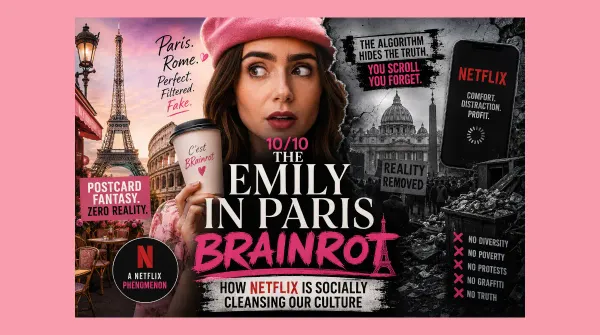
The Emily in Paris Brainrot: How Netflix Is Socially Cleansing Our Culture
Emily in Paris is the ultimate hate-watch turned global obsession—and a textbook example of algorithmic anesthesia. Why are millions of Americans hooked on a clinical, hyper-sanitized postcard fantasy of Europe while real-world crises are scrubbed from the screen? Welcome to the psychological reality of peak brainrot.
The Death of Storytelling: Inside the Corporate TikTok-Editing Loop
Tuning into an episode of Emily in Paris isn’t watching television anymore; it’s witnessing the complete surrender of narrative depth to the almighty Netflix algorithm. The show isn't art. It’s a 16:9 lobotomy custom-built for an audience whose neural pathways have already been fried by 140-character hot takes on X and endless, mindless scrolling on Instagram.
The production itself betrays the intent. The editing is erratic, moving at the breakneck speed of a hyperactive 90s music video. Scenes last barely a few seconds. Dialogues have devolved into sterile, punchy one-liners designed to double as captions for TikTok or Instagram Reels. Character development? Plot logic? Non-existent.
From Paris to Rome: The Algorithmic Cleansing of European Metropolises
Where this empty caravan sets up its next backdrop doesn't matter to the corporate algorithm. After completely strip-mining Paris of its aesthetic value, the protagonist spent the latest season stumbling through Rome. The playbook remains exactly the same. Whether it's France or Italy, the show refuses to engage with actual European cities, opting instead for a clinically wiped, Disneyfied micro-universe.
These historic cities are reduced to a neo-colonial postcard fantasy for wealthy American tourists. The actual urban reality is systematically and socially cleansed from the frame:
- Zero Multicultural Identity: The actual multicultural demographics of modern Europe—rich with North African, Middle Eastern, and Black communities—are completely wiped out. You will never see a woman in a hijab or the vibrant, complex diversity of the local working class.
- No Real-World Tension: The socio-economic friction, the famous European strikes, the crumbling infrastructure, political protests, and homelessness are entirely non-existent.
- Sterile Hygiene: In Emily’s world, there is no trash, no graffiti, no endless construction, and no collapsing public transit.
What remains is a bleached, overexposed playground where the ultimate existential crisis is whether a scoop of gelato on the Spanish Steps melts fast enough to look cute for the feed.
Escapism as Propaganda: The Dark History of Comfort Media
It’s impossible not to draw a chilling historical parallel here. During the darkest days of the 20th century, right in the middle of World War II, state-controlled film industries specialized in churning out opulent romance movies and "feel-good" comedies. The strategy was as cynical as it was simple: systematic distraction culture. The population was meant to be emotionally anesthetized by an artificial, crisis-free dreamworld so they would forget the grim reality outside their doors.
The only difference today? We don’t need a totalitarian government to dictate what we watch. Platform capitalism and Silicon Valley tech giants have taken over the job. The algorithm feeds the public digital sugar because total, conflict-free optimization scales globally and prints money. It is the systemic conditioning of an audience that has forgotten how to handle narrative friction or apply any cognitive effort to media consumption.
Psychology: Why the American Mind Craves Brainrot TV
Yet, an supposedly educated generation is devouring this visual garbage by the millions. The psychological mechanisms driving this obsession run deep into the modern American psyche:
1. Radical Escapism (Mood Management Theory)
As the real world becomes increasingly complex, threatening, and fractured by political polarization, inflation, and global conflict, the human brain screams for relief. Media psychologists call this Mood Management. The brain seeks content that produces zero cognitive dissonance. Emily in soft focus doesn't hurt to watch. It's the visual equivalent of a weighted blanket—no sharp edges, no moral gray areas.
2. The Aesthetic Gratification Loop
We live in a hyper-visual culture where personal status is defined by curated digital imagery. The show feeds this exact obsession with flawless aesthetics. The viewer's eye is bombarded with designer clothes, perfect lighting, and unattainable luxury. This triggers an effortless dopamine hit in the reward center of the brain—zero assembly required.
3. Cognitive Regression as a Survival Skill
After a exhausting day navigating a hyper-competitive, always-on corporate landscape, people don't want an intellectual challenge. They want to regress—to retreat into a passive state of near-infantile stimulation. These shows are engineered so that even if you look away for ten minutes to check your phone, you instantly know what's going on when you look up. They demand nothing, providing a safe—but ultimately hollow—refuge from reality.
Ultimately, this algorithmic numbing leaves a bitter taste. When you exclusively consume mental fast food, you lose the taste for a real feast. And when you look at the world through Emily’s lens, you lose the ability to comprehend reality in all its messy, complex, and fascinating truth.
SEO Backend Metadata (US Market)
- SEO Title (51 characters): Emily in Paris Review: How Netflix Ruined Television
- Meta Description (142 characters): A deep dive into Emily in Paris: Why the hit Netflix series relies on brainrot escapism and the dark psychology behind why we love it.
- Excerpt (294 characters): Emily in Paris is a global streaming powerhouse—and a textbook example of algorithmic brainrot. Why are millions of viewers hooked on a sterile, hyper-sanitized postcard fantasy of Europe while real-world crises are completely scrubbed from the screen? A deep psychological analysis.
Written by
Read next

Bahamas Corrupt Voucher Scandal Exposed: A Failed State
A newly leaked public procurement report reveals the Davis administration funneled $663K in no-bid contracts for voting vouchers weeks before the election. This institutional corruption proves the Bahamas’ democratic illusion is dead, paving a dangerous, volatile path toward a failed state.TikTok’s Double Standard: ‘Israel Will Live’ Removed
TikTok removed TaktGEFLECHT’s song “Israel Will Live,” released through Die Vossische. At the same time, Salafist influencers and radical channels reach millions of viewers. The article examines whether the platform applies unequal standards when moderating political and religious content.
Buried Gaza Doc: Why German TV Censored UNRWA Terror Links
As an award-winning doc exposes the systematic ties between UNRWA staff and Hamas terror, European state TV buried the film. Discover the shocking reality of how Western aid was weaponized, why the US cut funding, and the media scandal European elites tried to hide. Read the full investigation.
A Torrent of Evidence in a Darkening World
In Imported Hate, Alvan Bovay demonstrates how global antisemitism was unleashed following October 7, 2023. Through evidence on UNRWA, the Red-Green Alliance, and digital influence warfare, this book review analyzes the systemic failure of Western leadership and offers a roadmap for freedom.
The Unstoppable Fracture: Is the Democratic Party Splitting?
The Michigan primary between Haley Stevens and Abdul El-Sayed exposes a fatal divide. Why analysts predict a formal split in the Democratic Party that will change America forever.
TikTok’s Double Standard: ‘Israel Will Live’ Removed
TikTok removed TaktGEFLECHT’s song “Israel Will Live,” released through Die Vossische. At the same time, Salafist influencers and radical channels reach millions of viewers. The article examines whether the platform applies unequal standards when moderating political and religious content.