The Illusion of Sovereignty: The Methodical and Economic Collapse of the Bahamas
ehind the glossy tourist resorts, the Bahamas is teetering on the edge of economic and institutional collapse. Plagued by a bloated bureaucratic state, systemic corruption, and a toxic 77% debt-to-GDP ratio, the nation is quietly omitted from the Global Peace Index. It's time to halt the loans.

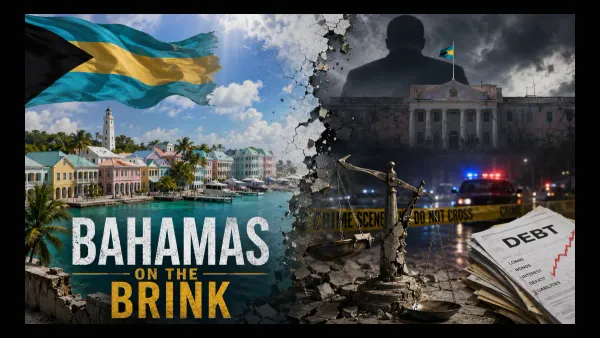
Every year on July 10th, the Bahamas celebrates its independence. The state apparatus champions sovereignty and brilliance, but behind the glossy tourist brochures lies a grim economic and societal reality. Driven by massive public fund misallocation, an eroding rule of law, and an exploding national debt, this island nation is quietly teetering on the edge of structural bankruptcy.
While the international community and global creditors often turn a blind eye, a data-driven analysis—specifically through the lens of global security and economic metrics—reveals a profoundly broken system.
The Blind Spot in the 2026 Global Peace Index
The Global Peace Index (GPI) 2026, published by the Institute for Economics and Peace (IEP), evaluates 163 independent states based on 23 indicators. Conspicuously, the Bahamas is completely absent from this ranking. Officially, this exclusion is attributed to a lack of standardized, independent data.
However, this statistical blind spot is symptomatic of a deeper crisis. If the Bahamas were measured against the strict methodology of the GPI, the results would be disastrous. In the crucial dimension of "Societal Safety and Security", the nation would plunge into the bottom quartile of the global rankings:
- Violent Crime at Global Limits: With a homicide rate that consistently ranks among the highest per capita worldwide, the Bahamas would receive the worst possible rating in the Level of Violent Crime category.
- Institutional Corruption: The GPI heavily penalizes political instability and a lack of reliable governance. Endemic corruption within local authorities, coupled with a justice system marred by arbitrary actions and the systematic falsification of evidence by investigative bodies, would severely impact its Political Instability indicator.
The Erosion of the Rule of Law and Capital Flight
A functioning society relies on the enforcement of contracts, the protection of property, and an impartial judiciary. In the Bahamas, this foundation has fundamentally eroded. A state that can no longer guarantee the rule of law doesn't just lose its status as a peaceful nation—it destroys its own economic lifeline.
The macroeconomic consequences are undeniable. The once-proud Bahamian offshore financial sector is effectively dead. Today, not a single reputable, international bank operates locally. Without institutional trust, capital inevitably flees an environment where the executive branch acts as a corrupt player rather than a neutral protector.
The Parasitic State: An Economy of Privilege
The void left by international capital has been filled by a toxic local economy. The Bahamas has developed a system that penalizes productive forces while rewarding a parasitic administrative bureaucracy.
- The Bureaucratic Aristocracy: The government has mutated into the dominant employer. Nearly the majority of formally employed Bahamians are directly or indirectly dependent on the state apparatus. This bloated sector insulates itself with tenured positions, free government vehicles, and exclusive privileges.
- The Destruction of the Free Market: The assumption that competitive economic structures still exist is an illusion. In formerly thriving zones like Freeport, Grand Bahama, genuine free enterprise has been suffocated. Local and international entrepreneurs are constantly choked by administrative blockades, bureaucratic overreach, and systematic extortion.
The Hard Numbers: A Looming Debt Collapse
A system that hollows itself out through unchecked privileges leaves a clear financial trail. The government’s rhetoric of sovereignty shatters against the reality of its exploding national debt.
Currently, the Bahamian national debt hovers at a critical level of 74% to 77% of its Gross Domestic Product (GDP). For a small, externally vulnerable island economy, this is a toxic burden. The fundamental issue lies in the allocation of these funds: domestic and foreign loans are not invested in competitive infrastructure. Instead, new debt is utilized almost exclusively to keep the parasitic state apparatus and its massive payroll afloat.
The International Monetary Fund (IMF) has repeatedly issued stern warnings regarding these fiscal vulnerabilities. Translated from diplomatic jargon, this means: the state can no longer service its obligations on its current trajectory.
PLP and FNM: Administrators of Decline
Political responsibility for this institutional and financial decay cannot be pinned on a single legislative term. The system is sustained by a corrupt political duopoly.
Both the ruling Progressive Liberal Party (PLP) and the opposition Free National Movement (FNM) have proven they have no interest in structural reform. Both parties ultimately serve to maintain their own patronage networks. Neither the PLP nor the FNM has taken decisive action to restore legal certainty, restructure the bloated civil service, or prosecute state corruption. They merely take turns administering the nation's decline.
The Necessary Consequence: Halting International Credit
A system that no longer creates real economic value, yet finances a bureaucratic caste through massive debt, must not be kept artificially alive by the international community.
The logical consequence of this systemic failure—marked by uncontrolled crime, massive corruption, and an impending debt collapse—must be a radical shift in approach by international creditors. The current government, and explicitly any potential future FNM administration, must be cut off from unconditional international credit lines.
As long as foreign capital flows unconditionally into this system, reforms will never happen. It only results in further subsidizing corruption, while poverty among the broader population and violence on the streets continue to escalate. An immediate halt to international credit is the only remaining leverage to hold a corrupt apparatus accountable.
Written by
Read next
The End of an Era? The Crisis of the British Monarchy
King Charles III’s shift from "Defender of the Faith" to a "protector of faith" signals a profound change. This move threatens to erode the Christian identity that has anchored the British monarchy for centuries, fueling a deeper debate on cultural survival and institutional legitimacy.The Dark Secret Behind Nassau’s Luxury: What Happens Inside Fox Hill
Away from the mega-yachts and turquoise waters of Nassau, a medieval engine of human degradation hums. Discover the brutal reality inside Fox Hill Prison—a state-administered catastrophe of strategic starvation and systemic torture, actively sustained by the machinery of the US government.
The Bahamas Real Estate Trap: Why Buying Property in Paradise is a Financial Disaster
The Bahamian real estate market is a highly predatory illusion. Driven by real estate agents who paper over systemic risks, naive buyers systematically underestimate the true, long-term cost of ownership, from paralyzing market stagnation and hidden fees to the physical collapse of the coastline.
The End of an Era? The Crisis of the British Monarchy
King Charles III’s shift from "Defender of the Faith" to a "protector of faith" signals a profound change. This move threatens to erode the Christian identity that has anchored the British monarchy for centuries, fueling a deeper debate on cultural survival and institutional legitimacy.
A Torrent of Evidence in a Darkening World
In Imported Hate, Alvan Bovay demonstrates how global antisemitism was unleashed following October 7, 2023. Through evidence on UNRWA, the Red-Green Alliance, and digital influence warfare, this book review analyzes the systemic failure of Western leadership and offers a roadmap for freedom.
The Unstoppable Fracture: Is the Democratic Party Splitting?
The Michigan primary between Haley Stevens and Abdul El-Sayed exposes a fatal divide. Why analysts predict a formal split in the Democratic Party that will change America forever.
TikTok’s Double Standard: ‘Israel Will Live’ Removed
TikTok removed TaktGEFLECHT’s song “Israel Will Live,” released through Die Vossische. At the same time, Salafist influencers and radical channels reach millions of viewers. The article examines whether the platform applies unequal standards when moderating political and religious content.