
Starmer Fall & Post-Colonial State Failure
The Westminster collapse mirrors a historical drama: when ideology replaces competence, ruin follows. An unvarnished analysis of infrastructure decay in South Africa, the decline of the Bahamas, and why the former mother country is now repeating the exact same fatal mistakes.
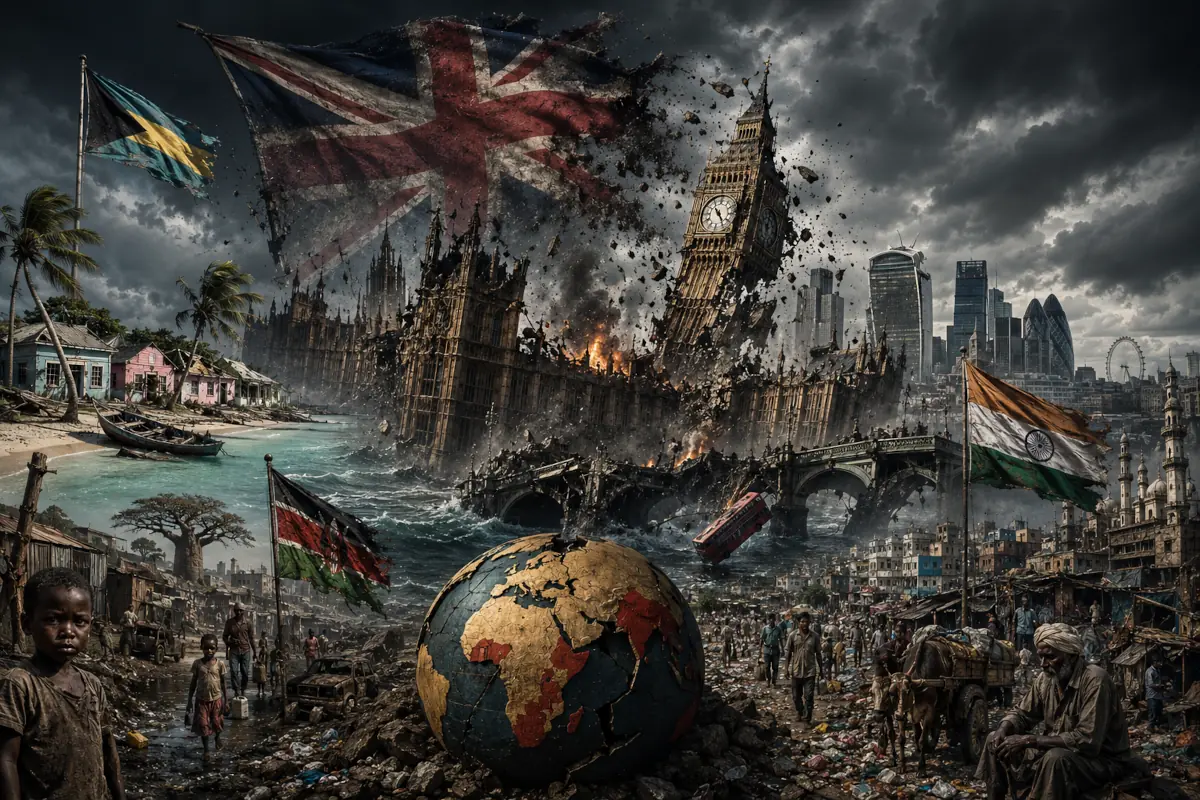
The Post-Colonial State Failure
The collapse in Westminster mirrors a historical drama: When competence is replaced by ideology, collapse inevitably follows. A raw analysis of infrastructure decay in South Africa, the decline of the Bahamas, and why the former mother
The Imploding Mother Country: Starmer, Westminster, and the End of Competence
On June 22, 2026, Sir Keir Starmer stood with a tear-choked voice before the historic door of 10 Downing Street to announce his resignation after just two years in office. Broken by internal revolts, crushed by historic defeats in local elections, and driven by an unprecedented loss of public trust, he leaves behind a country in a state of permanent political agony. Britain is now preparing for its seventh Prime Minister in just ten years—a frequency of political instability that Washington elites once mockingly associated only with so-called "banana republics."
Yet, Starmer's fall is not an isolated British phenomenon. It is the symptom of a deeper, systemic disease that has gripped the former heart of the largest empire in history: the replacement of meritocracy with ideology, the failure to protect critical infrastructure, and an administrative surrender to populist pressure. Anyone who takes an unvarnished look at London’s current permanent crisis—the idle management of economic stagnation, the inability to maintain control over its own borders, and the rise of forces like Reform UK—will find the exact same structural mechanisms that triggered the tragedy of decolonization decades ago. Today, the Empire is imploding at its core because it is repeating the very mistakes it made during its hasty retreat from its colonies.
When a state stops filling its institutions with the most capable minds and instead distributes positions based on political loyalty and ideological conformism—as Starmer painfully demonstrated with the catastrophic appointment of the Epstein-tainted Peter Mandelson as US Ambassador—the foundational fabric rots. And it was precisely this rot that plunged former colonies into chronic instability after the British Crown withdrew.
Southern Africa: From Economic Engine to Structural Failure
What we are witnessing today in the microcosmic chaos of Westminster has been playing out on a macrocosmic scale across the former crown colonies and dominions of Southern Africa for decades. A region that once possessed the most modern infrastructure, the most stable judicial system, and the most productive agriculture on the entire continent is now suffering from the devastating consequences of an ideologized political environment that prioritizes ethnic loyalty and partisan clientelism over economic and administrative competence. Britain's hasty withdrawal left behind functioning systems that were not developed further by the new governments, but systematically stripped of their substance.
Our Readers Also Read:Crisis of the Center: Germany remains paralyzed by political agony and polarization. While populist promises shatter against the hard reality of the rule of law, established forces merely manage scarcity. The solution lies in a forgotten synthesis of Christian ethics and classical liberty. By Michael KirschbergerBavaria's Queer Action Plan (Tax Dollars for Islamist Associations?): Bavaria's new "Aktionsplan QUEER" is causing massive controversy: For radicalization prevention, the state is partnering with the tax-funded association ufuq.de. Critics warn of the downplaying of Sharia and Jihad, and a creeping Islamization of our education system. By Paul Fisher
The Creeping Collapse of South Africa Under the ANC
Following the end of Apartheid in 1994, South Africa was hailed by American observers as the ultimate global promise of a peaceful, post-colonial transition. Yet, over three decades later, the former economic powerhouse stands on the precipice of becoming a failed state. The most glaring and destructive symbol of this decline is the catastrophic, chronic power crisis.
The state-owned utility Eskom, which under Western technocratic management was once one of the most efficient and advanced electricity producers in the world, has been ruined by decades of mismanagement, rampant corruption, and the politically enforced abandonment of meritocratic principles. Under the banner of Black Economic Empowerment (BEE), key positions in sensitive infrastructure were awarded based on ethnic affiliation and party loyalty rather than qualifications and technical expertise.
The result is a ruined power grid and daily, hours-long blackouts (rolling blackouts) that paralyze domestic industry, deter foreign investors, and destabilize the daily lives of citizens.
In parallel, the country's logistical arteries are failing: the rail network of the state-owned enterprise Transnet and the major deepwater ports have been so poorly managed and plagued by sabotage and theft that the vital export of commodities can barely be sustained. It is the exact African equivalent to the decaying public services in contemporary Britain: when ideology replaces competence, infrastructure dies.
The Tragedy of Farm Murders and the Loss of Food Security
A particularly dark and heavily suppressed chapter of South African reality in the US mainstream media is the ongoing wave of extremely brutal violence against white farmers. These so-called farm murders are not just human tragedies; they are the result of an inflamed political rhetoric that scapegoats the white economic backbone of the country to distract from the government's own political failures.
The systematic displacement, threats of expropriation, and rampant crime targeting this agricultural minority—who over generations built up the highly complex logistical know-how for commercial large-scale farming—now acutely threaten national food security.
Neighboring Namibia is currently walking a similarly precarious tightrope. While its post-independence transition was initially more pragmatic, growing populist pressure on white landowners and demands for radical land reform threaten to trigger the exact same economic domino effects that degraded Southern Africa from a net food exporter to a permanent beggar of international aid.
Historical Warning Signs: Zimbabwe’s Agricultural Collapse and Ethnic Cleansing in East Africa
The disastrous pattern emerging in South Africa today is nothing new. Post-colonial history is rich with examples demonstrating an undeniable truth: the expulsion or forced migration of qualified minorities who form the logistical, financial, and administrative backbone of a state is the most reliable death sentence for any economy. Where the colonial rule of law yields to ethnic nationalism, economic suicide inevitably follows.
Zimbabwe: How the "Breadbasket of Africa" Became a Famine Zone
The most drastic lesson in post-colonial decline was delivered by the former Rhodesia, which became Zimbabwe after independence. Under the decades-long rule of Robert Mugabe, the violent, racially motivated expropriation of white farmers was elevated to state doctrine at the turn of the millennium. Until that point, the country possessed a highly mechanized, extremely productive agricultural industry that not only fed its own population but served as the export engine for the entire region.
Mugabe’s actions were a classic display of post-colonial delusion: to deflect from his own corruption and economic incompetence, white-owned farms were handed over to violent occupations. However, these fertile lands were not given to experienced, qualified farmers, but were distributed as political spoils to loyal party members, generals, and cronies of the regime.
The bill arrived swiftly: within a few years, agricultural production plummeted by over 80 percent. Zimbabwe, the former "breadbasket of Africa," mutated into an international beggar plagued by famines, a total loss of foreign currency reserves, and historically unprecedented hyperinflation. The destruction of a minority's know-how ruined the livelihoods of the entire black majority population.
Uganda 1972: The Expulsion of the Indian Merchant Class
An equally devastating, though geographically distinct, example occurred in East Africa. Under the notorious dictator Idi Amin, Uganda executed an economic self-mutilation in 1972 that set the country back by decades. Amin ordered the immediate expulsion of the country's roughly 80,000 residents of Indian descent.
The crucial factor was that the Indian minority, purposefully integrated during British rule, formed the irreplaceable commercial, medical, and administrative backbone of the nation. They controlled the vast majority of urban retail, banking, transport companies, and industrial production.
With their expulsion—and the subsequent transfer of their businesses to unqualified cronies of the military regime—the Ugandan economy collapsed virtually overnight. Supply chains snapped, store shelves emptied, and the state’s administrative system dissolved into chaos.
Both in Zimbabwe and Uganda, the same law of the post-colony manifested: racially motivated hatred toward supposedly privileged minorities proved stronger than economic reason. The new regimes proved entirely incapable of managing the complex economic cycles left behind by Great Britain without the expertise of those who had built them.
The Caribbean Illusion: The Bahamas After 50 Years of Independence
When viewed from an American perspective, the Bahamas is often seen merely as a nearby, polished vacation destination for US tourists and a synthetic facade of luxury resorts in Nassau. Yet, away from the exclusive sandy beaches curated for foreign travelers, the bitter reality of a 50-year decline unfolds. Since the departure of the British colonial administration in 1973, the island nation has transformed from a stable, orderly outpost of the Crown into a territory fractured by structural crises.
A Logistical Hub for Organized Crime
Under the British flag, the Bahamas stood as a stable, well-regulated financial and commercial center anchored by the reliability of English Common Law. With the withdrawal of colonial institutions, however, an administrative control vacuum emerged that the new authorities were neither equipped nor willing to fill.
Due to its geographical proximity to the US coast and the extreme vulnerability of its newly underfunded security architecture to corruption, the islands mutated over the post-independence decades into a primary transit hub for international drug trafficking and modern human smuggling.
At the same time, infrastructure outside the protected tourist enclaves is visibly decaying. The road networks, the chronically unreliable power grid, and public institutions are dilapidated. This is the direct result of a bloated bureaucracy where public funds disappear into nepotistic networks rather than being reinvested into maintaining the country.
Extreme Debt, Corruption, and Post-Colonial Hubris
The post-colonial leadership of the Bahamas long lulled its population into the illusion that mass tourism and an opaque offshore banking sector could indefinitely mask the complete absence of a real economic strategy. Without the fiscal discipline imposed by the British Treasury, however, the country amassed an immense mountain of debt. Loans were rarely invested into sustainable, future-oriented projects; instead, they served as financial grease to maintain the ruling party's grip on power.
The initial euphoria of independence has given way to deep societal disillusionment. The fundamental flaw of decolonization became painfully obvious: the new rulers inherited the colonial offices, mansions, and titles, but failed to inherit the discipline, administrative ethos, and generations-deep logistical knowledge of the British civil servants. The result is a pronounced societal hubris that stands in stark contrast to the country's real economic impotence.
The Paradox of Racism: The Persecution of Haitians
The moral and structural decline is most drastically revealed in the deep-seated, often violent racism directed toward Haitian migrants. While the post-colonial rhetoric of the Bahamian elite celebrates liberation from white dominance in public speeches, today's black majority society practices a systematic, merciless exclusion of impoverished black immigrants fleeing the crisis-torn neighboring state of Haiti.
Haitians, who provide the cheap labor that fills the lowest-paying jobs on the islands, are routinely scapegoated for self-inflicted economic woes, institutionally discriminated against, arbitrarily detained, and socially ostracized. This is the ultimate paradox of the post-colony: following the departure of the Europeans, the formerly oppressed have themselves become the ruthless oppressors of an even weaker minority.
The Structural Mechanisms of Post-Colonial Decay
A comparative analysis of African nations and the Caribbean demonstrates that post-colonial decline is not a series of isolated, geographic anomalies. It is the output of a predictable, structural pattern. When experienced elites—whether white, Indian, or colonial-trained—are abruptly removed from a nation's equation, three destructive mechanisms inevitably take hold:
- Ideology Over Competence (The Triumph of Clientelism): In a functioning state, the staffing of key positions in the judiciary, economy, and infrastructure relies on the principle of meritocracy. In post-colonial contexts, this principle is almost always replaced by ethnic nepotism and partisan clientelism. State positions are treated as political plunder. When sensitive core infrastructure is managed based on ideological alignment rather than technical expertise, collapse is mathematically guaranteed.
- The Exodus of Human Capital (Brain Drain and Capital Flight): The forced or crime-induced flight of minorities deprives affected nations of both liquid capital and irreplaceable technological knowledge. This knowledge cannot be replicated by revolutionary rhetoric. The new governments frequently found themselves in charge of highly complex systems that they simply did not know how to maintain.
- The Erosion of the Rule of Law: British colonial rule left behind a priceless legacy in Common Law and independent courts—structures that guaranteed property rights and contractual security, the absolute prerequisites for prosperity. With the rise of post-colonial nationalism, these structures were dismantled as "imperialist." Without the protection of property, state institutions mutate into tools for regime self-enrichment, causing international investor confidence to vanish.
The Unvarnished Balance Sheet and the Bitter Irony of the Present
The historical reality of the post-colonial era demands a raw assessment that fundamentally contradicts the moralizing narrative prominent in American academia. The hasty abandonment of the protective, organizing, and disciplined hand of the British Crown did not lead the affected countries into an era of liberty and collective wealth. Instead, the experiment of decolonized self-governance all too often ended in chronic instability, economic agony, and functional decay.
Nations that blindly dismantle functioning administrative and legal frameworks out of ideological delusion rob themselves of their own future. A longer, more pragmatic retention of proven colonial administrative systems, a uncompromising enforcement of meritocracy, and the protection of productive minorities could have spared these societies decades of misery. True sovereignty is not demonstrated by tearing down the old, but by the capacity to permanently secure order, safety, and prosperity for all citizens.
The Epicenter of Decay: London as a Mirror of Its Former Colonies
The deepest and most bitter irony of this historical trajectory, however, reveals itself in 2026 within the mother country itself. When we look at the political chaos in Westminster today—at the logistical failure of British migration policy, the uncontrolled borders, the crumbling infrastructure of the National Health Service (NHS), and the spectacular collapse of Keir Starmer's government after just two years—we are not viewing an isolated British phenomenon.
We are viewing a Great Britain infected by the exact same structural diseases it once left behind in its colonies. Modern London is repeating the fatal mistake of prioritizing ideology and partisan conformity over technical competence and merit. While British elites spent decades nurturing post-colonial guilt complexes, they systematically hollowed out the very institutions that once formed the foundation of a global empire.
In the 21st century, the Empire is no longer collapsing at its distant peripheries, but at its source. The decay of the rule of law, infrastructure, and meritocracy in the former colonies of Africa and the Caribbean was not an African or Caribbean anomaly—it was the timeless, universal law of state decay. A law that today, in the summer of 2026, has struck Downing Street with full force. Those who close their eyes to this reality understand neither the tragedy of the past nor the crisis of the present.