Surviving Subversion: How the US Can Defend Its Constitution
The American Republic faces an asymmetric challenge. While the First Amendment shields freedom of belief, it was never designed to protect a political framework aiming to replace secular law with a theocratic order. To survive, the US must aggressively utilize its existing constitutional tools.
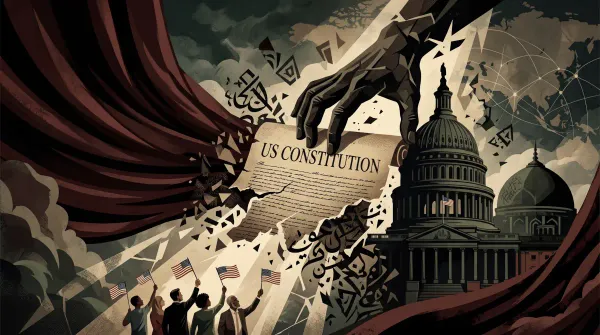
Subversion from Within: The Theocratic Assault on the US Constitution
The Blind Spot of the First Amendment
The American Republic is facing an asymmetric doctrinal challenge. For decades, the political and academic establishment has operated under a protective illusion: that Islamism is merely a fringe, radical distortion of a privatized faith. This categorical error threatens the very survival of the constitutional order.
Unlike Western Christianity, which evolved through the Enlightenment to accept a dualism between God and Caesar, orthodox Islam recognizes no separation between civil law and divine fiat. When an entire system treats human legislation as an act of apostasy and commands the eventual implementation of a global, divine law (Sharia), it ceases to be a mere confession of faith. It becomes a totalizing political project.
By leveraging the absolute protections of the First Amendment, radical networks within the United States are executing a long-term strategy of legal and cultural exceptionalism. The question is no longer whether this friction exists, but whether the United States has the strategic clarity to defend its sovereignty before its legal infrastructure is hollowed out from within.
The Theological Blueprint: Sharia Over Sovereignty
The core incompatibility between American jurisprudence and Islamic law is found directly in the foundational texts of Islam. The United States Constitution begins with the phrase "We the People," establishing human agency as the sole source of political legitimacy. The Quranic framework diametrically opposes this premise:
The Condemnation of Secular Law: Those who govern by man-made legal codes rather than divine revelation are explicitly cast out of the faith.
"And whoever does not judge by what Allah has revealed — then it is those who are the disbelievers." — Surah 5 (Al-Māʾida), Verse 44
The Rejection of Democracy (Shirk al-Hakimiyyah): In orthodox theology, the act of a human parliament voting on laws is viewed as an encroachment on Allah’s exclusive sovereignty.
"The command is for none but Allah." — Surah 12 (Yūsuf), Verse 40
In the American legal system, this creates an unresolvable paradox. As a prominent Muslim attorney famously argued in a US court transcript: “Islam is Sharia; Sharia is Islam. The two cannot be separated.” When the divine text commands that God's law must supersede all human conventions, every orthodox adherence to the totality of the text becomes an implicit rejection of the US Constitution.
The Voices of Subversion: Contemporary Imams and Clerics in the West
The assertion that Islam aims for political dominance is not a caricature invented by critics; it is openly preached by prominent Islamic figures operating inside the United States and the wider Anglo-American sphere.
Muzammil Siddiqi (Chairman of the Fiqh Council of North America)
Siddiqi, who has frequently been invited to interfaith events and government functions, has been explicit about the long-term goals of Muslims in America regarding the legal order:
"The institutions of America are conditionally acceptable, provided they do not violate Islamic principles. But ultimately, Muslims must establish Islamic law. If we are in a minority, we comply with the laws of the land, but we must work to create a society where Sharia is the supreme law."
Siraj Wahhaj (Imam of the Al-Taqwa Mosque in Brooklyn, New York)
Wahhaj, an influential American-born cleric who delivered the first Islamic invocation to the US House of Representatives, regularly preaches on the fundamental illegitimacy of the American system:
"In time, this so-called democracy will crumble, and there will be nothing left but Islam. [...] If Muslims are clever politically, they will take over the country and replace the Constitution with the unalterable law of Allah."
Haitham al-Haddad (Prominent UK-based Sharia Judge with extensive Western influence)
Al-Haddad reinforces the global, uncompromising nature of the legal struggle, warning Western Muslims against assimilating into secular constitutional frameworks:
"Sovereignty belongs to Allah alone. Any Muslim who believes that a secular parliament has the right to legislate contrary to Sharia has committed an act that nullifies their Islam. The West is in a state of moral collapse, and Islam is the alternative that will govern."
Facts, Numbers, and the Strategy of "Civilization Jihad"
The institutional framework for this subversion was captured definitively by federal investigators. During the landmark Holy Land Foundation trial—the largest terrorism-financing prosecution in US history—the FBI uncovered a strategic master plan written by the Muslim Brotherhood titled The Explanatory Memorandum on the General Strategic Goal for the Group in North America.
The document states unequivocally that their work in America is a form of grand jihad:
"...a 'grand Jihad' in eliminating and destroying the Western civilization from within and 'sabotaging' its miserable house by their hands and the hands of the believers so that it is eliminated and God's religion is made victorious over all other religions."
The Statistical Reality (Data and Trends)
- Institutional Proliferation: According to national mosque surveys, the number of mosques in the United States grew from 1,209 in 2000 to over 2,769. This expansion is heavily clustered in critical swing states like Michigan, Ohio, and Pennsylvania.
- Foreign Funding: Intelligence reports indicate that billions of dollars in foreign state capital (primarily from Qatar and Saudi Arabia) have been funneled into American universities and cultural centers over the past two decades. This funding directly subsidizes academic chairs and student organizations designed to shield political Islam from critical civic scrutiny.
- The Sharia Push: In major urban centers across the West, there is a measurable increase in demand for parallel religious courts. In the UK, over 85 formal and informal Sharia councils operate openly. In the US, organizations like the Fiqh Council of North America quietly issue binding religious rulings (fatwas) that govern family law, finance, and community standards, deliberately bypassing local state courts.
The Path to Sovereign Self-Defense
The United States cannot survive this civilizational pressure if it continues to treat political networks as protected religious entities. The Constitution provides the exact tools necessary for national self-preservation, provided the executive and legislative branches find the courage to use them:
- Enforce Foreign Agent Registration (FARA): Every mosque, advocacy group (such as CAIR), and university department that receives funding from foreign fundamentalist regimes must be forced to register as a foreign agent. This strips away their domestic legitimacy and exposes the financial pipeline of subversion.
- Criminalize Sedition and Subversive Activity: Under 18 U.S. Code § 2385 (The Smith Act framework), it is a federal crime to knowingly advocate, advise, or teach the duty, necessity, or propriety of overthrowing or destroying the government of the United States. Organizations that distribute literature calling for the replacement of the US Constitution with Sharia must be prosecuted under national security statutes.
- Ban Foreign Funding of Religious Infrastructure: Following the legislative models pioneered by European nations like Austria and France, the US must pass federal legislation outlawing the foreign state financing of domestic religious institutions, ensuring that external actors cannot buy ideological real estate on American soil.
A Republic, If You Can Keep It
When Benjamin Franklin emerged from the Constitutional Convention, he warned that America was a republic—if you can keep it. The greatest threat to the nation does not come from foreign militaries, but from an aggressive, patient political theology that exploits the tolerance of a free society to achieve its eventual destruction.
The United States must shake off its paralyzing fear of being labeled intolerant. To protect the First Amendment, the rule of law, and individual liberty for future generations, the nation must aggressively confront the infrastructure of political Islam. The Constitution is a shield for freedom of conscience; it must never be used as a weapon for its own execution.
Written by
Read next

Why Europe's Richest Nation Always Thinks It's About to Collapse
Germany is Europe's largest economy, yet millions believe the country is falling apart. From Hamburg's legendary complainers to the phenomenon of "German Angst," discover why pessimism has become part of Germany's national identity—and why Americans often misunderstand it.Washington’s Dangerous Capitulation to Riyadh
The U.S.-Saudi nuclear agreement is a historic capitulation: Washington hands Riyadh the path to uranium enrichment, shatters the UAE gold standard, and betrays Israel. A dangerous pact that severely threatens global security and Middle East peace.
Trump’s Iran Peace Deal Fails: Tehran Puts US and UK Leaders on Death List
Trump’s Iran Illusion Shatters: Following the total collapse of the Islamabad Memorandum in July 2026, Tehran’s state-backed Hamshahri newspaper has put Donald Trump and Keir Starmer in crosshairs on a death list. Trump’s corporate diplomacy has failed, pushing the West toward a major war.
A Torrent of Evidence in a Darkening World
In Imported Hate, Alvan Bovay demonstrates how global antisemitism was unleashed following October 7, 2023. Through evidence on UNRWA, the Red-Green Alliance, and digital influence warfare, this book review analyzes the systemic failure of Western leadership and offers a roadmap for freedom.
The Unstoppable Fracture: Is the Democratic Party Splitting?
The Michigan primary between Haley Stevens and Abdul El-Sayed exposes a fatal divide. Why analysts predict a formal split in the Democratic Party that will change America forever.
TikTok’s Double Standard: ‘Israel Will Live’ Removed
TikTok removed TaktGEFLECHT’s song “Israel Will Live,” released through Die Vossische. At the same time, Salafist influencers and radical channels reach millions of viewers. The article examines whether the platform applies unequal standards when moderating political and religious content.