The Bahamas Fallacy: How Nationalism Masks a Failing State
Beyond the aquamarine waters, the Bahamas has hit a catastrophic rock bottom. From hijacked church pulpits to collapsing public schools and rising xenophobia, hyper-nationalism is being used to mask systemic corruption. A raw, investigative look at a Caribbean dream in freefall.

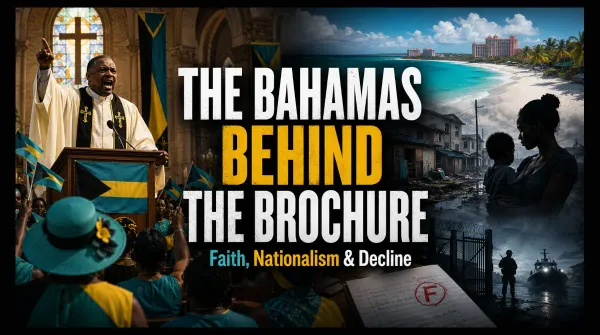
FREEPORT, Grand Bahama — To the casual observer, the scene inside Mary Star of the Sea Catholic Church in Freeport on Independence Sunday was a vibrant, postcard-perfect display of Caribbean piety. The pews were a sea of aquamarine, gold, and black. Parishioners proudly wore the national colors, nodding in unison as a female lay reader stepped up to the ambo to proclaim the Gospel—a local, pragmatic dispensation in a parish short on ordained deacons.
The congregation was beautifully diverse on the surface: Filipino guest workers who keep the local service sector alive, a handful of white Canadian and American expats, and a majority of local Bahamians.
But as the opening hymns faded, the universal nature of the Catholic liturgy dissolved. What followed was not a sermon on Christian grace, transcendence, or human dignity. Instead, the pulpit was hijacked.
For nearly forty minutes, the congregation was subjected to a hyper-nationalistic, political lecture. The priest delivered an aggressive monologue focused entirely on border control, immigration enforcement, and the brilliance of the Bahamian state. There were soaring, partisan prayers for Prime Minister Philip "Brave" Davis—whose Progressive Liberal Party (PLP) just secured a tight, early-called re-election in May 2026. The homily lauded the absolute authority of Customs and Immigration departments as if they were extensions of the Holy Trinity.
It was a striking, uncomfortable realization for the outsiders in the room: This was no longer a church service for Catholics. This was an exclusive, ethno-nationalist rally for Bahamians, weaponized by the cloth to distract from a brutal reality.
Behind the independent flags and the self-congratulatory applause, the modern Bahamas has hit a catastrophic rock bottom.
The Illusion of Independence: 53 Years of Systemic Decline
The contrast between the pulpit’s rhetoric and the reality outside the church walls is staggering. More than half a century after gaining independence from Great Britain, the Bahamas is wrestling with institutional rot that no amount of national pride can mask.
1. The Education Collapse and the "Brilliance" Paradox
While the national narrative relentlessly promotes an innate "Bahamian brilliance," the country’s public education system is in freefall. Standardized national exam averages have languished at D-grades for over a decade. A failing school system has created a widening skills gap, leaving the younger generation woefully unprepared for a globalized economy. The paradox is toxic: an inflated sense of national exceptionalism masking a desperate lack of educational infrastructure.
2. Corruption and Broken Promises
Prime Minister Davis’s administration secured its historic consecutive term by promising a "Blueprint for Progress," immediately expanding his executive branch into one of the largest, most expensive Cabinets in Bahamian history—totaling 28 ministers. Yet, on the ground in Grand Bahama, the skepticism is palpable. Decades of structural promises have yielded little more than deep-seated political patronage, systemic corruption, and stalled infrastructure projects. The local economy remains fragile, dependent entirely on volatile tourism cycles while everyday locals face soaring costs of living.
+-----------------------------------------------------------------------+
|                 THE REALITY BEHIND THE TOURIST BROCHURE               |
+-----------------------------------------------------------------------+
| • Education Crisis: National exam averages stagnant at D-levels.       |
| • Political Expansion: Massive 28-member Cabinet amid structural decay.|
| • Social Fractures: Record deportations and rising domestic poverty.   |
+-----------------------------------------------------------------------+
The Matriarchal Burden: The Crisis of Fatherless Homes
The structural decay of the Bahamas is not confined to government buildings or failing schools; it is tearing at the fabric of the Bahamian family. Walk through the neighborhoods of Freeport or Nassau, and a stark demographic reality emerges: the overwhelming majority of households are anchored solely by struggling single mothers.
This crisis is rooted in a toxic blend of historical trauma and modern economic despair. The legacy of the plantation economy historically fractured the traditional family unit, creating a cycle of matrifocality where men were systematically decoupled from the household. Decades later, this pattern has hardened into a cultural norm.
In a society where young men are denied genuine avenues of economic mobility due to a broken school system, masculinity has been reduced to a numbers game. Procreating with multiple women without overextending a hand of financial or emotional responsibility has become a cheap surrogate for actual social status. Biological fatherhood is widely celebrated; the grueling, daily labor of active parenting is routinely abandoned.
This behavior is actively enabled by institutional failure. The Bahamian state lacks the legal teeth and enforcement mechanisms to systematically collect child support from elusive fathers. More damningly, the highly political local churches—so vocal about border control and national identity—remain largely silent on the pulpit regarding the epidemic of deadbeat dads. While the choir sings of national pride, single mothers are left entirely alone to carry the crushing weight of inflation, childcare, and a collapsing society.
Scapegoating the Outsider: Rising Xenophobia in the Pews
When a state fails to provide basic economic mobility and functional public services, it invariably manufactures a scapegoat. The Bahamas is no exception.
The political fixation on "immigration and customs" during a Sunday sermon is a direct reflection of a dark social shift. As poverty deepens throughout the archipelago, xenophobia is being actively mainstreamed.
- The Haitian Crisis: The primary targets of this societal frustration are Haitian migrants. Fleeing unimaginable gang violence and state collapse in their homeland, tens of thousands of Haitians arrive in the Bahamas seeking survival. Instead, they face aggressive, militarized crackdowns. The Bahamas Department of Immigration routinely posts daily tallies of mass convictions and swift repatriations.
- The Expat Backlash: The resentment is no longer contained to undocumented migrants. As economic desperation spreads, an underlying hostility toward foreign professionals and white expats is growing. The very people who inject capital, technical expertise, and diverse cultures into the local economy are increasingly viewed through a lens of defensive tribalism.
The deep irony of the Freeport service was that Filipino workers actively helped organize the liturgy, and international expats sat quietly in the back rows. They listened to a sermon that functionally categorized them as transactional utilities or security threats, rather than brothers and sisters in faith.
A Dangerous Spiritual and Political Vacuum
When the Christian altar is transformed into a megaphone for state border policies, the church abdicates its moral authority. By replacing the gospel of universal human dignity with a gospel of national sovereignty and border enforcement, the institution becomes complicit in the state's failures.
Hyper-nationalism is a cheap anesthetic for a dying society. It feels powerful in the moment, especially when wrapped in the flag and sung from a hymnal. But when the benediction is over and the congregation steps outside, the underlying rot remains.
The Bahamas cannot boast its way out of an education crisis. It cannot pray away institutional corruption by deifying its politicians. Until the nation confronts its internal failures—rather than blaming immigration, customs gaps, and the outside world—the independent Bahamian dream will remain a luxury reserved strictly for the tourist brochures.
Written by
Read next
The Fall of New York: How the Democrats and Zohran Mamdani Are Radicalizing America’s Crown Jewel
With the rise of Zohran Mamdani in New York City, pragmatic liberalism has collapsed. A radical alliance of democratic socialists and ideologues drives a creeping transformation of the metropolis, while antisemitic hate crimes on the streets reach historic, deeply alarming local peaks.The Dark Secret Behind Nassau’s Luxury: What Happens Inside Fox Hill
Away from the mega-yachts and turquoise waters of Nassau, a medieval engine of human degradation hums. Discover the brutal reality inside Fox Hill Prison—a state-administered catastrophe of strategic starvation and systemic torture, actively sustained by the machinery of the US government.
The Bahamas Real Estate Trap: Why Buying Property in Paradise is a Financial Disaster
The Bahamian real estate market is a highly predatory illusion. Driven by real estate agents who paper over systemic risks, naive buyers systematically underestimate the true, long-term cost of ownership, from paralyzing market stagnation and hidden fees to the physical collapse of the coastline.
The End of an Era? The Crisis of the British Monarchy
King Charles III’s shift from "Defender of the Faith" to a "protector of faith" signals a profound change. This move threatens to erode the Christian identity that has anchored the British monarchy for centuries, fueling a deeper debate on cultural survival and institutional legitimacy.
A Torrent of Evidence in a Darkening World
In Imported Hate, Alvan Bovay demonstrates how global antisemitism was unleashed following October 7, 2023. Through evidence on UNRWA, the Red-Green Alliance, and digital influence warfare, this book review analyzes the systemic failure of Western leadership and offers a roadmap for freedom.
The Unstoppable Fracture: Is the Democratic Party Splitting?
The Michigan primary between Haley Stevens and Abdul El-Sayed exposes a fatal divide. Why analysts predict a formal split in the Democratic Party that will change America forever.
TikTok’s Double Standard: ‘Israel Will Live’ Removed
TikTok removed TaktGEFLECHT’s song “Israel Will Live,” released through Die Vossische. At the same time, Salafist influencers and radical channels reach millions of viewers. The article examines whether the platform applies unequal standards when moderating political and religious content.