The Bahamas Trap: Why US and Canadian Investors Are Fleeing Paradise
Behind the postcard-perfect turquoise water of the Bahamas lies a predatory bureaucratic machine. While Nassau demands global mobility for its own citizens, North American property owners and expats face systemic shakedowns, institutional corruption, and an unsustainable economic mirage.

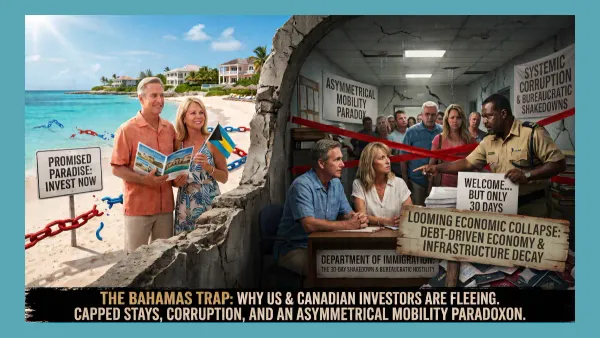
The Bureaucratic Hostility, Systemic Corruption, and Economic Mirage Threatening North American Investors
The Bahamas has long marketed itself to Americans and Canadians as the ultimate tax haven and tropical sanctuary. Glossy real estate brochures promise a seamless transition to island life, enticing affluent winter residents to dump millions into luxury condos and beachfront estates.
But behind the carefully curated tourism campaigns lies a predatory bureaucratic machine, systemic public-sector corruption, and a staggering national debt crisis. For many North American expats and property owners, the dream of paradise is rapidly turning into a costly cautionary tale of institutional decay and administrative hostility.
The 30-Day Dictate: Shakedown Tactics for North American Property Owners
The most glaring absurdity of the Bahamian system is the aggressive asymmetry in its immigration policy. Bahamian citizens enjoy immense global mobility, including streamlined, visa-free access to Canada, the United Kingdom, and the European Schengen Area.
Yet, when American and Canadian citizens—the literal lifeblood of the Bahamian economy—attempt to spend extended time on the islands, they face an iron curtain of bureaucratic suspicion.
- Arbitrary Entry Restrictions: Despite pouring millions into the local economy via the International Persons Landholding Act, US and Canadian winter residents are routinely humiliated at the border. Inbound immigration officers frequently grant affluent property owners a meager 30 days of entry stamp.
- The "Extension of Stay" Extortion: If an American or Canadian wants to stay for the winter to manage their own multi-million dollar property, they are dragged into a humiliating residency shakedown. The Department of Immigration demands a steep, non-refundable $200 USD application fee just to request an extension. Property owners are forced to appear in person, present return tickets, undergo invasive background scrutiny, and provide exhausting financial audits—treating high-net-worth investors like flight risks.
- The Hostile Expat Environment: For foreign professionals (expats) trying to bring specialized skills to the islands, the system is explicitly designed to exclude them. Annual Work Permits carry extortionate five-figure fees and are tightly gatekept under a aggressively protectionist "Bahamianization" doctrine that suffocates innovation and foreign capital.
A Sovereign Shakedown: Systemic Corruption and Institutional Decay
The administrative machinery in Nassau is notoriously sluggish, opaque, and highly susceptible to nepotism. While Transparency International’s Corruption Perceptions Index technically ranks the Bahamas relatively high for the region, local business chambers and foreign chambers of commerce paint a much darker picture of daily operations.
"Without political connections or the right financial 'lubrication,' the wheels of the Bahamian bureaucracy simply do not turn." – From an internal report on foreign direct investment.
Whether an American or Canadian investor is trying to secure a building permit, clear essential construction materials through Customs, or navigate the Residency Permit backlog, they are met with manufactured delays. Bureaucratic bottlenecks are frequently weaponized by public officials to solicit bribes or favor local political cronies. For foreign property owners, this institutional rot translates into a never-ending cycle of hidden costs and legal vulnerabilities.
The Sovereign Debt Time Bomb: A Failed Micro-Economy
From a macroeconomic standpoint, the Bahamas is skating on incredibly thin ice. According to data from the Central Bank of the Bahamas and international financial agencies, the country’s sovereign debt-to-GDP ratio sits at a precarious 77.1 %—failing to fully recover from pandemic-era spikes that cleared 95%.
- The Illusion of Solvency: Leading economists warn that under current structural constraints, the Bahamas can never realistically repay its mounting debt. The entire national budget is entirely co-dependent on a volatile tourism sector (which is highly vulnerable to hurricanes and US economic downturns) and a rapidly shrinking offshore banking industry.
- Severe Structural Deficits: Because the islands possess virtually zero domestic agricultural or industrial manufacturing capabilities, nearly every consumer good must be heavily imported. The vast majority of government revenue is consumed by a massive, bloated public sector and astronomical debt servicing, leaving the country's public infrastructure in shambles.
4. House-Made Impoverishment: The Demographic Breaking Point
While the Bahamian ruling class and foreign enclaves live in fortified luxury on Paradise Island or exclusive patches of New Providence, the country’s domestic social fabric is fraying.
- The Cycle of Local Poverty: For decades, the lower socio-economic demographics of the Bahamas have maintained persistently high birth rates. When combined with a chronically failing public education system and a lack of economic diversification outside of entry-level hospitality jobs, the risk of structural poverty has multiplied exponentially.
- An Infrastructure at the Brink: Public security, social safety nets, and healthcare systems are critically underfunded. The relentless population boom within the urban slums of Nassau (such as the "Over-the-Hill" districts) has driven up violent crime rates, youth unemployment, and profound social instability.
Conclusion: The Final Verdict for Investors
The government in Nassau operates with a staggering level of geopolitical hubris. They demand effortless global mobility for their own citizens while treating the very North Americans who fund their economy with deep administrative suspicion and bureaucratic malice.
For US and Canadian tourists, expats, and real estate buyers, the message is clear: the Bahamas is a predatory paradise. Until Nassau implements radical transparency, reins in its corrupt immigration regime, and diffuses its fiscal time bomb, your capital is far safer elsewhere. The tropical postcard is simply no longer worth the sovereign risk.
Buying Property Bahamas, Bahamas Expat Restrictions, Bahamas Corruption, Moving to the Bahamas, Bahamas Real Estate Warning, Nassau Immigration Rules, Caribbean Investment Risk
Written by
Read next

Zohran Mamdani and New York’s Radical Left Turn
Zohran Mamdani’s rise to City Hall marks more than a generational change in New York politics. It signals a rupture inside American liberalism itself — one that places socialism, anti-Zionist activism, and identity politics at the center of municipal power.The Dark Secret Behind Nassau’s Luxury: What Happens Inside Fox Hill
Away from the mega-yachts and turquoise waters of Nassau, a medieval engine of human degradation hums. Discover the brutal reality inside Fox Hill Prison—a state-administered catastrophe of strategic starvation and systemic torture, actively sustained by the machinery of the US government.
The Bahamas Real Estate Trap: Why Buying Property in Paradise is a Financial Disaster
The Bahamian real estate market is a highly predatory illusion. Driven by real estate agents who paper over systemic risks, naive buyers systematically underestimate the true, long-term cost of ownership, from paralyzing market stagnation and hidden fees to the physical collapse of the coastline.
The End of an Era? The Crisis of the British Monarchy
King Charles III’s shift from "Defender of the Faith" to a "protector of faith" signals a profound change. This move threatens to erode the Christian identity that has anchored the British monarchy for centuries, fueling a deeper debate on cultural survival and institutional legitimacy.
A Torrent of Evidence in a Darkening World
In Imported Hate, Alvan Bovay demonstrates how global antisemitism was unleashed following October 7, 2023. Through evidence on UNRWA, the Red-Green Alliance, and digital influence warfare, this book review analyzes the systemic failure of Western leadership and offers a roadmap for freedom.
The Unstoppable Fracture: Is the Democratic Party Splitting?
The Michigan primary between Haley Stevens and Abdul El-Sayed exposes a fatal divide. Why analysts predict a formal split in the Democratic Party that will change America forever.
TikTok’s Double Standard: ‘Israel Will Live’ Removed
TikTok removed TaktGEFLECHT’s song “Israel Will Live,” released through Die Vossische. At the same time, Salafist influencers and radical channels reach millions of viewers. The article examines whether the platform applies unequal standards when moderating political and religious content.