The Islamabad Syndrome: How Trump’s Deal with Teheran Revived Hezbollah
The Islamabad Memorandum promised peace, but Trump’s deal with Iran has backfired. Driven by billions in unfrozen assets and Washington’s diplomatic naivety, a battered Hezbollah is staging a dangerous comeback in Lebanon—and now openly threatens the central government with an armed coup.
Introduction: The Illusion of Peace at Versailles
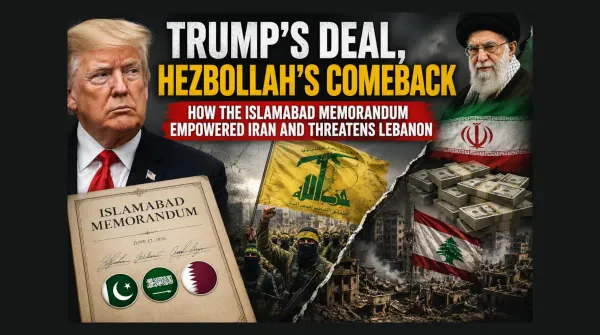
When President Donald Trump sat down for dinner with French President Emmanuel Macron at the Palace of Versailles on June 17, 2026, the White House was quick to frame the moment as a historic geopolitical triumph. By digitally signing the Islamabad Memorandum—an agreement finalized simultaneously by Iranian President Masoud Pezeshkian in Teheran—Washington claimed it had officially ended the devastating 2026 Iran War, permanently reopened the Strait of Hormuz, and stabilized the Middle East.
But just weeks after the U.S. Navy eased its maritime blockade, the true cost of this transactional diplomacy is coming to light. Far from bringing stability, Trump’s deal with the Mullahs is acting as a geopolitical accelerant across the Levant.
Hezbollah, the Shiite militia in Lebanon that had been battered, structurally fractured, and left near collapse by months of intensive Israeli military strikes, is experiencing a stunning and dangerous resurrection. Fueled by fresh capital unfrozen by Teheran and backed by renewed Iranian logistical commitments, the militant group is reasserting itself in Beirut with terrifying confidence. It is now openly threatening the Lebanese interim government of Prime Minister Nawaf Salam with an armed coup.
The Islamabad Memorandum is not the solution to Middle Eastern instability—it is the root cause. By prioritizing a quick exit over long-term strategy, the Trump administration sacrificed regional equilibrium, paving the way for Hezbollah's destabilizing comeback in the summer of 2026.
Inside the Deal: The Fatal Flaws of the Islamabad Memorandum
To understand how Hezbollah managed to regain its footing so rapidly, one must dissect the clauses of the framework brokered behind closed doors by Pakistan, Saudi Arabia, and Qatar. Facing intense domestic pressure from skyrocketing oil prices and a war-weary electorate, Trump sought an immediate exit, operating under his oft-repeated transactional maxim that "a ceasefire just means you're shooting in a more moderate manner."
The 14-point Islamabad Memorandum contains three critical structural flaws that directly benefited Teheran and its proxies:
The $300 Billion Lifeline for the "Axis of Resistance"
Paragraphs 6 and 10 of the memorandum served as the economic salvation for a crumbling Iranian regime. The U.S. agreed not only to an immediate suspension of secondary sanctions on Iranian crude oil exports but also sanctioned a massive $300 billion reconstruction fund, alongside the release of frozen Iranian assets worldwide.
While the White House insisted these funds were strictly earmarked for humanitarian goods, the reality of Middle Eastern shadow finance is that money is completely fungible. By restoring Iran’s ability to generate hundreds of billions in oil revenue, Teheran instantly freed up immense domestic budgetary capacity. The Islamic Revolutionary Guard Corps (IRGC) Quds Force swiftly rerouted billions to its primary vanguard in Lebanon. While ordinary Lebanese citizens suffere under hyperinflation, Iranian dollars are once again flowing unimpeded into Hezbollah’s coffers.
The Lebanon Vacuum
The most glaring diplomatic failure of the memorandum lies in its geographic scope. In Paragraph 1, the U.S. and Iran agreed to a "permanent cessation of military operations across all fronts," explicitly mentioning Lebanon. However, neither the Lebanese government nor Israel had a seat at the table in Islamabad.
Iranian Foreign Minister Abbas Araghchi capitalized on the tunnel vision of U.S. negotiators, securing a commitment that Washington would halt military intelligence and offensive logistical support for Israeli operations inside Lebanon. Crucially, Teheran flatly refused to allow any clauses mandating the disarmament of Hezbollah into the text. Iran's Supreme Leader Ali Khamenei only approved the deal after ensuring the "rights of the resistance front" remained untouched. Trump accepted this compromise to clear the Strait of Hormuz quickly—sacrificing long-term regional security for a short-term economic victory.
A Toothless Nuclear Compromise
Though the administration touted Paragraph 8 as a victory for containing Iran's nuclear ambitions, the text reveals that U.S. negotiators abandoned their baseline demand for "zero enrichment." Iran was permitted to retain the vast majority of its nuclear infrastructure. This signaled to Teheran that Washington lacked the stomach for a prolonged confrontation, emboldening the regime to signal to its regional proxies: The West is withdrawing; we are staying.
The Fallout in Beirut: From Ruins to a Coup Threat
Prior to the Islamabad Memorandum, Hezbollah was fundamentally on the defensive. The targeted eliminations of its senior leadership, the systematic destruction of its southern tunnel networks, and the compromise of its internal communications infrastructure had left the organization reeling. In Beirut's government quarters, optimism was rising. The regular Lebanese Armed Forces (LAF) and the pro-Western interim government saw a historic window to reassert state sovereignty and finally enforce UN Resolution 1701.
Trump’s pact with the Mullahs shattered those hopes instantly, acting as a geopolitical defibrillator for the militia.
The "Divine Victory 2.0" Narrative
Immediately following the signing at Versailles, Hezbollah Secretary-General Naim Qassem took to the airwaves to frame the agreement as proof of the militia's resilience. The narrative is simple but highly effective among its core constituency: The United States was forced to capitulate, lift sanctions, and halt the war because the Axis of Resistance stood firm. The physical destruction of the past months is no longer blamed on Hezbollah’s strategic recklessness, but is instead framed as a "necessary sacrifice" for a historic triumph against Western hegemony.
The Coup Threat Against Nawaf Salam
The most volatile consequence of this shift is Hezbollah’s aggressive internal offensive. Because the Islamabad Memorandum establishes a formal ceasefire, the Lebanese central government has demanded that the regular army assume sole control over national borders and security. Prime Minister Salam sought to use this momentum to criminalize the militia's independent arsenal.
Hezbollah’s retaliation was swift. Qassem publicly accused the Salam government of "high treason" and "executing Zionist directives." Backed by fresh Iranian cash, Hezbollah has resumed full, on-time salary payments to its fighters and repaired its domestic supply chains, drastically increasing its coercive power. Heavily armed Hezbollah units have returned to patrolling the streets of Beirut’s southern suburbs (Dahiyeh). Internal intelligence reports indicate the militia has issued an ultimatum: either Beirut halts all initiatives to disarm the group, or Hezbollah forces will occupy the government quarter and install a pro-Teheran military council.
Balance of Power: How Strong is Hezbollah Today?
Assessing the current threat requires looking past rhetoric to analyze the military and socio-economic realities on the ground in July 2026.
Military Resurgence and Re-Armament
While Israeli operations successfully depleted an estimated 40 to 50 percent of Hezbollah’s pre-war missile arsenal, the remaining capabilities are deeply entrenched. Thanks to the de-escalation mechanisms embedded in the Islamabad Memorandum, Iranian resupply corridors running through Iraq and Syria are operating at full capacity. Crucially, U.S. airstrikes targeting IRGC logistics along the Syrian-Iraqi border have ceased as part of the diplomatic detente.
- The Missile Arsenal: Current intelligence estimates place Hezbollah’s remaining stockpile at roughly 70,000 to 80,000 short- and medium-range rockets. More concerning for planners in Tel Aviv is the shift from quantity to quality. Teheran is utilizing the current operational pause to deliver highly sophisticated, GPS-guided precision munitions (such as advanced Fateh-110 variants) and loitering munitions designed to saturate and bypass Israel's multi-layered air defense systems.
- Command Structure: While the losses of top commanders like Fuad Shukr left significant vacuums, Hezbollah’s organizational structure is designed to be both hierarchical and decentralized. The IRGC has dispatched senior advisors to Beirut to oversee the restructuring of the command chain, elevating younger, battle-hardened commanders from the Syrian theater. Active troop strength remains formidable, estimated at 30,000 active personnel and an equivalent pool of reservists.
The Socio-Economic Weapon
In Lebanon, Hezbollah functions as a state within a state, managing an extensive network of hospitals, schools, supermarkets, and its own microfinance institution (Al-Qard Al-Hassan).
Utilizing the financial influx enabled by the Trump-Mullah deal, Hezbollah launched a massive, rapid reconstruction subsidy program for Shiite families whose homes were destroyed. While the official Lebanese state remains effectively bankrupt and unable to provide relief, Hezbollah is distributing direct cash aid in U.S. dollars. This parallel welfare state cements the reliance of its domestic base, making the political isolation of the militia virtually impossible.
The Architecture of a New Conflict
The resurgence of Hezbollah is neither a miracle nor a purely localized military phenomenon. It is the direct consequence of a deeply flawed, transactional U.S. foreign policy.
The Islamabad Memorandum serves as a textbook example of how a isolated, short-term deal with an autocratic regime can destabilize an entire regional ecosystem. By ignoring the realities of Lebanon, restoring Teheran’s financial capabilities, and undercutting the political leverage of Beirut’s central government, Washington did not end a war—it merely funded the next one.
While structurally scarred, Hezbollah enters the latter half of 2026 financially revitalized and politically emboldened. The threat of a coup in Beirut is real. Unless the international community addresses the massive loopholes of the Versailles agreement, Lebanon risks becoming a fully consolidated, Iranian-controlled fortress on the Mediterranean, proving that Trump’s "historic peace" is actually the foundation for a much larger, impending conflagration.
Written by
Read next
The Nicotine Trap: How Vapes and Cigarettes Hack Your Brain and Wallet
Once it was smelly cigarettes; today it’s sleek vapes smelling like pink lemonade. But behind the modern tech lies the same old trap. This comprehensive report demasks the neurobiology of nicotine addiction, exposes the hidden financial costs, and gives you a scientific blueprint to break free.The Dark Secret Behind Nassau’s Luxury: What Happens Inside Fox Hill
Away from the mega-yachts and turquoise waters of Nassau, a medieval engine of human degradation hums. Discover the brutal reality inside Fox Hill Prison—a state-administered catastrophe of strategic starvation and systemic torture, actively sustained by the machinery of the US government.
The Bahamas Real Estate Trap: Why Buying Property in Paradise is a Financial Disaster
The Bahamian real estate market is a highly predatory illusion. Driven by real estate agents who paper over systemic risks, naive buyers systematically underestimate the true, long-term cost of ownership, from paralyzing market stagnation and hidden fees to the physical collapse of the coastline.
The End of an Era? The Crisis of the British Monarchy
King Charles III’s shift from "Defender of the Faith" to a "protector of faith" signals a profound change. This move threatens to erode the Christian identity that has anchored the British monarchy for centuries, fueling a deeper debate on cultural survival and institutional legitimacy.
A Torrent of Evidence in a Darkening World
In Imported Hate, Alvan Bovay demonstrates how global antisemitism was unleashed following October 7, 2023. Through evidence on UNRWA, the Red-Green Alliance, and digital influence warfare, this book review analyzes the systemic failure of Western leadership and offers a roadmap for freedom.
The Unstoppable Fracture: Is the Democratic Party Splitting?
The Michigan primary between Haley Stevens and Abdul El-Sayed exposes a fatal divide. Why analysts predict a formal split in the Democratic Party that will change America forever.
TikTok’s Double Standard: ‘Israel Will Live’ Removed
TikTok removed TaktGEFLECHT’s song “Israel Will Live,” released through Die Vossische. At the same time, Salafist influencers and radical channels reach millions of viewers. The article examines whether the platform applies unequal standards when moderating political and religious content.