The Nicotine Trap: How Vapes and Cigarettes Hack Your Brain and Wallet
Once it was smelly cigarettes; today it’s sleek vapes smelling like pink lemonade. But behind the modern tech lies the same old trap. This comprehensive report demasks the neurobiology of nicotine addiction, exposes the hidden financial costs, and gives you a scientific blueprint to break free.

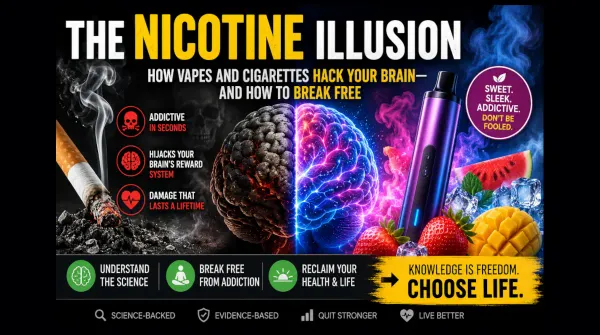
The Nicotine Illusion: How Vapes and Cigarettes Hack Your Brain—and How to Break Free
It smells like fresh mango, cool mint, or pink lemonade. It comes wrapped in sleek, matte aluminum casing that fits perfectly in the palm of your hand, looking more like an Apple gadget than an engine of addiction. Modern vaping and electronic cigarettes have given nicotine one of the most successful cosmetic upgrades in history. The smelly, staining smoke of the old "cancer sticks" has been replaced by a clean, digital lifestyle.
But behind this sweet, aromatized facade hides the same cold, calculating manipulator. Nicotine is perhaps the most perfidious toxin in human history because it convinces you it is your best friend while quietly stripping away both your biological autonomy and your hard-earned wealth.
This comprehensive, evidence-based guide pulls back the curtain on the tobacco and vape industries. Whether you smoke traditional cigarettes, vape daily, are planning your quit day, or simply want to understand the neurobiology of addiction, this is the truth the multi-billion-dollar marketing departments don't want you to see.
The Neurobiology of Addiction: How Nicotine Hacks the Brain
To understand why quitting smoking or vaping feels incredibly daunting, you must look at the underlying biochemistry. The tobacco and vape lobbies have successfully sold a brilliant lie: "Smoking relieves stress." From a neurological standpoint, the exact opposite is true.
When nicotine is inhaled into the lungs, it reaches the brain within seven to ten seconds—faster than an intravenous injection. Once there, it binds directly to the nicotinic acetylcholine receptors (nAChRs), triggering a massive, immediate release of neurotransmitters:
- Dopamine: The "reward" hormone that creates an instant sense of pleasure and satisfaction.
- Adrenaline and Noradrenaline: Stress hormones that immediately spike your heart rate, constrict your blood vessels, and put your body into a "fight-or-flight" state.
- Serotonin: Elevates mood and temporarily dampens anxiety.
[Inhalation] ➔ (7-10 Seconds) ➔ [Binds to nAChR Receptors] ➔ [Dopamine & Adrenaline Spike] ➔ [Artificial High]
The Relaxation Illusion
Why does hitting a vape or lighting a cigarette feel so relaxing? Within about 20 to 30 minutes after your last puff, the nicotine levels in your blood begin to drop. This triggers immediate, often subconscious withdrawal symptoms. You become slightly anxious, restless, and irritable.
When you take the next puff, those withdrawal symptoms vanish instantly. Your brain registers a false correlation: "The cigarette relaxed me." But nicotine didn't fix your real-world stress; it only cured the chemical stress that it created in the first place.
The Reality: A smoker must constantly consume a neurotoxin just to experience the baseline mental stability that a non-smoker enjoys all day long for free. Nicotine sets fire to your house just to sell you a glass of water.
From Cigarettes to High-Tech Vapes: The Evolution of the Trap
Traditional cigarettes are steadily declining in social acceptability. Stained teeth, lingering odors, and second-hand smoke do not fit the aesthetic of a modern, health-conscious society. In response, tobacco companies pivoted to "Slick Tech"—introducing e-cigarettes, disposables (like Elf Bar or Lost Mary), and heated tobacco systems (like IQOS).
The False Promise of "Harm Reduction"
The industry aggressively markets vaping under the banner of harm reduction. While it is true that vapes eliminate many of the combustion byproducts of traditional tobacco (like tar and carbon monoxide), they are far from safe.
Current medical research indicates that the carrier liquids (propylene glycol and vegetable glycerin), when heated to extreme temperatures, oxidize into heavy metals and cytotoxic aerosols. The human lung evolved exclusively to breathe clean air—not vaporized, strawberry-flavored chemical cocktails.
Why Modern Vapes are More Addictive Than Cigarettes
| Metric | Traditional Cigarette | Modern E-Cigarette / Disposable Vape |
| Taste & Odor | Acrid, harsh, socially ostracized | Sweet, fruity, leaves a pleasant room scent |
| Social Barrier | Requires steping outside, finding an ashtray | Consumed discretely anywhere (bedroom, office, car) |
| Nicotine Form | Freebase nicotine (harsh on the throat at high doses) | Nicotine Salts (massive doses inhaled without throat irritation) |
| Consumption Pattern | Finite (the cigarette burns down after 5 minutes) | Infinite (continuous micro-dosing all day long) |
The introduction of nicotine salts fundamentally altered the addiction curve. By adjusting the pH level of the liquid, chemists removed the natural harsh throat hit of high-dosage nicotine. This allows teenagers and new users to inhale massive concentrations of the drug without the body's natural defense mechanism: coughing. Because vapes don't smell and don't burn out, users shift from distinct "smoke breaks" to a state of near-permanent, automated micro-dosing.
The Financial Fire: What Nicotine Costs in the US and the Caribbean
The damage of nicotine isn't confined to your lungs; it drains your bank account via a recurring lifetime subscription. The cost of maintaining a nicotine addiction has skyrocketed, making it one of the most expensive habits on earth. Let's look at the financial reality across the United States and the Caribbean.
The Math in the United States
In the US, cigarette prices vary wildly due to state excise taxes. As of 2026, the national average for a pack of cigarettes sits at $10.15. However, if you live in high-tax areas like New York or Washington D.C., you are looking at up to $14.83 per pack.
If you smoke one pack a day at the national average ($10.15):
- Per Month: ~$304
- Per Year: ~$3,704
- Over 10 Years: $37,047
The Math in the Caribbean (The Bahamas Example)
The economic reality is even harsher in import-dependent Caribbean nations. In The Bahamas, high import duties and sin taxes mean that even the cheapest budget pack of cigarettes costs a minimum of 12.20 BSD (equivalent to $12.20 USD). Premium brands easily push past $14.00 BSD per pack.
If you smoke one budget pack a day in Nassau or the Family Islands ($12.20 BSD):
- Per Month: ~$372 BSD
- Per Year: ~$4,453 BSD
- Over 10 Years: $44,530 BSD
10-Year Nicotine Financial Drain:
[US National Average] ➔ $37,047 USD
[The Bahamas Minimum] ➔ $44,530 BSD
If you invest that exact same monthly smoke money into a basic index fund yielding a conservative 7% annual return, after ten years you would have over $55,000 to $65,000. You are literally handing your financial freedom, a down payment on a home, or a luxury island vacation over to tobacco executives in exchange for a chemical leash.
The Timeline of Healing: What Happens When You Quit?
The human body possesses an incredible capacity for cellular regeneration. The moment you stop inhaling nicotine and chemical aerosols, your physiology launches a systematic cleanup operation:
After 20 Minutes
Your heart rate and blood pressure drop back toward normal levels. Circulation in your hands and feet begins to improve.
After 8 Hours
The level of carbon monoxide in your blood drops to zero. Your red blood cells can now carry their maximum capacity of oxygen. Your cells finally breathe.
After 48 Hours
Nicotine is completely eliminated from your body. Your damaged nerve endings start to regrow, leading to a dramatic sharpening of your senses of taste and smell. Food suddenly tastes vibrant again.
After 2 Weeks to 3 Months
Your lung function increases by up to 30%. The chronic "smoker’s cough" clears out, and your stamina during workouts or climbing stairs noticeably improves.
After 1 Year
Your excess risk of coronary heart disease is halved compared to that of a current smoker.
After 10 Years
Your risk of dying from lung cancer drops to half that of a smoker, and your risk of other tobacco-related cancers decreases significantly.
The Blueprint for a Successful Quit: Breaking the Psychological Chain
Nicotine withdrawal is 10% physical and 90% psychological. The physical withdrawal—a faint empty feeling, mild irritability—peaks within 72 hours and is completely gone within a week. The rest of the battle is dismantling your mental conditioning. Use this tactical framework to succeed:
1. The Cold Turkey / Cold Precision Method
Statistical data shows that gradually reducing your intake rarely works. It keeps you in a perpetual state of physical withdrawal and causes you to value each remaining cigarette or vape puff even more. Pick a clear quit date within the next week. Tell your friends, family, and co-workers to establish a layer of social accountability. When the day comes, discard all hardware, juices, pods, and packs.
2. The 4-A Strategy for Cravings
Nicotine cravings hit in acute waves that rarely last longer than 3 to 5 minutes. When an urge strikes, deploy this protocol:
- Delay: Wait 5 minutes. Tell yourself: "If I still absolutely need it in 5 minutes, I'll re-evaluate." Usually, the neurological wave passes.
- Deep Breathe: Inhale deeply through your nose, hold for three seconds, and exhale slowly through your mouth. This triggers the parasympathetic nervous system, lowering stress without chemicals.
- Distract: Change your physical environment immediately. Drink a cold glass of water, do ten pushups, wash your face, or step outside for actual fresh air.
- Avoid: In the first critical weeks, avoid high-risk triggers, especially heavy alcohol consumption at bars or parties, which lowers inhibition and re-ignites old habitual pathways.
3. De-Coupling Your Routines
Identify your personal consumption triggers (e.g., the morning coffee, driving your car, gaming on your computer, taking a high-stress phone call). Consciously rewrite those moments. If you used to vape while driving, keep healthy mints or a toothpick in your center console. If you smoked with your morning coffee, switch to green tea or sit in a different room. Break the automated loop.
Conclusion: The Ultimate Act of Rebellion
Nicotine is not a luxury, a treat, or a reliable coping mechanism. It is a highly addictive pesticide optimized by multi-billion-dollar corporations to hijack your brain's reward highway, turning you into a reliable cash machine for their balance sheets.
Choosing to quit smoking or vaping is not an act of deprivation; it is the single greatest gift of abundance you can grant yourself. You are giving up nothing except an expensive, toxic illusion.
True vitality, clear focus, and genuine peace of mind don't smell like synthetic fruit or burnt tobacco. They smell like clean air and uncompromised, authentic freedom. Take control of your biology and your wallet—your countdown to freedom starts right now.
Written by
Read next

The Bahamas Fallacy: How Nationalism Masks a Failing State
Beyond the aquamarine waters, the Bahamas has hit a catastrophic rock bottom. From hijacked church pulpits to collapsing public schools and rising xenophobia, hyper-nationalism is being used to mask systemic corruption. A raw, investigative look at a Caribbean dream in freefall.A Torrent of Evidence in a Darkening World
In Imported Hate, Alvan Bovay demonstrates how global antisemitism was unleashed following October 7, 2023. Through evidence on UNRWA, the Red-Green Alliance, and digital influence warfare, this book review analyzes the systemic failure of Western leadership and offers a roadmap for freedom.
The Unstoppable Fracture: Is the Democratic Party Splitting?
The Michigan primary between Haley Stevens and Abdul El-Sayed exposes a fatal divide. Why analysts predict a formal split in the Democratic Party that will change America forever.
TikTok’s Double Standard: ‘Israel Will Live’ Removed
TikTok removed TaktGEFLECHT’s song “Israel Will Live,” released through Die Vossische. At the same time, Salafist influencers and radical channels reach millions of viewers. The article examines whether the platform applies unequal standards when moderating political and religious content.