Trump’s 2026 Foreign Policy: How the Dealmaker Weakened USA
Written from a staunchly Republican perspective, this investigative dossier exposes how the Trump administration liquidated decades of American deterrence in 2026. By freezing Taiwan's defense package and signing the Islamabad Memorandum with Iran, Trump traded vital alliances for quick deals.
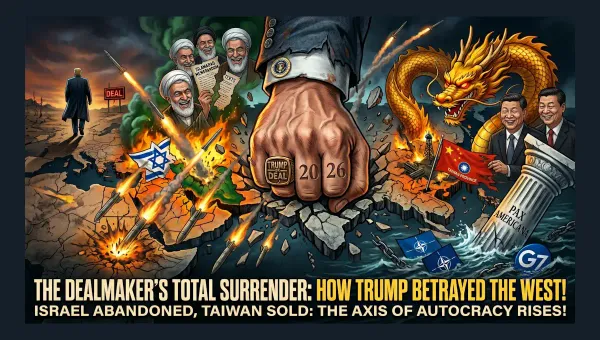
The Illusion of Strength – How 'Maximum Pressure 2.0' Blew Up in Our Faces
The True Believer’s Awakening
I voted for Donald Trump in 2016, and I proudly voted for him again in 2024. Like millions of constitutional conservatives, America-First realists, and registered Republicans across the nation, I believed in the promise of Peace through Strength. I cheered when he appointed strict constructionists to the Supreme Court, and I fully backed the original Maximum Pressure campaign that brought the Iranian regime to its knees during his first term.
When Trump re-entered the Oval Office in January 2025, we expected a return to that Reagan-esque resolve. The immediate signing of National Security Presidential Memorandum/NSPM-2 felt like a victory lap. It was designed to be the final hammer: a total secondary-sanction blockade aimed at cutting off Iran’s remaining crude oil exports to Communist China and bankrupting the Islamic Revolutionary Guard Corps (IRGC).
For a few weeks, the theater worked. Global energy markets braced for impact, and Brent crude spiked past $95 per barrel. The President took to his platforms, projecting the image of the ultimate dealmaker who had Washington’s adversaries running scared.
But as a conservative who believes in structural reality over populist rhetoric, I have to look at the hard data. The administration made a classic, fatal error: they mistook a short-term tactical victory for a long-term strategic endgame.
In April 2025, Washington issued a rigid 60-day ultimatum to Tehran. The demands were absolute: Iran must permanently halt all uranium enrichment and dismantle its entire ballistics program. It sounded tough. It played great on cable news. But the Mullahs didn’t blink.
When the ultimatum expired in June 2025, the illusion vanished, and a chaotic, kinetic escalation took its place. With Washington’s quiet nod, Israeli jets carried out massive strikes against nuclear sites in Natanz and Fordo. But instead of the regime collapsing, a brutal, multi-front war ignited across the Middle East. Suddenly, US CENTCOM forces weren’t deterring a conflict—they were trapped in a grinding, open-ended war of attrition that drained American resources and overextended our military.
The Mirage of the Swift Collapse
The entire strategy of Trump’s inner circle rested on a hollow premise: the belief that surgical strikes and economic strangulation would cause the klerikale tyranny in Tehran to implode overnight. It didn’t happen. Instead, our get-rich-quick foreign policy ran into the harsh reality of asymmetric warfare.
Tightening the Grip at Home
Rather than fracturing, the Mullahs weaponized the American and Israeli military pressure. The regime used the external threat as a perfect totalitair tool to ruthlessly crush the domestic freedom protests that had been brewing for years. Every voice of dissent was branded as "Zionist and American treason," allowing the hardliners to close ranks and solidify their grip on power tighter than ever before.
The Asymmetric Cost to the West
While the US Navy and Air Force spent billions deploying Patriot and THAAD missile batteries to protect regional assets, Iran fought back on the cheap, hitting the global economy where it hurts most:
| Proxy Actor / Theater | Tactical Operation | Global Economic Impact |
| Houthi Rebels (Red Sea) | Relentless drone and anti-ship missile barrages | Forced global shipping around the Cape of Good Hope; ocean freight rates skyrocketed by over 140%. |
| Schiite Milicias (Iraq/Syria) | Constant low-cost rocket and drone strikes on US bases | Kept US forces pinned down, causing logistical strain and constant casualties. |
The blockade of the world's vital shipping lanes didn’t hurt the Mullahs; it hurt the American working class. The resulting spike in consumer inflation and energy prices began to gut Trump’s domestic approval ratings. For all the tough talk, the administration lacked the stomach for a multi-year economic siege. The Mullahs knew it, they waited us out, and Washington was the first to blink.
The Shame of Versailles – The Islamabad Memorandum and the Knife in Israel’s Back
The Scene of the Surrender: June 17, 2026
As a conservative who still believes in the principles of peace through strength, June 17, 2026, will forever stand as a day of profound geopolitical humiliation. It was the moment the "Dealmaker" paradigm completely collapsed into unconditional appeasement.
On the sidelines of the G7 summit at the historic Palace of Versailles in France—a venue already heavy with the ghosts of failed treaties—Donald Trump executed a stunning, unilateral U-turn. Bleeding support at home due to the economic fallout of the shipping crisis, and desperate for a quick, primetime victory headline, the President bypassed Congress and his own traditional national security advisors.
While attending an exclusive dinner hosted by French President Emmanuel Macron, Trump used a remote secure signature to sign off on a document finalized hours earlier by diplomats in Pakistan: The Islamabad Memorandum. On the other side of the digital ink was Iranian President Masoud Pezeshkian.
The political spin machine from Mar-a-Lago immediately blasted out notifications calling it "The Greatest Peace Accord in History." But for those of us who look at the cold, hard text, it was nothing short of a rushed liquidation of American leverage. Trump wanted out of a fight he couldn’t fast-talk his way out of, and he was willing to pay any price to do it.
The Core of the Betrayal: Funding the Axis of Terror
When you strip away the populist slogans, the Islamabad Memorandum reads like a total concession to the klerikale tyranny in Tehran. In exchange for a fragile, unverifiable truce and a vague promise to pause uranium enrichment at current levels, Washington granted historic concessions that handed the Middle East to the Mullahs on a silver platter:
- Amnesty for Ballistic Missiles: The memorandum contains absolutely zero restrictions or verification protocols regarding Iran’s highly advanced ballistic missile and kamikaze drone programs.
- Legitimizing Terror Proxies: The funding and arming of regional terror networks—including the Houthi rebels who spent the last year choking Western commerce—was entirely excluded from the enforcement mechanisms, relegated instead to a non-binding "intent clause."
- Bailouts for Despots: Washington agreed to the phased unfreezing of billions of dollars in frozen Iranian central bank assets and a roll-back of core oil sanctions. This injection of hard currency directly subsidizes the very regime that American patriots spent decades trying to isolate.
The Knife in Israel’s Back
The shockwaves from Versailles instantly shattered decades of trust between the United States and its most vital democratic ally in the world: Israel.
       [ USA ] --(Islamabad Memorandum 2026)--> [ IRAN ]
          |
    (Shattered Security Commitments)
          |
          +---> [ ISRAEL ] (Geopolitically Isolated & Facing Existential Threat)
          |
          +---> [ SAUDI ARABIA ] (Forced into Nuclear Self-Reliance)
Jerusalem Abandoned
In Jerusalem, the reaction was a mix of fury and profound betrayal. Israel had taken the ultimate risks, trusting American assurances when it executed the strategic strikes of 2025. Yet, when the chips were down, Prime Minister Netanyahu's government was completely locked out of the room in Islamabad. Trump’s unilateral deal leaves Israel isolated, facing an empowered, enriched, and entirely un-dismantled Iranian war machine on its borders. The message to our allies was unmistakable: under this administration, America's word is an item to be traded away for domestic poll numbers.
The Demolition of the Abraham Accords
The damage didn't stop with Israel. The moderate sunnitische Gulf states, led by Saudi Arabia, now realize that Washington's security umbrella is an illusion. The historic diplomatic architecture built during Trump's first term has been completely demolished.
The logical, terrifying consequence of this power vacuum is already underway: Riyadh is now quietly accelerating its own nuclear path, realizing that self-reliance is the only option left in a region abandoned by the West. By signing the Islamabad Memorandum, Trump didn't bring peace; he guaranteed a multi-theater, nuclear-armed powder keg for the next generation.
The Beijing Capitulation – Trading Taiwan’s Freedom for Short-Term Gains
The Illusion of Victory: Beijing, May 2026
While the Middle East was still reeling from the fallout of a grinding war of attrition, Donald Trump engineered his next major foreign policy spectacle in May 2026: A high-profile, heavily staged state visit to the People's Republic of China. Received with sweeping military honors in Beijing and flanked by the slick propaganda machinery of the Chinese Communist Party, Trump took to the global stage to declare a "historic breakthrough" in economic relations.
The White House aggressively promoted a new trade framework designed to slash the US trade deficit. Beijing agreed to massive bulk purchases of American agricultural exports and liquefied natural gas (LNG)—concessions that Trump immediately used as ammunition to shore up support across the American Heartland ahead of mid-term cycles.
But for those who understand the cold reality of Pacific deterrence, the commodity purchases were nothing more than a glittering distraction. The true cost of Xi Jinping's economic flattery was paid behind closed doors in the Great Hall of the People and during a series of candid conversations aboard Air Force One. It was here that the administration traded away decades of American strategic dominance for a temporary boost to the balance sheet.
The Scrap Metal Deal: Transforming an Ally into a "Chip"
The real damage to the free world wasn't written into the official trade communiqués; it was executed through a deliberate, calculated betrayal of democratic Taiwan. For decades, the Taiwan Relations Act and the concept of "strategic ambiguity" formed the bedrock of American policy, ensuring that the self-governed island remained an unassailable bastion against totalitarian expansion.
But by late May 2026, transcripts and leaked audio from press briefings aboard Air Force One revealed that Trump had shattered that consensus.
The Weapons Freeze
Months prior, a bipartisan majority in the US Kongress had authorized a vital, multi-billion-dollar defensive weapons package for Taipei, designed to provide the island with advanced anti-ship missiles and air-defense networks to deter a looming amphibious invasion by the People's Liberation Army (PLA). During his return flight from Beijing, Trump openly admitted to freezing those shipments, offering an explanation that sent shockwaves through the Pentagon:
"Taiwan is immensely wealthy. They took our semiconductor business. When we are negotiating comprehensive structural deals with the mainland, those weapons are a very powerful negotiating chip (negotiating chip). You don't just give away a card like that before you've finalized the big picture."
With those words, the leader of the free world re-defined a critical democratic partner—and a linchpin of global technology supply chains—as a disposable asset to be bartered away for agricultural quotas.
Turning Off the Defensive Shield: A Green Light for Tyranny
The betrayal went beyond freezing military hardware. In a bid to reassure Xi Jinping of Washington's transactional mindset, Trump went on to systematically dismantle the core tenets of Western deterrence in the Indo-Pacific.
In a series of public statements following the summit, the President laid out a radical new vision:
- The Tyranny of Distance: Trump repeatedly questioned the logistics of Pacific defense, stating he saw no value in "flying 9,500 miles to fight a war over an island that sits right off China's coast."
- Abandoning Autonomy: He explicitly stated that his administration was "not looking to support Taiwanese independence," a rhetorical shift that Beijing immediately recognized as the green light they had spent decades waiting for.
| Defense Parameter | Traditional US Policy | The Trump Shift (May 2026) |
| Defensive Hardware | Continuous, statutory supply of military aid | Frozen and held hostage as an economic bargaining tool |
| Strategic Commitment | Credible deterrence backed by implicit naval intervention | Explicit withdrawal based on geographic distance ("9,500 miles") |
| Political Alignment | Status quo preservation and defense of democracy | De-facto capitulation to Beijing's regional hegemony |
For a principled conservative, this is the antithesis of the Peace through Strength doctrine. While the Islamabad Memorandum in June would soon destabilize the Middle East, the Beijing deal in May effectively signaled the end of American maritime primacy in the South and East China Seas. Trump didn't beat the Chinese Communist Party; he signed their lease on the Pacific.
The Global Meltdown – The Collapse of Alliances and the Death of Pax Americana
The Pacific Domino Effect: A Crisis of Confidence
The tectonic shifts engineered by Donald Trump in the spring and summer of 2026 have reverberated far beyond the immediate coastlines of Taiwan or the deserts of the Middle East. What we are witnessing in the second half of 2026 is the rapid, unravelling chain reaction of a superpower that has voluntarily declared its own word to be worthless.
In the capitals of America’s most critical, long-standing Asian allies—Tokyo, Seoul, and Manila—there is an unprecedented sense of panic. For generations, the explicit promise of American military intervention served as the shield under which the democratic East Asia flourished. But when a sitting American President openly brags about holding a frontline democracy hostage as a „negotiating chip,“ every other treaty signed by Washington is instantly exposed as a hollow piece of paper.
- Japan is now moving at breakneck speed to permanently dismantle its post-war pacifist constitution, pivoting toward massive, independent offensive re-armament because it can no longer outsource its survival to Washington.
- South Korea has entered intense, closed-door parliamentary debates regarding the immediate development of its own domestic nuclear weapons program, openly acknowledging that the U.S. nuclear umbrella has folded under Trump’s transactional view of alliances.
Trump’s isolationist maneuverings did not relieve the burden on the American taxpayer; they triggered a hyper-volatile power vacuum that has stripped the United States of its strategic leverage in the world's most critical economic corridor.
The Structural Betrayal of the Reagan Coalition
Herein lies the ultimate, devastating irony of the Trump foreign policy paradigm. The leader who electrified millions of conservative patriots with the vow to project unyielding American strength, dismantle the gains of the Chinese Communist Party, and permanently crush the terror-sponsoring network of the Iranian regime has achieved the exact opposite. He has surrendered the moral and strategic high ground for the fleeting dopamine hit of a transactional press release.
Rank-and-file Republicans, who supported this administration believing it would revive a formidable, feared America, must now confront a bitter truth: behind the aggressive rhetoric lies a foreign policy structured like a clearance sale at an insolvent real estate firm. Everything is up for auction if the short-term optics serve the immediate domestic cycle.
By projecting the United States as an erratic, mercenary, and profoundly untrustworthy actor, Trump has not made America Great Again. He has made America highly predictable to our enemies. Dictators in Beijing and Moscow no longer need to fear American resolve; they simply have to outlast the current news cycle, confident that everything from vital trade routes to sovereign allies can be bought or bartered away if the political price is right.
The Conservative Verdict: The End of an Era
As 2026 draws to a close, the final verdict is as clear as it is tragic. The doctrine of America First has devolved into America Alone and America Weak. It has systematically liquidated the global network of alliances that generations of American service members and strategic minds built from the ashes of World War II.
The New Geopolitical Balance Sheet
The ledger of 2026 tells a story of absolute strategic retreat, and the beneficiaries are the world's most dangerous autocracies:
- The People's Republic of China now commands uncontested maritime dominance across the South and East China Seas, proving to the world that American security commitments have a shelf life and a price tag.
- The Klerikale Dictatorship in Tehran has survived a kinetic conflict, brutally secured its internal grip on power, and emerged economically rescued and diplomatically legitimized by the terms of the Islamabad Memorandum.
- The United States of America enters the late months of 2026 profoundly isolated, its deterrence shattered, and its historical role as the anchor of the free world completely abandoned.
Trump did not defeat the deep state; he broke the global spine of American power. By trading structural deterrence for short-term political expedience, this administration has brought an ignominious end to the Pax Americana, ushering in a dark, multipolar era of unchecked aggression and global instability. The world is profoundly more dangerous today—and the blame lies squarely at the resonator of the Dealmaker's gavel.
Trump Foreign Policy Failure, Collapse of Ameri
Written by
Read next
Surviving Subversion: How the US Can Defend Its Constitution
The American Republic faces an asymmetric challenge. While the First Amendment shields freedom of belief, it was never designed to protect a political framework aiming to replace secular law with a theocratic order. To survive, the US must aggressively utilize its existing constitutional tools.The Dark Secret Behind Nassau’s Luxury: What Happens Inside Fox Hill
Away from the mega-yachts and turquoise waters of Nassau, a medieval engine of human degradation hums. Discover the brutal reality inside Fox Hill Prison—a state-administered catastrophe of strategic starvation and systemic torture, actively sustained by the machinery of the US government.
The Bahamas Real Estate Trap: Why Buying Property in Paradise is a Financial Disaster
The Bahamian real estate market is a highly predatory illusion. Driven by real estate agents who paper over systemic risks, naive buyers systematically underestimate the true, long-term cost of ownership, from paralyzing market stagnation and hidden fees to the physical collapse of the coastline.
The End of an Era? The Crisis of the British Monarchy
King Charles III’s shift from "Defender of the Faith" to a "protector of faith" signals a profound change. This move threatens to erode the Christian identity that has anchored the British monarchy for centuries, fueling a deeper debate on cultural survival and institutional legitimacy.
A Torrent of Evidence in a Darkening World
In Imported Hate, Alvan Bovay demonstrates how global antisemitism was unleashed following October 7, 2023. Through evidence on UNRWA, the Red-Green Alliance, and digital influence warfare, this book review analyzes the systemic failure of Western leadership and offers a roadmap for freedom.
The Unstoppable Fracture: Is the Democratic Party Splitting?
The Michigan primary between Haley Stevens and Abdul El-Sayed exposes a fatal divide. Why analysts predict a formal split in the Democratic Party that will change America forever.
TikTok’s Double Standard: ‘Israel Will Live’ Removed
TikTok removed TaktGEFLECHT’s song “Israel Will Live,” released through Die Vossische. At the same time, Salafist influencers and radical channels reach millions of viewers. The article examines whether the platform applies unequal standards when moderating political and religious content.